Chart your course
Buying Your First Sailboat: A Practical Guide
Quick answer
The short version
Buy your first sailboat by defining its real job before choosing a model. Decide where you will sail, who will usually crew, how you will store or berth it, and which maintenance you can support yourself. Build a total ownership budget that includes insurance, mooring or storage, maintenance, bills, and immediate repairs, not just the asking price. When a used boat reaches the shortlist, confirm what equipment is actually included and whether the seller can document ownership. Make any offer subject to an acceptable survey and trial under an appropriate local agreement, and hire a surveyor who works for you and reports to you alone. A typical larger-boat survey combines an in-water inspection, an out-of-water haulout, and a trial run, each showing you something the others cannot. Review the findings as a repair plan, a negotiation tool, or a clear reason to walk away, and treat the last option as a legitimate outcome rather than a failure.
Viral refit videos make a neglected boat look like a straight path from bargain to dream, with the hard months compressed into a highlight reel. Sometimes a project genuinely suits the buyer. The harder question is whether it suits your time, skills, location, and budget after the camera stops rolling and the boat is still sitting in your yard. A first sailboat should make it easier to sail regularly, not harder. That may favour a smaller boat nearby over a larger one that quietly consumes every free weekend in repairs instead of on the water. Separate the pleasure of shopping from the job of owning, because they pull toward different boats. The best-looking listing is only a candidate until purpose, cost, condition, and paperwork all agree, and any one of those can end the deal on its own.
Define the Job Before the Boat
Write down the sailing you expect to do most often, and be specific rather than aspirational. Local day sailing, club racing, coastal weekends, and longer passages call for different space, performance, systems, and storage, and a boat built to excel at one of those jobs is often a compromise at the others. Add the regular crew you actually have, not the crew you hope to recruit later. A boat that depends on several strong hands may sit unused if you normally sail with one other beginner, however capable the boat is on paper.
Consider the local water and berth next. Draft, rig height, weather exposure, haulout access, and distance from home can matter more day to day than an extra cabin you will rarely use. Decide honestly which jobs you can perform yourself, from routine cleaning to basic mechanical work, and which will always need professional help, since that split changes both your ongoing costs and how often the boat is actually available to sail.
Use these constraints to eliminate boats early, before you fall for a listing that cannot fit your life. A clear job turns model comparisons into practical questions instead of a feelings contest: can your regular crew actually handle it without a struggle? Can you reach and use it often enough to justify owning it? Does its equipment support the sailing you planned, without forcing you to add systems, skills, or crew you do not currently have? A boat that answers yes to all three is a stronger candidate than one that merely looks the part, and reading about types of sailboats for beginners before you shop can sharpen exactly which questions matter for your situation.
Build the Total Ownership Budget
The asking price is the entry line, not the full budget, and treating it as the whole number is the single most common mistake in a first purchase. Add mooring or storage, insurance, routine maintenance, haulout, winter or storm preparation where relevant, and the repairs needed before the first season actually begins. Keep a reserve on top of all of that for findings that only appear after the purchase closes, because something usually does.
Compare a ready-to-sail boat with a cheaper project by the same standard, not by purchase price alone. Price the missing or tired systems on the project boat, then add professional labour for anything that sits beyond your own skill. Your own time belongs in that comparison too. A repair you genuinely enjoy doing can be part of the hobby rather than a cost. A repair that keeps blocking every planned sail is a real cost even when the parts themselves are cheap, because the lost weekends do not come back. A closer look at what a boat costs to keep, not just to buy, is worth reading through the full breakdown in what it costs to own a sailboat before you set your ceiling.
Ask directly what equipment is included, and get the answer in writing rather than assuming from the photographs. Sails, tender, electronics, safety gear, cradle, and spares can change the practical value of a listing substantially, but only if you also know their condition and whether they actually suit the boat you are buying. List every item rather than relying on what happens to be visible in the pictures, since a seller is not obliged to point out what a photo leaves out.
Use Survey, Haulout, and Trial for Different Views
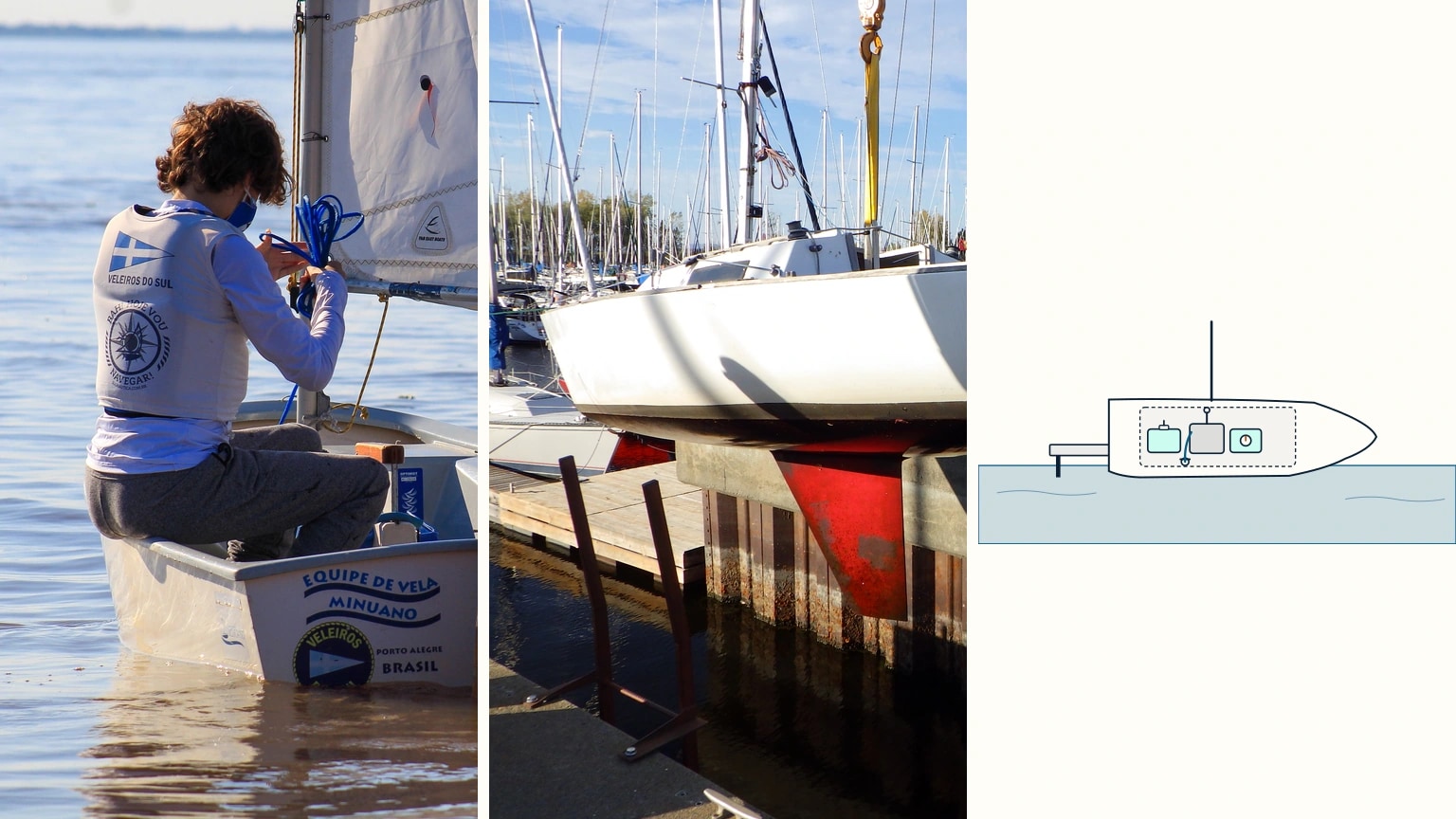
Choose an independent pre-purchase surveyor who works for you and only for you. You select and pay the surveyor, and the report belongs to you, not to the seller or the broker, which is what keeps the findings honest. The surveyor should understand the specific type of boat and how it is used, since a survey written by someone unfamiliar with your kind of boat is worth less than its price. For a larger used sailboat, survey day commonly runs across three complementary views, and each one shows you something the others structurally cannot.
The in-water inspection covers accessible structure and systems in their normal, floating state, the condition the boat lives in day to day. The haulout lifts the boat clear of the water and exposes the hull, rudder, keel area, propeller, and other gear below the waterline that you and the seller have likely never seen together. The trial run lets the surveyor observe the engine and running systems actually under way, away from the dock. It is a working check, not a demonstration that the boat can survive every condition it might ever meet, and treating it as the latter oversells what a single trial can prove.
A general survey may not include climbing the mast or running deep engine diagnostics, and it is a mistake to assume it does. If the rig or engine carries major value or a specific concern you already have, arrange a specialist inspection alongside the general one rather than after you have already closed. Once the report is in hand, follow it up, ask the surveyor direct questions about anything unclear, and turn every finding into one of three things: a costed repair item, something to raise in negotiation, or a genuine reason to walk away. A full checklist for that inspection day, including what a good surveyor covers and what typically costs extra, is laid out in used sailboat inspection checklist.
Close Only When the Local Details Agree
Use a written sale agreement suitable for your location, and make the survey and trial conditions explicit in it before you pay anything beyond the agreed deposit. Confirm the seller's ownership evidence directly, get the included inventory in writing, and establish how any outstanding finance or lien on the boat will be cleared before money changes hands rather than after.
Registration, tax, design-compliance documents, insurance, and proof-of-competence requirements all vary by country and even by the specific water you plan to sail, and none of that is safe to guess at. Verify current local rules with the relevant authorities and, where the paperwork is unfamiliar, with a professional who handles it regularly. A checklist copied from another jurisdiction, or from a forum thread about a different country's process, cannot settle your purchase and can leave you holding a boat you are not legally clear to use.
Now review the complete decision as a whole, not just its parts in isolation. Does the boat still fit the job, the regular crew, the berth, and the total budget you defined at the start? Do the survey findings fit inside your repair capacity, in both money and time? Did the trial reveal handling or systems that quietly change the plan you started with? Walking away is a successful use of this whole process when the answers no longer line up, not a wasted afternoon. Another boat will appear, and by walking away you keep your sailing budget intact for it.
Boat ownership makes more sense after you understand the basic types, rigs, sails, and systems you are comparing. SailStarter's boat-type lesson gives you that vocabulary without steering you toward a particular model or purchase. Use it to build a shortlist that matches your intended sailing, then spend practical time aboard similar boats before you buy. Crewing and courses can reveal whether you prefer the quick feedback of a dinghy, the teamwork of a keelboat, or the systems and space of a cruising yacht, in a way no listing photo can. A survey still does the technical checking. Knowledge helps you ask clearer questions, read that report with real understanding, and choose a first boat for the sailing you will actually do rather than the sailing you imagined while scrolling listings.
Try it from the lesson
Can you spot the next move?
A wide sailboat glides past on two side-by-side hulls, barely leaning at all. What type is it?
Why you can trust this guide
. We build each guide from public seamanship and safety sources, then teach the universal principle before any local difference.