Chart your course
Catamaran Charter for Beginners

Quick answer
The short version
A beginner can charter a cruising catamaran with suitable support. If the provider does not accept your experience for bareboat responsibility, or you do not want to be in charge, hire a professional skipper or consider a supported flotilla. A beach-cat lesson does not by itself prepare someone to command a large cruising catamaran. The wide platform, two hulls, deck layout, systems, and manoeuvring need a boat-specific handover and supervised practice.
Send the provider an honest sailing resume before paying a non-refundable balance. Ask what experience, evidence of competence, crew, and checkout it requires for the exact boat and destination. Charter requirements and local rules vary, so obtain current written terms. Then keep the first itinerary short, flexible, and within the accepted skipper's experience. The aim is a manageable holiday, not proof that you can use every mile of the booking area.
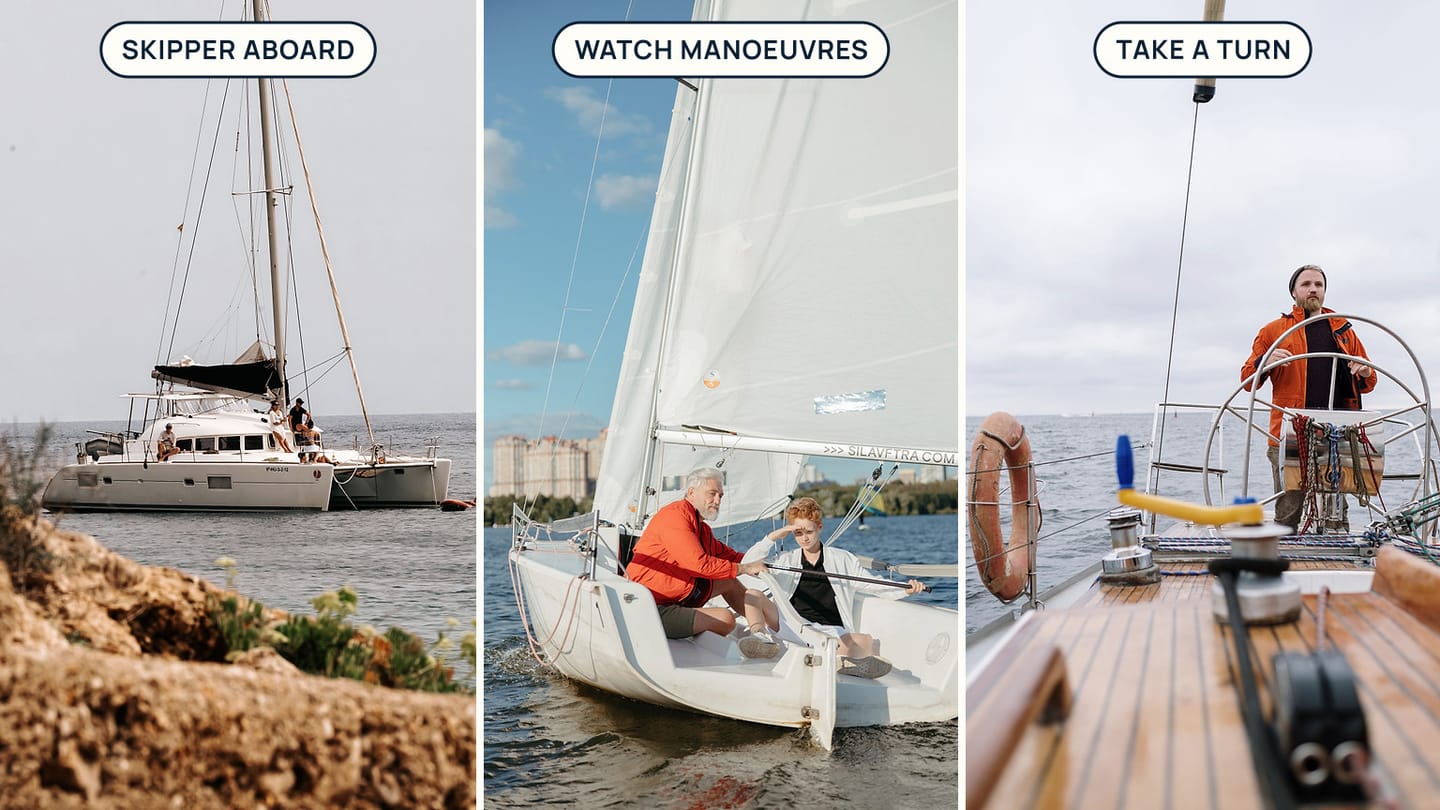
Choose a skippered start
Bareboat charter means the customer supplies the skipper and accepts operating responsibility. It does not mean “boat without support” in every detail, but the central responsibility sits with your party. A skippered charter places a professional aboard. A flotilla may provide route support and lead crews, although each operator defines its service differently. Ask who is legally and practically in charge in each option. Readiness for that responsibility follows the same demonstrated-skill standard used to judge whether a beginner is ready to sail alone.
Choose support by the weakest relevant part of the plan. A sailor may handle a monohull confidently yet have no experience with twin engines or the beam of a cruising catamaran. Another may know catamarans but not the local approaches. A professional skipper can manage the boat while explaining decisions, but confirm whether instruction is included rather than assuming the holiday is a course.
If you hope to take a turn, agree on boundaries before departure. Ask which manoeuvres you may practise, under whose direction, and when the skipper will take over. Use low-pressure conditions and plenty of room selected by the professional. Watching a harbour manoeuvre from the cockpit is useful orientation; it is not independent experience.
Discuss sleeping arrangements, meals, costs, duties, and privacy with a hired skipper. Clarify whether the skipper remains aboard every night and what cabin or berth is allocated. Written expectations prevent an awkward first evening.
If a provider approves bareboat charter after a checkout, treat that approval as specific to the named boat and trip. It does not transfer automatically to a larger catamaran or more demanding destination.
Compare the total cost of each support level. A professional skipper needs an agreed berth and meals as well as the stated fee. A flotilla may include briefings or lead-crew contact but still leave substantial responsibility with your skipper. Bareboat pricing may include a security deposit, cleaning, fuel, tender, and optional equipment. Ask for the complete written quotation so a cheaper headline does not force an unsuitable choice.
Understand the wide platform
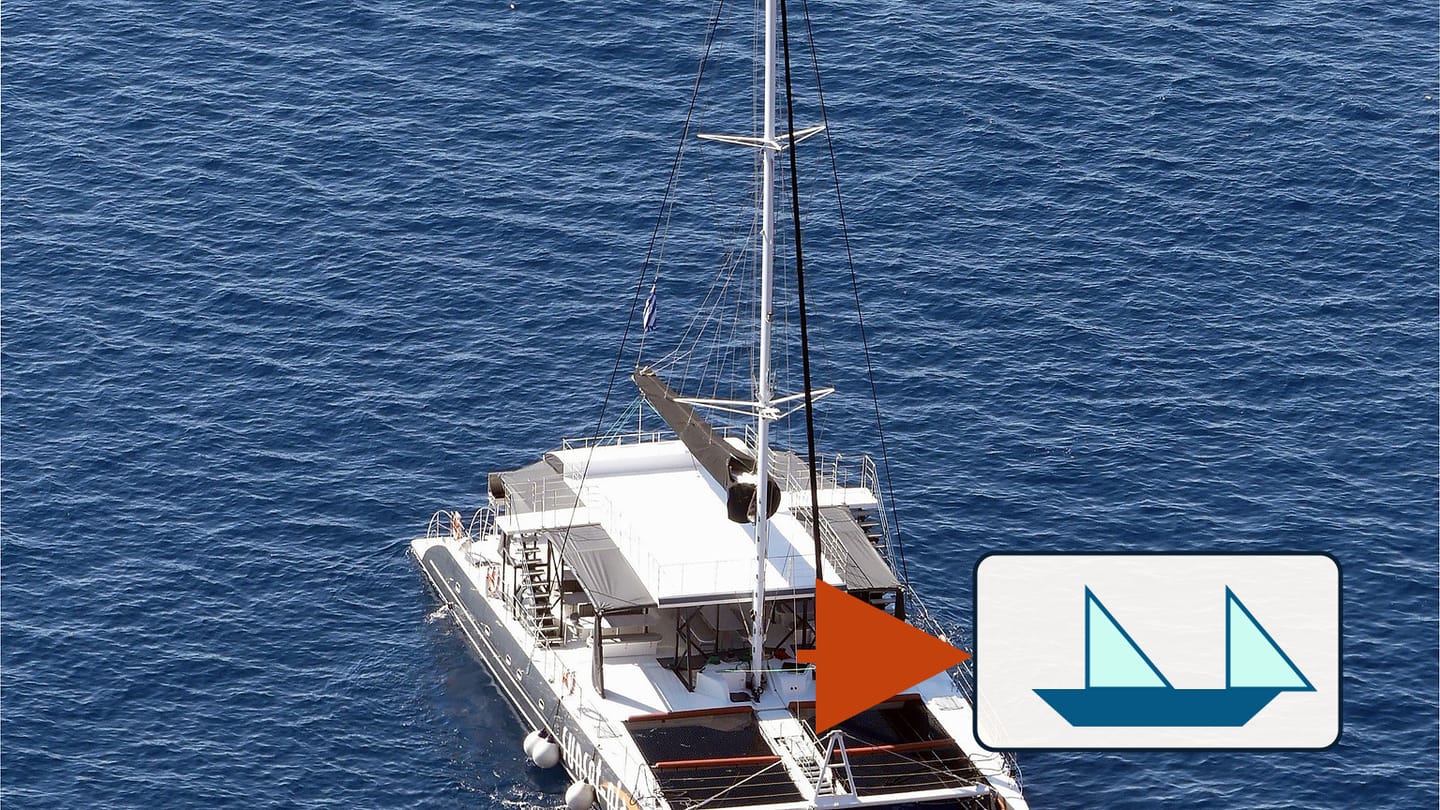
A cruising catamaran has two hulls connected by a broad deck structure. The beam creates generous living space and also changes the space needed at a berth. You must know the actual width before selecting a marina place, judging a gap, or arranging fenders and lines. Do not estimate it from the view at the helm.
Two engines can provide useful control at low speed, but their response, control layout, propeller behaviour, and limits belong in the handover. Ask the provider to demonstrate the exact boat, then repeat the manoeuvre under supervision where permitted. Learn which engine moves which stern and what happens when wind acts on the large above-water profile.
The helm may be offset or raised, leaving blind areas near a bow or quarter. Assign a crew member to a position with a clear view and agree on simple reports. A camera or display may help, but it does not replace a lookout who understands the intended manoeuvre.
Deck movement also differs. The distance between helm, bow, and stern can make quiet conversation unreliable. Brief line placement and crew positions before entering close quarters. Keep people out of pinch points and never ask them to stop the boat with a hand or foot.
Under sail, follow the charter operator's reefing and sail-handling instructions for that catamaran. Do not import settings from another design. Find the limits and procedures in the handover material, and make sure more than one crew member can locate the controls used to reduce sail.
Walk the full perimeter while secured. Note where the hull sides disappear from the helm's view, how far a crew member must travel to reach each line, and which deck areas become wet or awkward. Agree on hand signals or concise reports for the bow lookout if ordinary speech is unreliable. Practise those reports before the first close approach. “Two metres to the dock, closing slowly” carries more useful information than “You're fine.”
Plan the charter handover
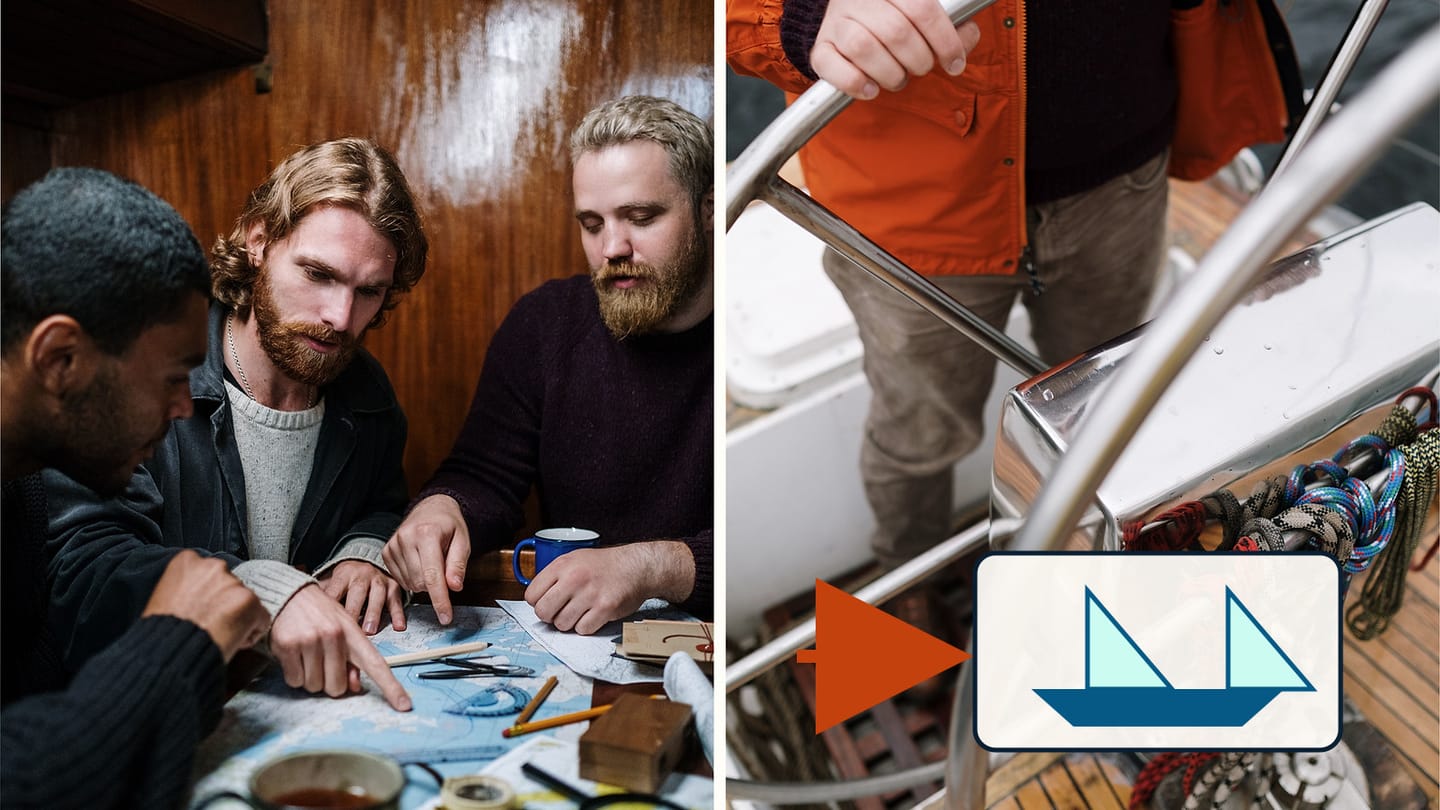
Arrive with a written checklist based on the provider's documents. Record fuel and water arrangements, battery and charging controls, engine start and stop procedure, steering, navigation equipment, anchors, bilge systems, heads, cooking fuel, tender, and emergency gear. The provider should demonstrate; your crew should then point to or operate each item as appropriate.
Spend extra time on faults that would change the trip. How do you isolate a leaking water system? Where are the engine shut-offs? How is an anchor recovered if the electric windlass is unavailable? What number do you call for technical help, and what does the company expect before authorising a repair? Write the answers rather than trusting holiday-day memory.
Inspect the boat jointly and record its condition before departure. Note existing marks and damaged equipment through the provider's process. Check inventory items that matter to your route, and understand the security deposit, insurance excess, damage reporting, and dispute terms. The RYA charter checklist specifically recommends an agreed condition report before and after the charter.
Conduct a crew briefing after the formal handover. Translate systems into roles: who handles the tender, who checks hatches, who monitors water, and who can start the engines if the skipper is unable. Walk the route from sleeping cabins to deck exits. Test communication from helm to bow while still secured.
Do not rush away because the handover ran late. A first departure in poor light or with unanswered equipment questions creates an avoidable burden. Ask whether you can remain at the base or take a smaller first step.
Photograph control panels only with the provider's permission, then connect each image to written notes. A row of anonymous switches is little help later. Test cabin lights, pumps, charging points, refrigeration, and heads while staff can correct the setup. Confirm which tanks or batteries each gauge represents. Domestic-system confusion can consume the same attention you need for navigation and boat handling.
Make the first days small
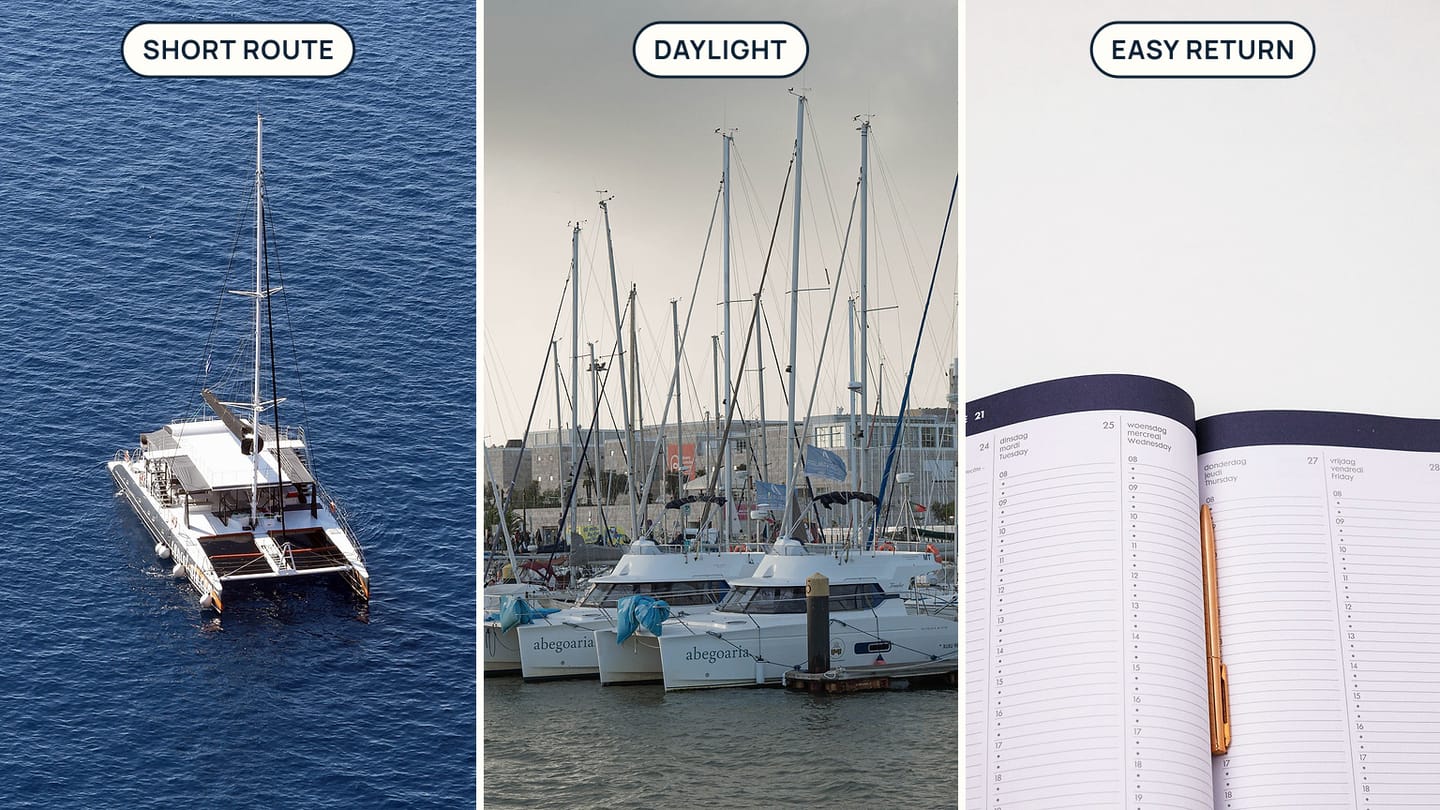
Choose a short first leg with an easy alternative and enough daylight for arrival. The point is to learn how the boat moves, how long crew tasks take, and whether the onboard systems work as demonstrated. Avoid committing the first day to a distant reservation that forces the boat onward when people are tired or equipment needs attention.
Mark the catamaran's draft and beam on the working plan, using the provider's figures for the exact boat. Check that intended berths, approaches, and anchorages suit both. A shallow draft may open options, but it does not make charted hazards, local restrictions, or safe under-keel clearance disappear.
Build decision points into the day. Before departure, name the latest comfortable turn-back time, the weather or equipment change that would shorten the route, and the backup berth or anchorage. Tell the crew that changing the plan is normal. This makes an early return a planned option rather than a debate.
Keep the second day flexible until the first has been reviewed. Did helm visibility require a different lookout position? Were lines prepared early enough for the wide boat? Did the crew understand the engine calls? Correct one routine at the dock before adding distance.
Plan the final return with the same care. Leave margin for fuel, waste arrangements, inspection, and the provider's check-in time. A rushed handback can hide damage or turn a small delay into a dispute. Confirm where the boat must be left and who attends the condition check.
Use SailStarter to review how to charter a sailboat before speaking with operators. Make a list of the boat systems and crew jobs you cannot yet explain, then use that list to choose between a professional skipper, flotilla support, more training, or an appropriately modest bareboat plan. The honest support choice is part of good skippering.
Try it from the lesson
Can you spot the next move?
You turn to face the stern. A crewmate points at your right hand. Which side of the boat is that?
Why you can trust this guide
. We build each guide from public seamanship and safety sources, then teach the universal principle before any local difference.