Chart your course
Sailboat Charter Hidden Costs and Deposits

Quick answer
The short version
Finding the real cost of a sailboat charter means building your own itemized total instead of trusting the number in the ad. Start with the base rental rate, then ask the operator in writing what it does and does not include: fuel, cleaning, linens, taxes, and any local check-in payment. List every optional extra your crew plans to add, such as a paddleboard or a stocked galley, at its quoted price. Note the security deposit or damage waiver on its own line too, since that money follows different rules from the rest of the quote. Add the base rate to every mandatory and selected charge for one trip total, and keep the deposit or waiver separate so you always know what cash needs to stay available, and when.
A charter ad usually leads with one number, and that number rarely finishes the story. Operators build a base rate around the boat itself: a hull, a rig, a set number of days on the water. Almost everything a crew actually touches during the trip, from fuel and cleaning to the money held against damage, gets priced separately and disclosed in different places: a rate sheet, an online booking form, and a contract signed near departure. None of that makes the extra costs dishonest. It does mean a low headline price and a high headline price can end up costing the same once every mandatory item is added, while the security deposit or damage waiver adds a second number that behaves nothing like ordinary trip spending. This article walks through how to rebuild the real total before choosing one operator over another.
Separate Every Cost by Type
Before comparing a single quote, split the money into categories that behave differently. A charter's base rate covers the yacht itself, plus whatever standard equipment and supplies the operator bundles in for the booking period; linens, basic kitchen gear, and safety equipment are common inclusions on established operators' own pricing pages. That base number sits apart from mandatory fees the operator charges every charterer, which some companies collect as one fixed local payment at check-in rather than folding into the advertised rate. Optional extras form a third category entirely: a skipper, a stocked galley, water toys, or early boarding, each priced only if the crew selects it. Fuel deserves its own row too, because whether it is included in the base price depends on the operator, the region, and even the boat type. Last, set the security-related money apart from the rest: a refundable deposit or a non-refundable damage waiver protects the operator against damage, and neither one is spending money for the trip itself.
When you fill in a booking form online, resist entering just the total budget you are willing to pay. Enter each category on its own line instead, noting whether it is fixed, optional, or refundable. That structure is what lets you catch a mislabeled fee later, and it is the same structure you will use to compare two operators fairly.

What Does the Base Rate Actually Leave Out?
Ask the operator directly, in writing, what the quoted rate does not cover, because the excluded list is where a comparison usually breaks down. Established operators publish their own inclusion lists, and even a well-known company can leave out food and drink, marina or mooring fees, park or customs fees, garbage disposal, and any cleaning beyond the standard end-of-charter service. None of that is concealed. It is simply priced outside the headline number, and a quote that looks cheaper can turn out that way only because it excludes more of the trip.
Request the exclusion list for the exact boat, base, and dates you are booking rather than trusting a general answer from a sales page, since terms can differ by destination and boat type even within one company. If you are still forming a sense of what a full week costs before extras, the charter cost breakdown is a reasonable starting point, though your own written quote is the only document that answers the exclusion question for your specific booking. Once you have the list, sort each excluded item as either mandatory (fuel, local taxes) or optional (paddleboard rental), because that split decides whether it belongs in the trip total or in a separate maybe column. Confirm every blank on the list has an answer before you sign, even when the answer is that an item simply does not apply to your charter.

How Do You Read the Deposit Clause?
Most operators offer a choice between two structures: a refundable security deposit held as collateral, or a smaller non-refundable damage waiver fee that lowers what you would owe if something goes wrong. Read which one your quote assumes, because the two create very different cash-flow needs. A security deposit is a real hold on a card or account, released back only after the operator confirms the boat's condition and settles any unpaid charges, so it is not spending money even though it can look like a large charge on a statement. A damage waiver works the other way: it is never returned, but it usually caps liability at a lower figure than the full deposit would.
Look for the exclusions written into that same clause. Damage caused by negligence or reckless conduct commonly falls outside both the deposit and the waiver, so liability can extend past the amount paid or held. The charter insurance explainer covers how a separate insurance policy interacts with these operator-provided options, and the cancellation and security deposit guide goes deeper into refund timing and conditions. For a cost comparison, the immediate task is simpler: write down the deposit amount, the waiver price if one is offered, and the specific conditions that release or forfeit each, so you can weigh a lower headline price against a larger amount tied up at the dock.

Build One Worked Comparison
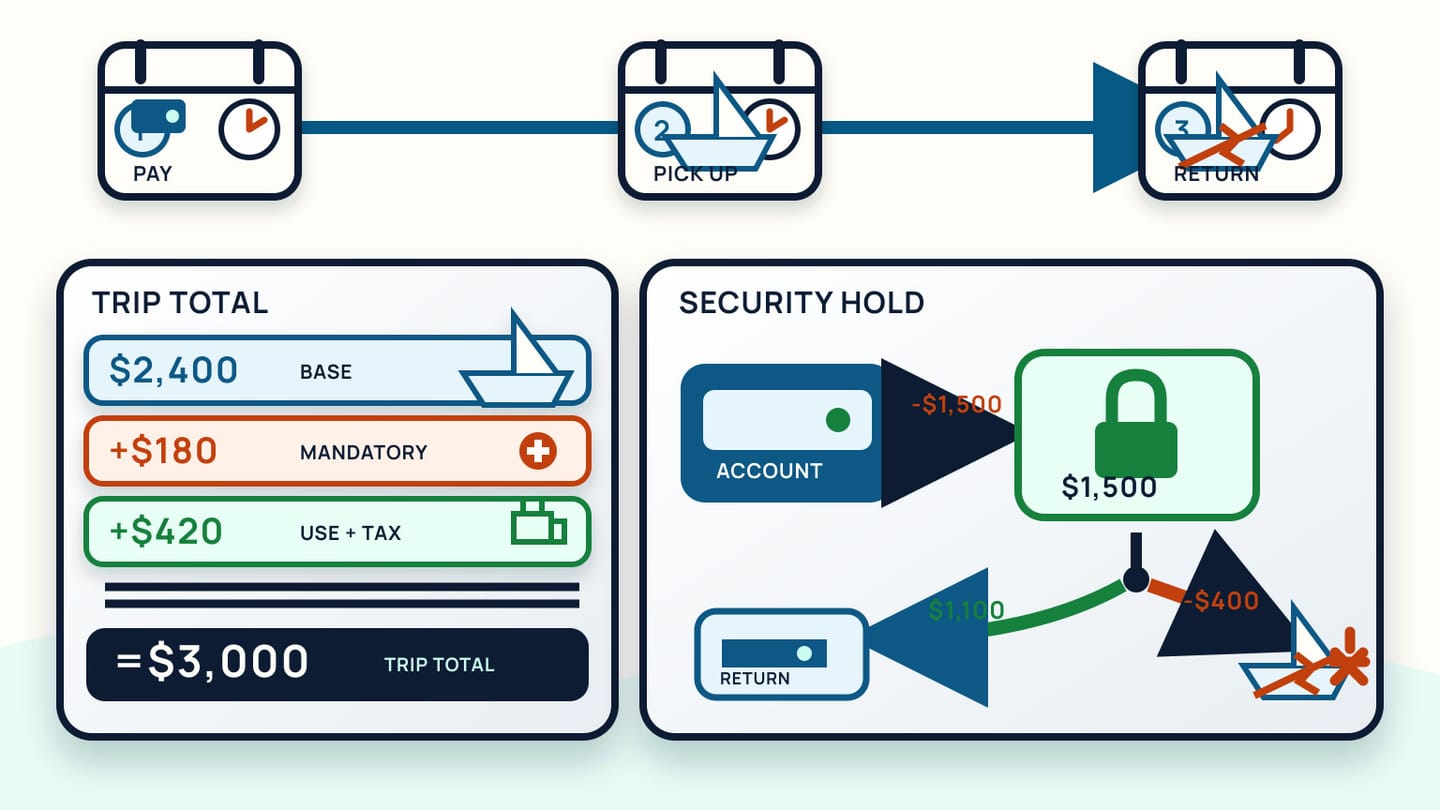
Here is a hypothetical example that shows why the two totals need to stay apart. Imagine a quote lists a $2,400 base rental rate, a $180 mandatory local fee, and $420 in taxes and use charges the crew selected. Added together, that is a $3,000 trip cost, the figure that belongs on a comparison sheet next to any competing operator's total. Separately, the same booking might carry a $1,500 security hold placed on the card used at pickup. If the boat comes back with no unresolved issues, most of that hold returns, say $1,100, while $400 is retained to cover a documented repair. That retained amount is not part of the $3,000 trip cost; it is a risk-based deduction from money that was never meant to be spent.
This is only an illustrative example, not a typical price for any boat or destination. The layout still holds regardless of the numbers involved. When you compare operators, build the same two-column structure: one column for the trip total made of the base rate plus every mandatory and selected charge, and a second column for the deposit or waiver with its release conditions written beside it. An operator with a lower trip total but a much larger, uncapped deposit may tie up more of your crew's available cash than one with a slightly higher total and a capped, well-documented waiver. Weigh both columns before deciding, not just the number printed largest on the page.
Keep Proof at Handover
The paperwork gathered before booking only pays off if it is protected at pickup and return. Photograph the boat's condition, the fuel and water levels, and any existing marks before leaving the dock, and ask the check-in staff to note the same details on their own form. That shared record is what a deposit release usually depends on, not private photos alone. At return, repeat the process before anyone signs off on the condition report, and ask specifically how and when the deposit refund or waiver settlement will arrive.
The check-in and checkout guide walks through that handover process step by step, including what belongs in a base inspection and what to do if you and the staff disagree about a mark on the hull. For the cost side specifically, keep every invoice, the signed contract, and the final settlement statement together until the deposit posts back to the account or the waiver charge appears exactly as quoted. If a charge shows up that does not match the written quote or the condition report, those documents let you question it immediately instead of reconstructing the trip from memory once the crew has gone home.
None of this turns charter shopping into an accounting exercise you need to master before your first trip. It just means reading the quote as a document rather than comparing single numbers against other single numbers. Ask for the itemized breakdown, get the exclusion list in writing, understand which money is refundable and which is not, and keep proof at both ends of the charter. Do that once and the pattern is easy to recognize on every future booking. If you are still building the sailing skills and boat-handling judgment that make a charter week comfortable rather than stressful, SailStarter's lessons cover the practical seamanship side of chartering, from points of sail to basic maneuvering, at your own pace. They stay focused on seamanship rather than contract interpretation, and they can help you walk aboard ready for the parts of the trip that have nothing to do with paperwork.
Try it from the lesson
Can you spot the next move?
A wide sailboat glides past on two side-by-side hulls, barely leaning at all. What type is it?
Why you can trust this guide
. We build each guide from public seamanship and safety sources, then teach the universal principle before any local difference.