Chart your course
Prop Walk: Why Your Stern Kicks Sideways
Quick answer
The short version
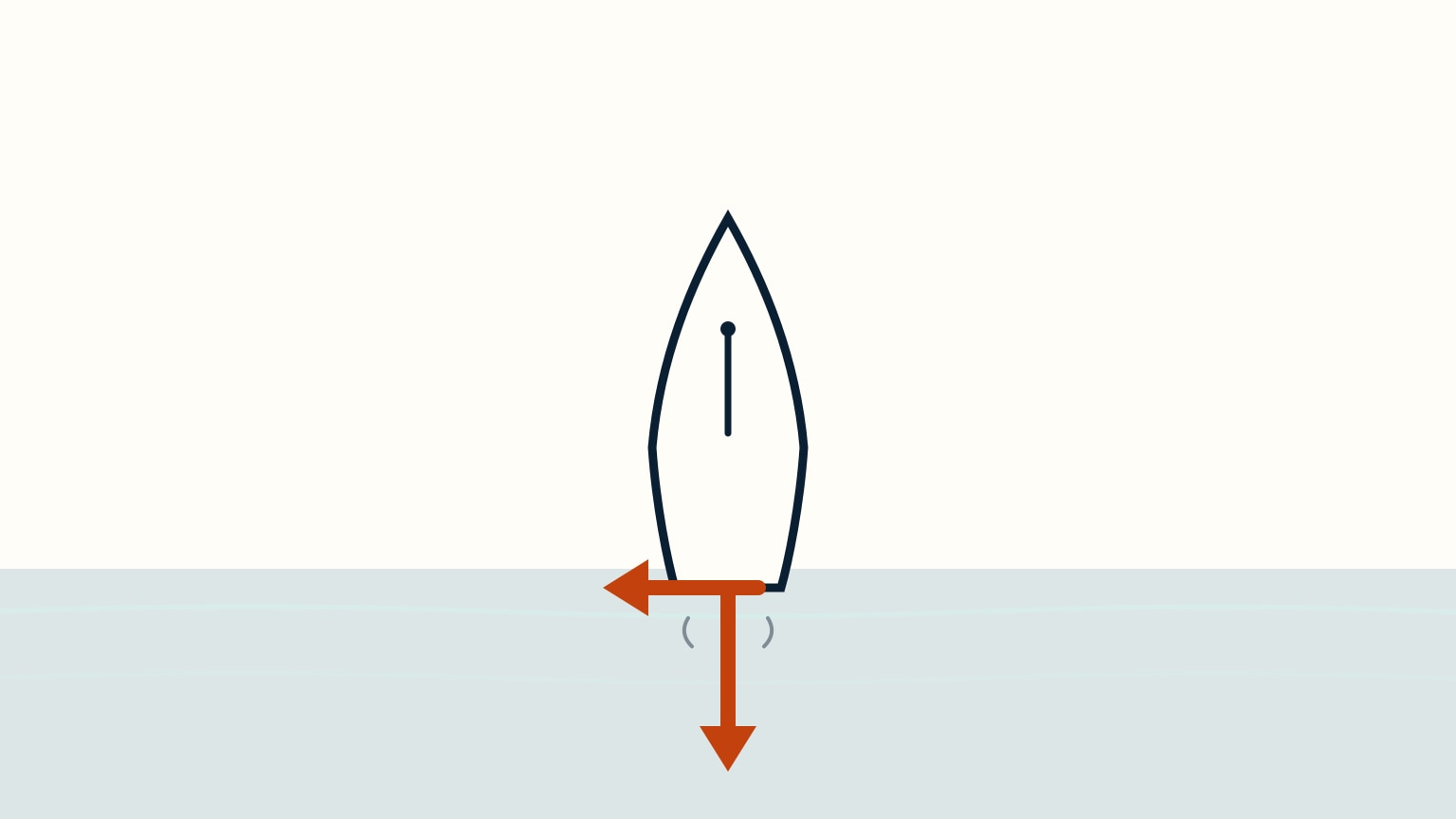
Prop walk is the sideways kick a spinning propeller gives your stern, most noticeable in reverse gear. It happens because the propeller shaft tilts down a few degrees instead of sitting dead level, so the blades push more water on their upstroke than their downstroke. That imbalance shoves the stern to one side even as the propeller's main job is pushing the boat backward. Most sailboats carry a right-handed propeller, and in reverse it walks the stern to port (the mirror for a left-handed prop: starboard). The kick is strongest at low speed astern, before there's enough sternway for the rudder to answer over it, which is why it surprises new drivers and why experienced ones use it on purpose.
Every boat under power has a habit that catches new drivers off guard: put the engine in astern, and the stern doesn't back up in a straight line. It swings to one side on its own. New drivers often blame wind, current, or a clumsy turn of the wheel, when the real cause sits right beneath the hull, in the propeller itself. Once you know it's there, prop walk stops being a mystery and becomes useful information: which way your own boat's stern will kick, when that kick takes over, and how sailors turn it into a docking advantage instead of fighting it every time. This guide covers the mechanism, the direction it goes for the common propeller type, why it dominates at the moment you're trying to be precise, and how to use it on purpose.
What Causes Prop Walk
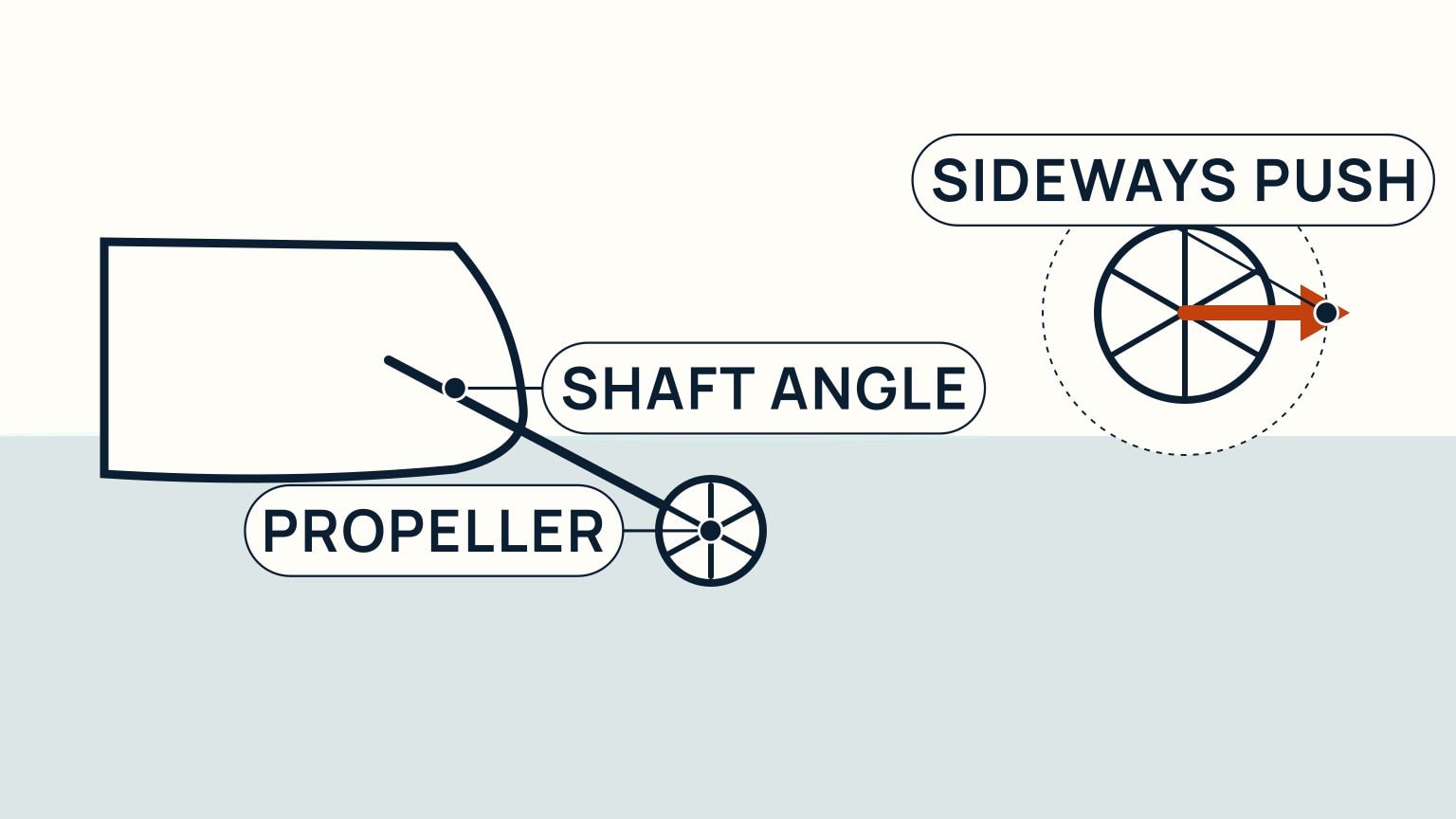
Prop walk starts with a small, deliberate imperfection: a propeller shaft isn't mounted dead level, it tilts down a few degrees from the hull toward the propeller. Because of that tilt, the blade sweeping through its upstroke travels a slightly greater cylindrical distance through the water than the same blade does on its downstroke a moment later. A blade pushing more water on one side of its rotation than the other shoves the stern sideways in addition to driving the boat forward or backward, since the thrust isn't perfectly balanced around the propeller's axis.
That sideways shove is there in both forward and reverse gear, but you rarely notice it going ahead: the rudder has plenty of water flowing past it at a normal cruising speed, and a small, steady correction cancels the kick out before it's ever felt. Reverse gear removes that safety net. The rudder is markedly less effective astern, so the same sideways push that used to be an invisible correction becomes the dominant force acting on the stern. That force gets stronger, not weaker, at slow speed and high engine rpm, which is the combination beginners use backing out of a slip.
Which Way Your Stern Kicks
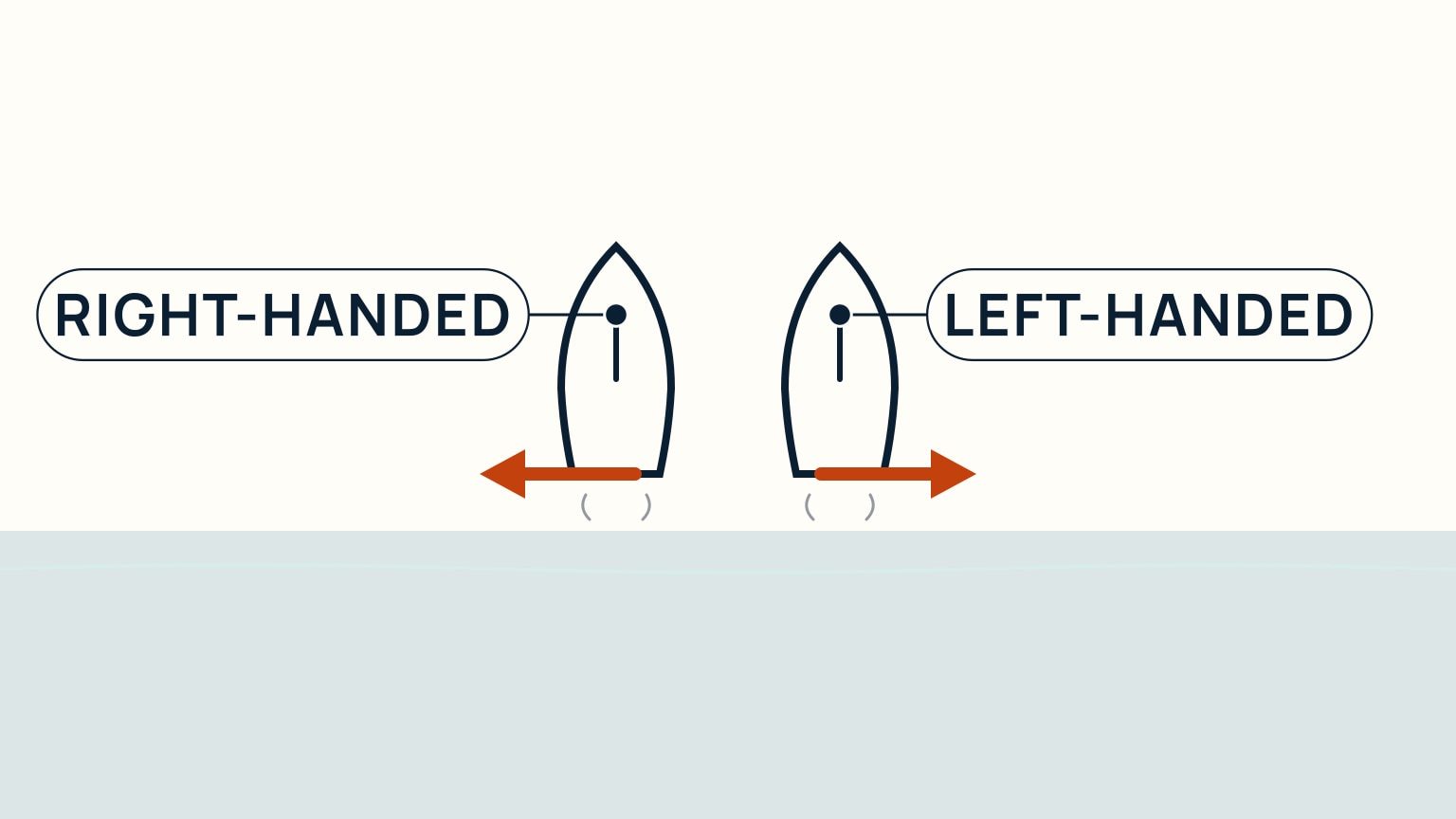
Most sailboats carry a right-handed propeller, one that spins clockwise when you look at it from behind the boat in forward gear. In reverse, that same rotation walks the stern to port and the bow to starboard. A left-handed propeller is the exact mirror image: turning counterclockwise viewed from astern in forward gear, and walking the stern to starboard in reverse. Neither direction is better or worse, and you can't tell which one you have just by looking at your boat from the dock. It comes down to how that individual propeller was cast.
Two easy checks settle it. Look at the propeller's blade. Many are stamped RH or LH near the hub. Or shift into reverse at idle while still tied up and watch over each stern quarter: turbulence showing to starboard means a right-handed propeller (walking the stern to port), turbulence to port means a left-handed one (walking the stern to starboard). Learn your own boat's answer once, and every low-speed reverse maneuver from then on has one less unknown in it.
Why It Dominates at Low Speed
A rudder only works if water is flowing across it (moving through the water yourself, or getting a burst of prop wash blasted over it from the engine). At the very start of a reverse maneuver, neither is true yet, and reverse gear makes the rudder markedly less effective to begin with. That's the moment prop walk has nothing to compete against, so it wins, kicking the stern before you've built enough speed astern for the rudder to answer back.
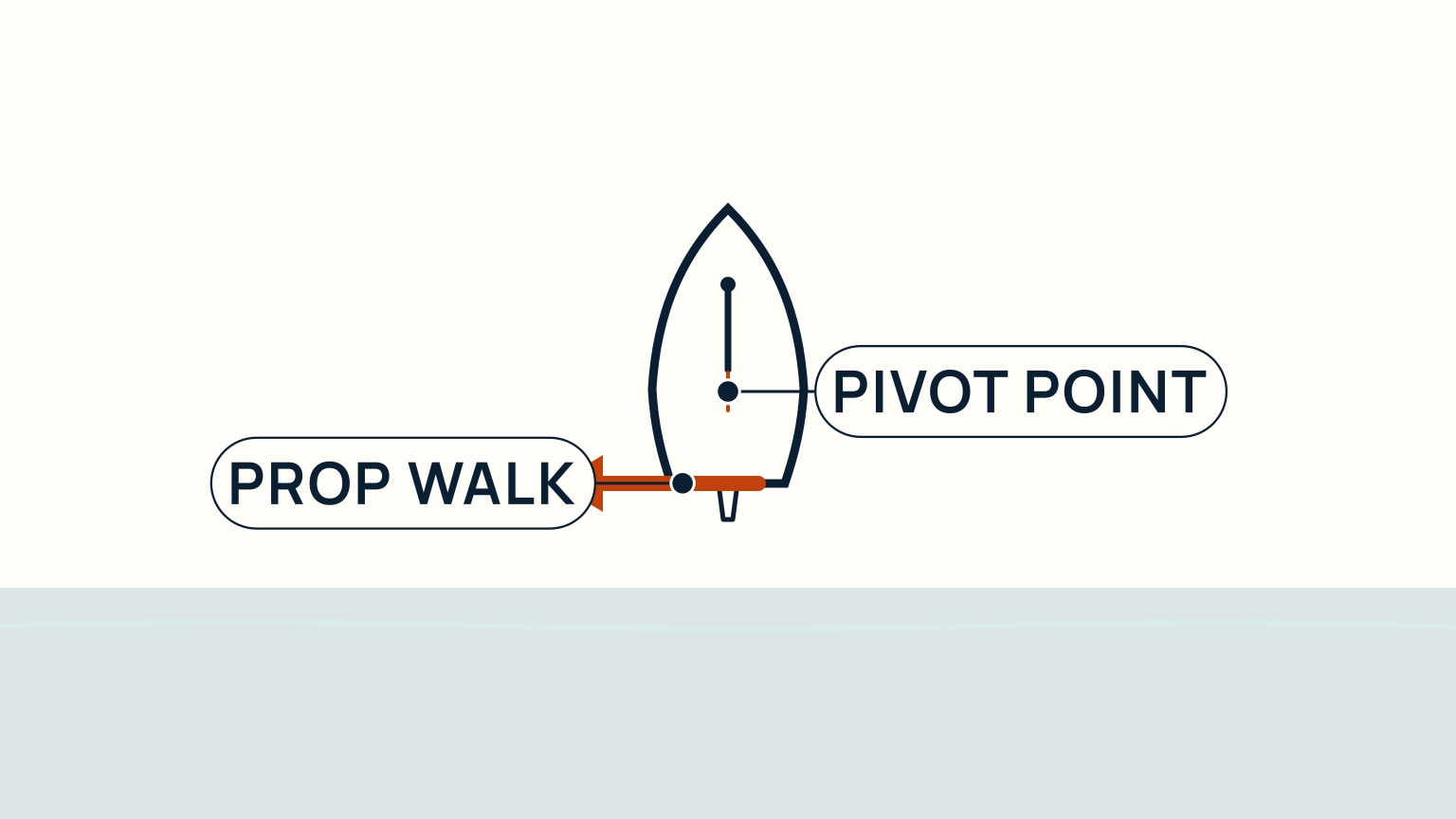
It matters because the stern is what you're actually steering, more than the bow. Moving ahead, a boat pivots around a point roughly a third of its length back from the bow. Turn the wheel and the stern swings out wide while the bow barely moves off its line. Reverse the boat and the pivot point shifts aft again, so once more it's the stern doing the moving. Add in windage (the slower you go, the more the wind above the waterline outmuscles your rudder and hull below it), and at low speed several forces stack up on the stern at once, prop walk included.
Using Prop Walk on Purpose
Test direction before a close manoeuvre
Do not rely on a rule of thumb about propeller rotation. In open water or while securely controlled, use the boat's normal procedure to apply a short burst of reverse with the rudder centered. Watch which way the stern initially moves before clear sternway develops. Repeat to confirm the result and note wind and current.
Then test how rudder angle, engine speed, and existing boat motion change the response. Prop walk is often strongest when reverse thrust begins and water flow over the rudder is still weak. Once the boat has sternway, rudder effect can become more important. The transition depends on the installation and hull.
Record the result near the helm: “stern tends to port in initial reverse,” for example. Include the conditions and whether the boat has a right- or left-handed propeller only if confirmed. Visiting crew need the observed behavior more than a theory lesson during docking.
Build it into the plan without depending on it
Use a helpful stern kick to begin a turn away from a dock or align the boat for a berth. Keep power brief and controlled, then shift attention to steerage, wind, current, and momentum. If prop walk moves the stern the wrong way, change the departure geometry, use a spring line, or choose another berth or approach rather than applying more power beside an obstacle.
The effect can weaken, strengthen, or feel different after a propeller, shaft, saildrive, rudder, loading, or engine change. Growth on the propeller and hull can also alter handling. Retest after relevant work or a long period ashore.
Use the leaving-dock guide to combine spring lines with known reverse behavior, and docking in wind and current to decide whether prop walk is important compared with external forces.
Common mistakes
Do not keep the throttle high while waiting for the rudder to win. Speed and closing distance may rise faster than control. Do not assume the stern kick will overcome a strong crosswind or current. Do not test for the first time inside a tight marina. Finally, do not focus on the stern alone: as it moves one way, the bow swings the other and may strike something outside the helm's immediate view.
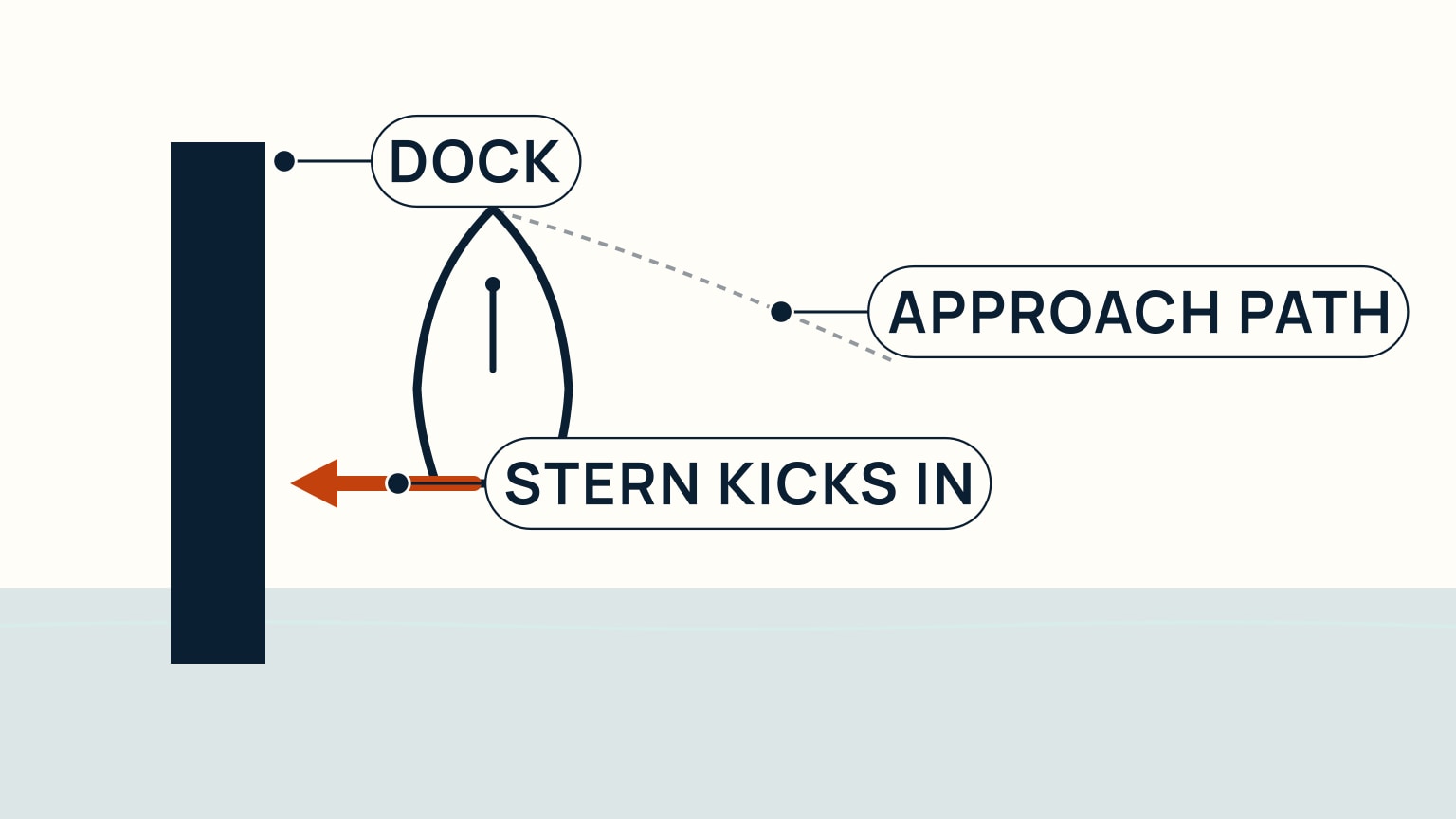
Because prop walk is consistent for a given boat, sailors treat it as a tool rather than a nuisance to fight every time. The clearest example: a right-handed propeller's stern-to-port kick is exactly what you want on a port-side-to landing. Approach the dock gently, at a shallow angle, bow pointed just ahead of where you actually want to stop. When you're close, shift to reverse and give one short, deliberate burst of throttle. The boat's forward motion stops, and the same prop walk that gets in the way everywhere else kicks the stern neatly in toward the dock instead of away from it.
The same idea works leaving a berth: alternating short bursts, forward with the wheel over one way, then a burst of reverse, uses prop walk and prop-wash steering together to rotate the boat around its pivot point and walk it clear, without needing room to build headway. Either way, the discipline is the same one that makes low-speed maneuvering safe in general (short bursts of throttle, then neutral to judge the result, never a steady throttle setting held through a turn you are still learning).
Prop walk is one of those things that sounds like a party trick until the first time you're backing out of a tight slip with boats on both sides. Then it's simply the fact that decides whether your stern swings toward open water or toward someone else's hull. The mechanism doesn't change from boat to boat, only the direction: work out once whether your propeller is right- or left-handed, and you'll know which way to expect the kick every time you shift into reverse from then on.
Docking and leaving under power is exactly the kind of skill that rewards a little groundwork before you're standing at the helm with an audience. SailStarter's lessons on handling a boat under power walk through prop walk, pivot points, and close-quarters throttle control step by step, so the theory is already familiar the first time you actually need it.
Try it from the lesson
Can you spot the next move?
Compare approaching the same dock bow-first against a current with approaching in the direction the current flows. Which needs more stopping room, and where should you check the boat’s response first?
Why you can trust this guide
. We build each guide from public seamanship and safety sources, then teach the universal principle before any local difference.