Chart your course
Sailing as a Couple: Roles and Communication
Quick answer
The short version
Two people can run a sailboat well when they agree the jobs on shore, before the lines come off the dock. Waiting until the boat is already moving to work out who does what leaves both of you improvising under load. List the recurring tasks (helm, lookout, lines, anchor, navigation, food, rest) and assign a lead and a backup for each, based on current skill instead of habit. Choose a handful of short, specific calls for the manoeuvres you use often, and rehearse them somewhere calm before you need them for real. When something does go wrong, secure the boat first, describe the action rather than the person, and save the longer conversation for later. After each outing, note one thing to swap or sharpen next time, so the skills build in both of you together.
A cockpit is a small space to share with an evolving plan, a shifting wind, and two different energy levels by mid-afternoon. The habits that work at anchor over coffee are not automatically the habits that work when a squall is closing and a line has jammed. Most sailing couples do not lack goodwill. What they often lack is structure: an agreed answer for who does what, which words mean what, and what happens the moment a manoeuvre goes sideways. None of this requires one partner to become the permanent skipper and the other a permanent passenger. It works better the other way, with both people able to run the boat and both people knowing, well before it matters, exactly what the other one needs from them.
Who does which job on board?
Start with the tasks you actually repeat on a normal outing: helm, lookout, lines and fenders, anchoring, navigation, weather checks, cooking, and rest. Write them down and give each one a lead and a stand-in, chosen by who is currently better at that specific task, not by who happened to do it last time. That single change breaks the pattern where one person always drives and the other always fetches fenders, a default split that sailing-skills writers warn against because it wastes whatever the second partner is actually good at.
Both of you should also become able to run the other's core jobs. If one person can start the engine, steer, and call for help on the radio, and the other cannot do any of that, the boat effectively has only one working skipper. A pre-departure safety briefing is a natural point to name a backup out loud and confirm that the backup genuinely knows how to operate the boat, beyond simply knowing where the switches sit.
Roles are not fixed for the season. Fatigue, a sore shoulder, or plain confidence on a given day should move a job from lead to backup for that outing, and that swap goes far more smoothly when you agreed the rule in advance than when you negotiate it mid-manoeuvre.
What words do you actually use?
Before you cast off, agree the short calls you will use for speed, distance, line state, and stopping a manoeuvre. Settle them somewhere calm, well before you are relying on them mid-manoeuvre. Gather at a spot where you can both hear each other, walk the sequence through out loud, and decide how each of you will signal that something is ready.
Make the instruction itself specific. Naming an exact amount, such as easing a sheet by half a metre, gives a clear result to aim for, while a vague request to ease it "a bit" does not. There is also a real difference between speaking firmly and speaking with aggression: short, plain language under load is not the same thing as raising your voice at the person who hears it. If wind, spray, or a hood is muffling your voice, face the listener and fix that before you reach for more volume.
A simple loop helps here. One person gives the instruction, the other repeats it back, and the first person confirms it is correct before the action starts. Report the result too, whether the sail is drawing or a line is jammed, so silence is never mistaken for success. A shared list of common sailing commands gives you a starting vocabulary, and the version you actually keep is whichever wording both of you use the same way once the wind picks up.
Practise before pressure
Rehearse departures, arrivals, reefing, and stopping the boat somewhere open and calm, with suitable instruction if either of you is still building confidence. Run the sequence through in your head before you start, the way short-handed sailors prepare a manoeuvre in more detail than a fully crewed boat needs, precisely because there is no spare set of hands to cover a gap.
Swap positions and repeat the same manoeuvre slowly enough that the person watching can catch a timing or sightline problem before it turns into a habit. Docking in wind and current is a useful drill for this, since it forces both people to commit to a role, adjust as the situation changes, and talk through what shifted.
If one of you plans to go forward alone (on the foredeck or below), say so before you move. That single sentence lets the other person stay alert instead of discovering the change by surprise, and it matters most exactly when neither of you has spare attention to notice on their own. A role only counts as a working backup once the less experienced partner can run it without a prompt at every step.
How do you reset after a rough moment?
Secure the boat and check that both of you are actually fine before either of you says anything about what just happened. A jammed line or a badly timed tack is a task problem first, and it stays a task problem if you describe the action rather than the person: what happened, what you noticed, what you would try next time, not who was careless or slow.
That distinction matters because a two-person crew often has no spare capacity. Whoever is left on deck during a bad moment may end up calling for help, tending the sail, and finishing the manoeuvre with nobody free to hand anything to. It is reasonable for that to feel stressful, and unhelpful for the stress to harden into "always" or "never" the moment the boat is safe again.
Pick one specific change for next time rather than relitigating the whole afternoon. If you already named a backup for each job, use this moment to check whether that backup actually held up under real conditions, and not only in the plan you wrote at the dock. A short, honest exchange here does more for the next sail than a long one does for this one.
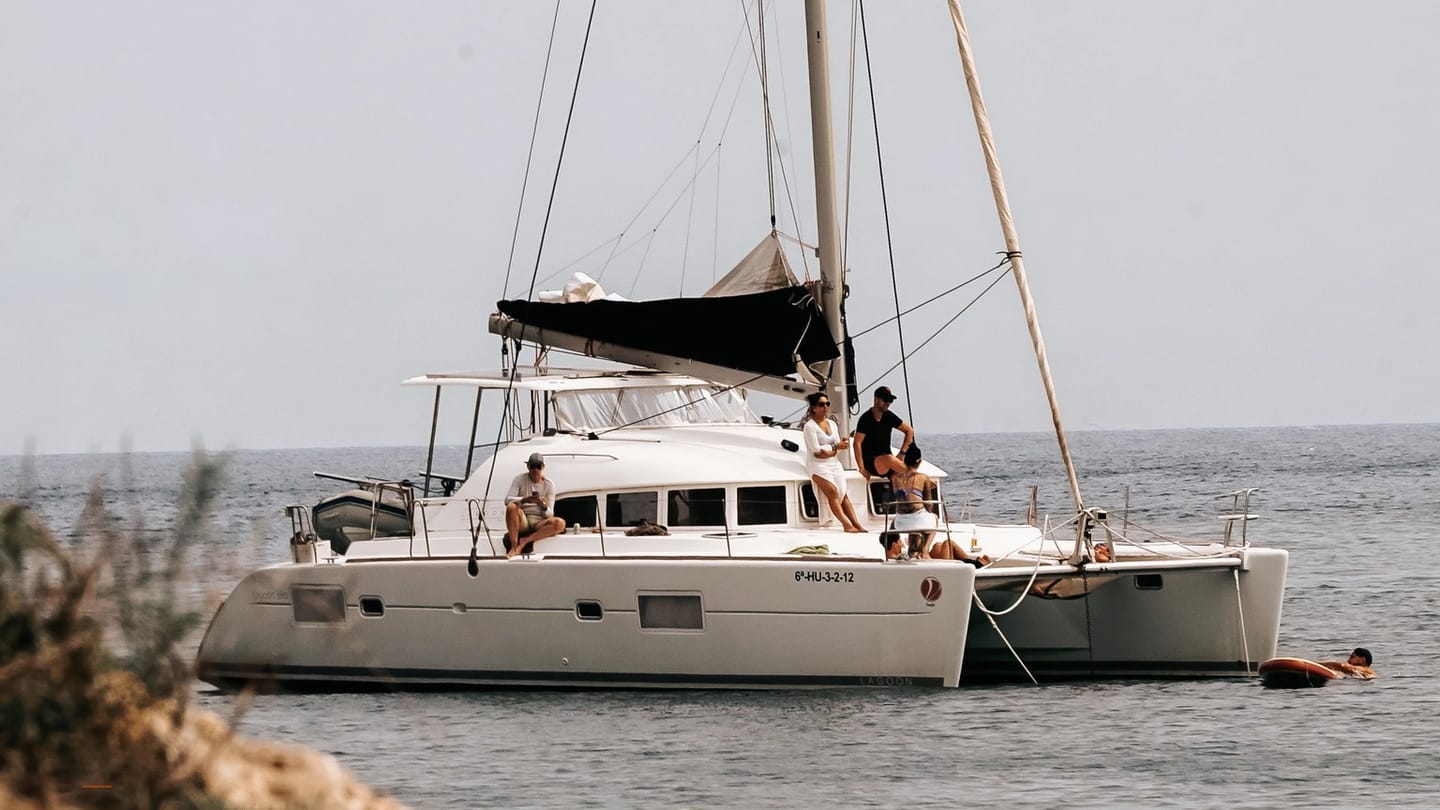
Turn each outing into a rehearsal for the next one
Before the next trip, pick one job to swap and one skill to build. Repeating the exact plan that worked last time keeps the same person doing the same job forever. If the same person always navigates or always handles the anchor, use a calm outing to hand that job to the other partner while the first one backs them up close by.
Watch and rest patterns deserve the same review on longer days. Sailors covering bigger distances short-handed adjust their rotation to the conditions and the people aboard instead of keeping one fixed pattern for every passage, because what works on a flat afternoon is rarely what still works on an overnight leg. If you are building toward longer trips together, planning a multi-day coastal passage is a good place to test a rotation before you actually need it to hold up through the night.
Close each outing with a short, specific note: which job moved to the other person, which call worked and which one did not, and what you will rehearse next time. That habit turns ordinary sailing days into a slow, deliberate build toward two capable skippers, rather than one skipper and one helper who never quite gets a turn at the wheel.

None of this asks either partner to become a different kind of person on the water. It asks you to agree, before the boat is moving, who does what, which words you will both use, and how you will talk to each other when a manoeuvre goes sideways. That structure is what turns two individually competent sailors into a crew that can actually rely on each other, especially on the day only one of you is available to act. If you want a shared vocabulary and a structured way to build these skills together, SailStarter's lessons work through the roles, calls, and manoeuvres above at a pace either partner can follow, so you both arrive at the next practice sail carrying the same plan.
Try it from the lesson
Can you spot the next move?
You sailed with this skipper last month and know the boat well. Does today still get a full briefing?
Why you can trust this guide
. We build each guide from public seamanship and safety sources, then teach the universal principle before any local difference.