Chart your course
Sailboat vs Sailboat: Who Has Right of Way?
Quick answer
The short version
When two sailboats meet, COLREGs Rule 12 decides who gives way with two straightforward tests. If the boats are on different tacks (one has the wind over her port side, the other over her starboard side), the port-tack boat keeps clear, no matter which boat is bigger or which one got there first. If both boats share the same tack, the windward boat, whichever one sits closer to where the wind is coming from, keeps clear of the leeward boat. If you genuinely can't tell which tack the other boat is on, you give way yourself, without exception. Whichever boat gives way needs to alter course early and obviously, usually by bearing away to pass astern of the other boat rather than pressing on toward her bow.
Right of way at sea isn't one rule. It's a set of roles assigned situation by situation, and two sailboats meeting is its own specific case. You already know the general shape from give-way and stand-on: one boat acts, the other holds steady. The rules themselves never actually use the phrase "right of way" either; Rule 12 assigns a duty to keep out of the way, a subtly different framing worth having straight even though "right of way" is how everyone talks about it. What decides which sailboat acts, when both boats are under sail, is COLREGs Rule 12, and it comes down to two questions you can answer just by looking at where the wind is hitting each hull. Get the read wrong, or can't get a read at all, and the rule still has an answer ready for you. This guide walks through both tests, the fallback for when you're not sure, and what giving way looks like once you know you're the one who has to move.
Rule 12 assigns the give-way duty differently depending on which of these three situations you're in.
| Dimension | Opposite tacks | Same tack | Can't tell either tack |
|---|---|---|---|
| Governing rule | Rule 12(a)(i) | Rule 12(a)(ii) | Rule 12(a)(iii) |
| Who gives way | The port-tack boat | The windward boat | You — give way yourself |
| How you tell | Which side the wind crosses each hull | Which boat sits closer to the wind's source, or which side the boom is on | Neither test can be read with certainty |
| Does size or arrival order matter | No | No | No |
Opposite Tacks: The Port-Tack Boat Gives Way
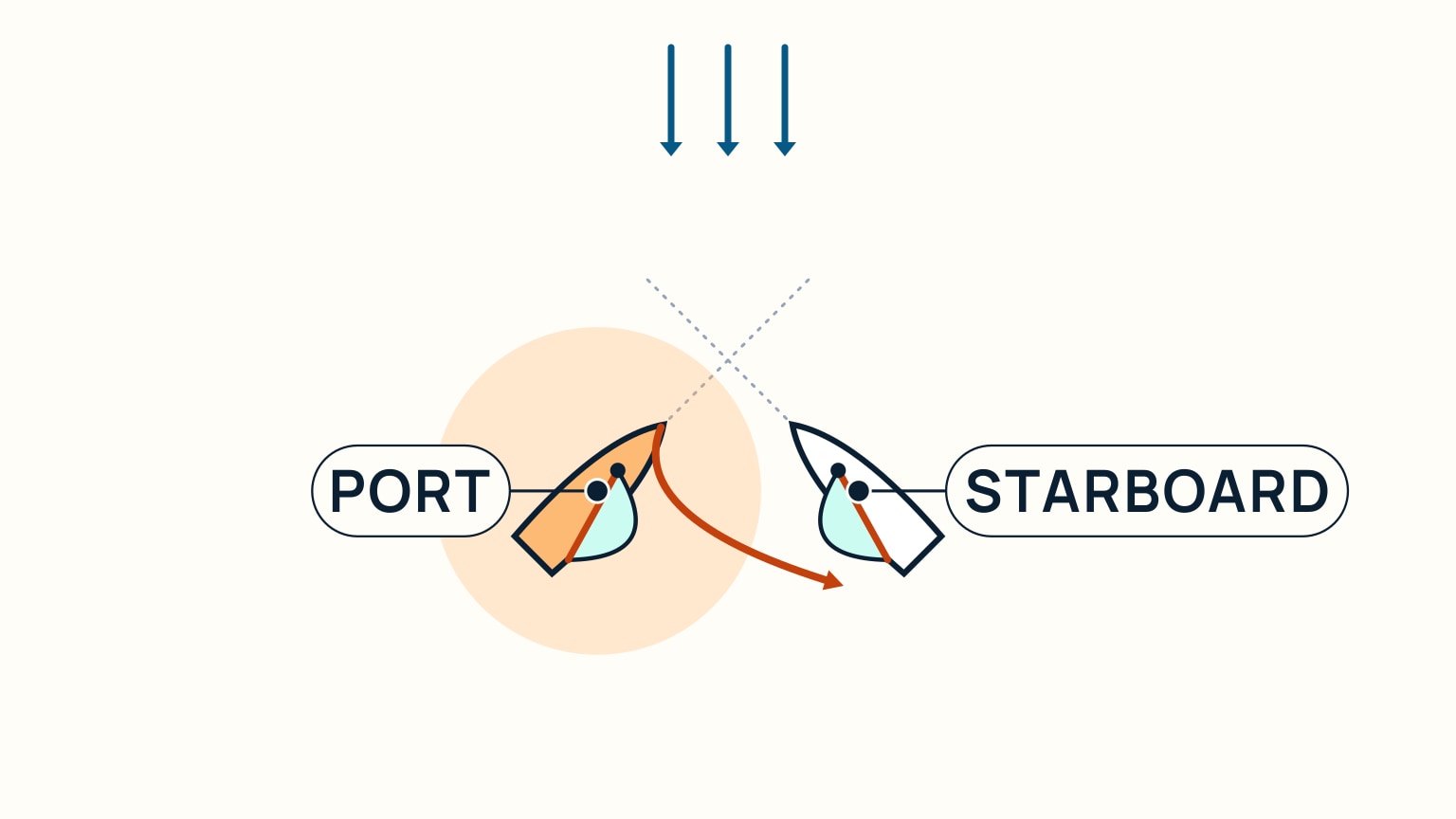
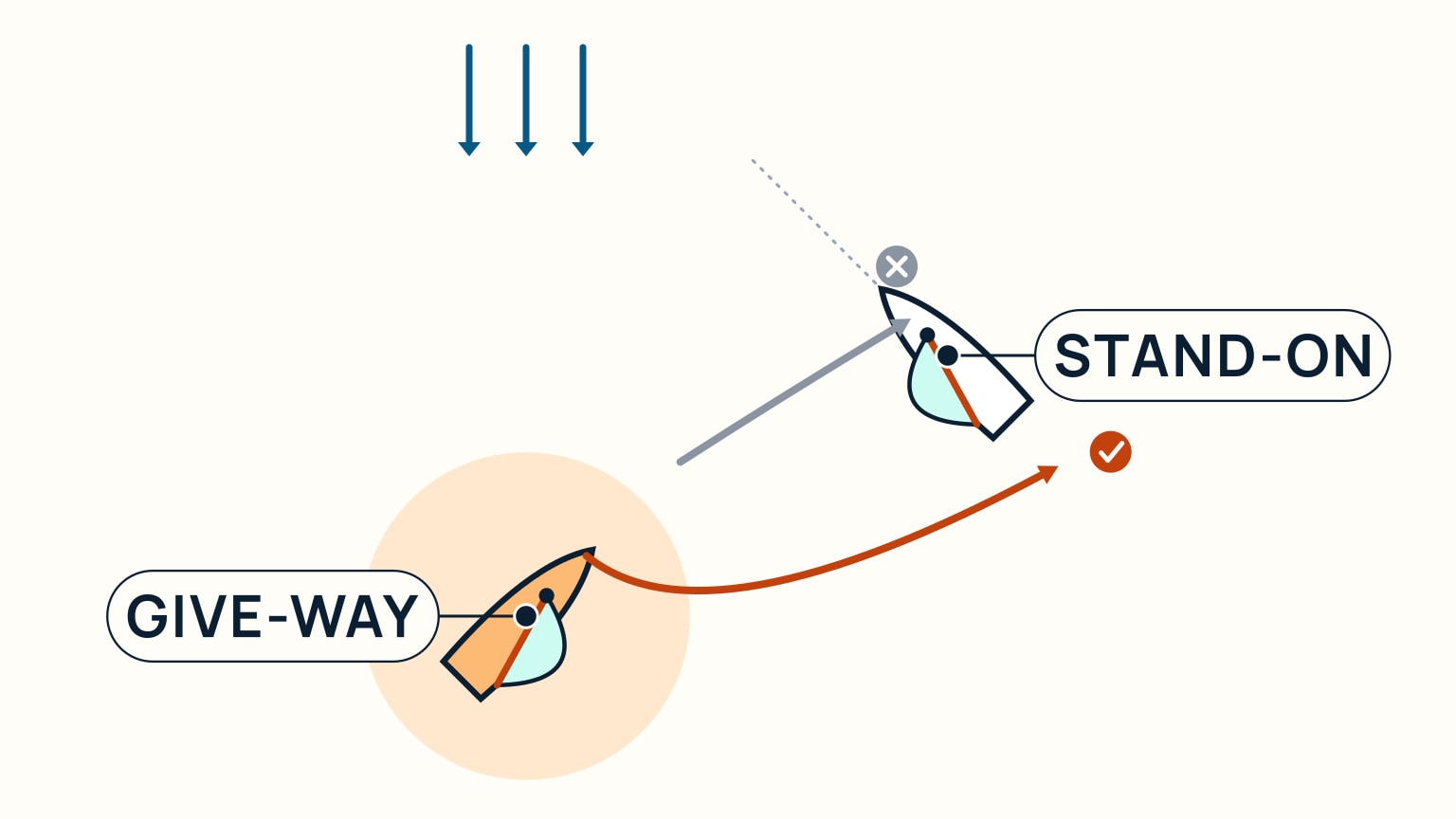
Two sailboats meeting on different tacks each have the wind hitting a different side of their hull: one has it over her port side (she's on port tack) and the other has it over her starboard side. COLREGs Rule 12(a)(i) settles this pairing with no ambiguity: the port-tack boat keeps out of the way of the other, every time. It doesn't matter which boat is larger or which one reached the crossing point first; tack alone decides. If you're on port tack and another sailboat is converging with you on starboard tack, you're the one who acts; she holds her course and speed as the stand-on boat. The figure below shows the shape of it: the port-tack boat's course bends away early, dropping in behind the starboard-tack boat rather than trying to beat her across.
Size and Speed Don't Enter Into It
It's tempting to assume a small dinghy owes a much larger yacht extra room, or that whichever boat reached the crossing point first has some claim to holding her course. Rule 12(a)(i) draws no such exception. A small dinghy on starboard tack is the stand-on vessel over a much larger cruising boat on port tack, full stop, and arrival order at the meeting point changes nothing about who gives way. The rule reads the same regardless of which boat you'd rather not argue with. That's deliberate: a rule that bent for size or timing would need a judgment call exactly when there's no time to make one. Read the tack, not the hull length, and you already know who acts.
Same Tack: The Windward Boat Gives Way
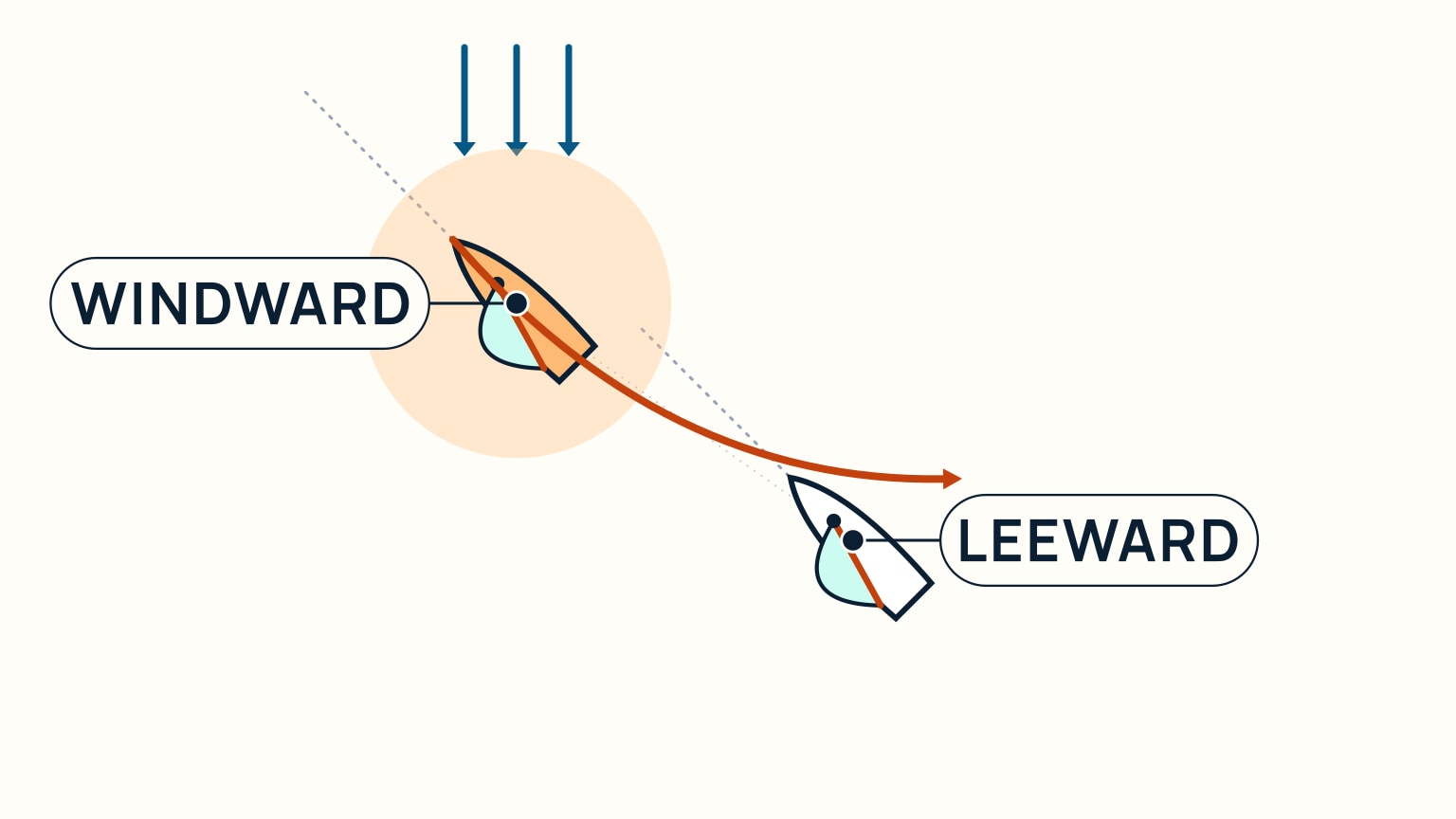
When both sailboats have the wind on the same side (both on port tack, or both on starboard), Rule 12(a)(ii) uses a different test: position, not tack. Whichever boat sits further upwind, closer to where the wind is actually coming from, is windward; the other is leeward. The windward boat keeps out of the way of the leeward boat. Rule 12 itself defines windward a little more technically, as the side opposite wherever your own mainsail is carried, which comes in handy when you can read a boom but not the wind angle. For a normally trimmed boat the two readings always agree, since wind pressure carries the boom to leeward regardless of which test you use. On the water, position is usually the faster read: look at which boat is closer to the wind's source, and that's your answer.
A Worked Example: Judging Windward on a Run
Picture two boats sailing almost dead downwind, sails out wide on a run, where the wind on your face barely tells you which side it's really coming over. This is exactly when the boom-side test earns its keep: look at which side your own boom is carried, and the wind is on the other side of your hull, no guessing required. Do the same read on the other boat. If her boom sits out toward you, you're likely sharing a tack and the windward-leeward test above decides between you. If it sits away from you, you're on opposite tacks and the port-tack test from the section above applies instead. Reading a boom takes a glance. Reading the wind on a dead run can take much longer, and a boat converging with you will not wait for you to be sure.
Can't tell her tack?
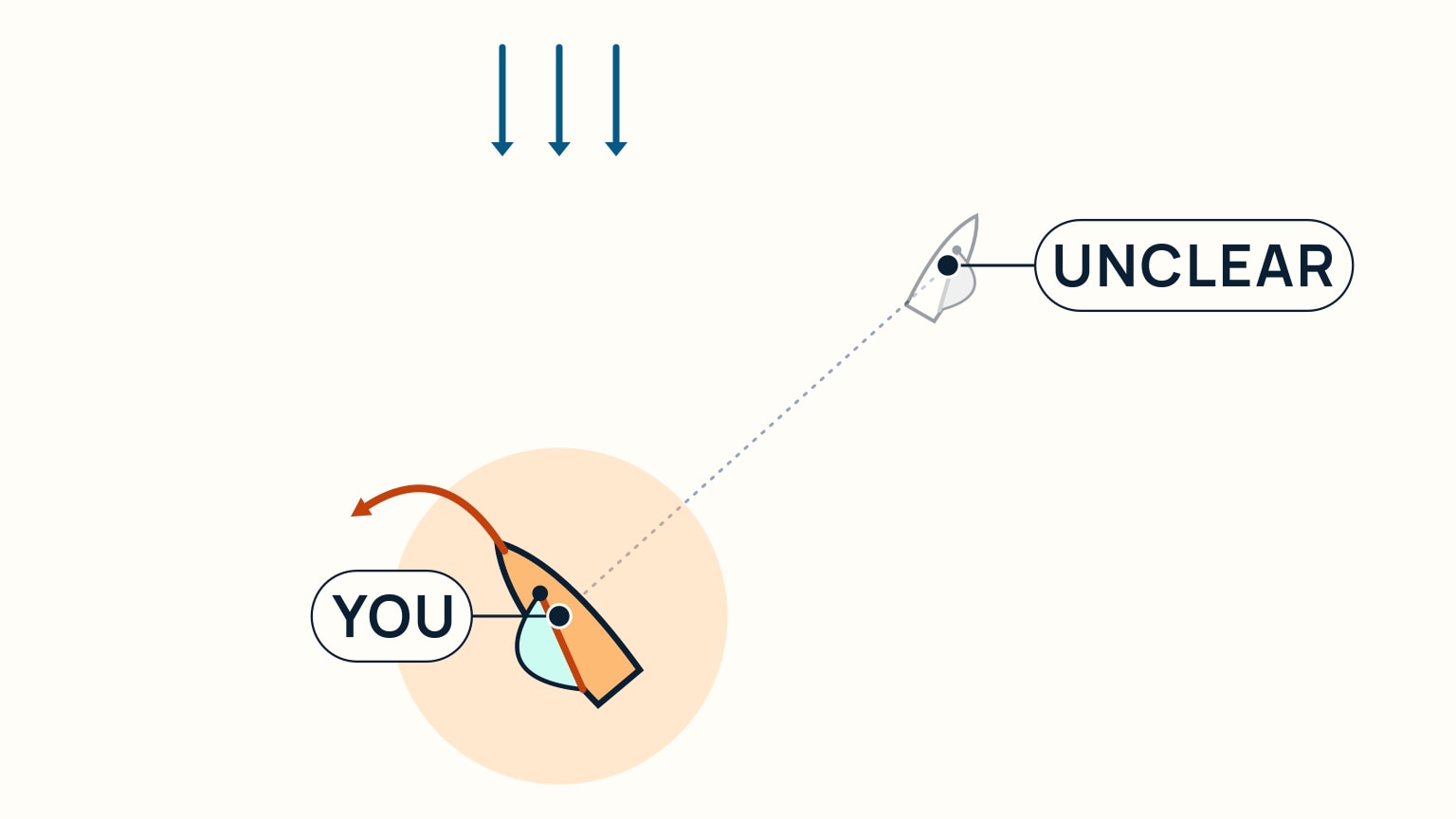
Sometimes you genuinely can't read another boat's tack: she's far off, nearly bow-on, or angled so her boom isn't visible from where you sit. Rule 12(a)(iii) doesn't let that uncertainty become a reason to wait and see: if you can't determine with certainty which side the wind is on for the other boat, you keep out of her way regardless. It's a deliberately conservative rule, and it's meant to be. Guessing wrong about someone else's tack, in either direction, is exactly the situation that turns two converging boats into a collision. Treat "I'm not sure" the same as "I'm the one who has to move," and act on it early rather than closing the distance while you try to get a clearer look.
A Worked Example: Nearly Bow-On at Dusk
Picture another sailboat approaching almost bow-on as the light fades, her hull end-on enough that you can't tell which side her boom is carrying her sail. You genuinely don't know her tack, and guessing wrong in either direction is exactly how two converging boats end up on a collision course instead of a safe crossing. Rule 12(a)(iii) removes the guess: you keep out of her way, the same as if she'd turned out to be on starboard tack and you on port. Alter course early, while there's still plenty of room, rather than closing the gap while you wait for a clearer look at her rig. If she resolves into a boat that should have given way to you, you've lost nothing but a little time. If you'd guessed wrong the other way, you'd have lost a great deal more.
What does giving way mean?
Knowing you're the give-way boat only matters if the other boat can actually tell. The same standard that governs every give-way situation, Rule 16, applies here too: your action has to be early and substantial enough to be obvious, not a token nudge that leaves your intentions ambiguous until the last few boat-lengths. In practice, for two sailboats, that almost always means altering course (and easing sheets if you need to) enough to drop in behind the other boat, passing astern of her rather than trying to cross ahead. The figure shows both versions side by side: an early, wide turn that clears her stern with room to spare, against a late, small correction that's still aimed toward her bow when it matters. If you're racing rather than day-sailing, the Racing Rules of Sailing hand right of way between racing boats their own separate terms. Rule 12 above is what applies the moment either of you isn't.
Turn to Starboard, Not Port
The direction of your turn matters as much as its size. Standard practice, once you're the give-way boat, is to turn to starboard and drop in behind the other boat's stern, not to turn to port even if a port turn looks like the shorter way to pass astern of her. The reason is the other boat's own expected response: if she needs to alter course too, proper practice has her turning to starboard as well, to pass behind you. Two boats both turning to starboard open up cleanly. A boat that turns to port while the other holds her expected starboard response can turn the two of you right back toward each other, undoing the whole point of altering course early. When you tack or bear away to give way, make it a clear turn to starboard where the geometry allows it, not the port-hand shortcut that looks quicker in the moment.
Two sailboats meeting is one of the most common situations you'll face under sail, and it rewards being automatic about it: the moment you clock which tack you're each on, you already know who moves. SailStarter's lesson on sail meets sail walks through these same tests with interactive diagrams you can tap through scenario by scenario, building on the give-way and stand-on roles from the lesson right before it. If Rule 12 still feels like something you'd have to stop and calculate mid-maneuver rather than something you just know, that's exactly the gap a few short, visual lessons are built to close.
Try it from the lesson
Can you spot the next move?
Two sailing boats are in sight with collision risk; neither is overtaking. You are on starboard tack, the other on port tack. Who gives way?
Why you can trust this guide
. We build each guide from public seamanship and safety sources, then teach the universal principle before any local difference.