Chart your course
Spinnaker vs Gennaker
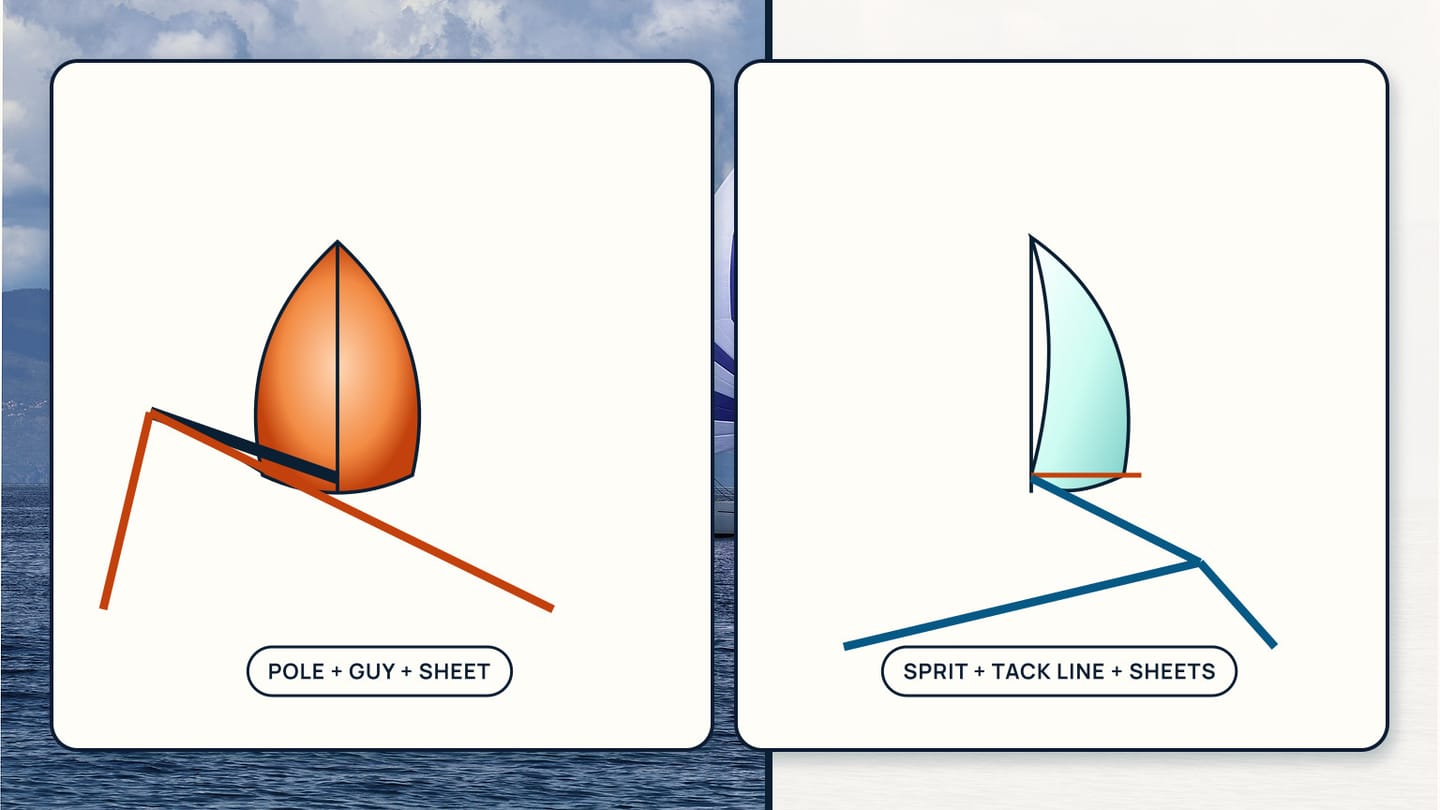
Quick answer
The short version
A traditional symmetric spinnaker mirrors around its vertical centreline and usually uses a spinnaker pole to hold the windward lower corner. An asymmetric spinnaker has a defined tack and clew and normally attaches at the bow or a bowsprit. “Gennaker” is commonly used for an all-purpose asymmetric cruising sail with a genoa-like form and spinnaker-like width. Names overlap between sailmakers, so choose from the sail's intended apparent-wind range, your boat's attachment points, and the crew's ability to hoist, trim, gybe, and douse it.
The useful comparison is not “advanced versus easy.” A well-drilled crew can handle a symmetric sail smoothly, while a poorly rigged gennaker can still become a large loaded problem. Inventory, pole or sprit, halyard, sheets, tack line, retrieval system, and safe deck positions all belong to the choice.
Review points of sail explained, how apparent wind works, and how to sail wing-on-wing first. Flying-sail handling needs boat-specific training and open water; this guide helps you identify the systems, not improvise a first hoist.
Corner count and attachment point drive most of the difference in course, gybe, and rigging.
| Dimension | Symmetric spinnaker | Asymmetric spinnaker | Gennaker |
|---|---|---|---|
| Corners | Two matching lower corners; tack and clew swap roles at each gybe | Three distinct corners — head, tack, clew | Follows the asymmetric layout, with a free clew |
| Attachment | Windward corner held by a spinnaker pole | Tack fixed at the bow or a bowsprit, via a tack line | Same bow or bowsprit tack point as an asymmetric |
| Best course | Deep running | Reaches and broad reaches; some designs sail deep | Broad, all-purpose cruising angle |
| Gybe mechanics | Pole and lower-corner roles transfer | Clew and sail move around the forestay | Same as an asymmetric |
| Added rigging | Pole, topping lift, downhaul/foreguy, sheet and guy | Sprit or bow tack point, tack line, sheets | Often a sock or furling system, with its own line routes |
Recognise the sail before judging it
A symmetric spinnaker has two matching lower corners. Whichever one is held to windward by the pole acts as the tack; the leeward corner is the clew with the working sheet. During a gybe those roles exchange. The broad, rounded sail can project to windward of the boat and support deep downwind courses.
An asymmetric sail has three distinct corners: head, tack, and clew. The tack connects near the centreline at a bow point or bowsprit, often through an adjustable tack line. Two sheets attach to the clew and lead around the boat for gybes.
A gennaker usually follows that asymmetric layout, with head and tack constrained and a free clew. North Sails describes it as combining a genoa-like asymmetric form with spinnaker girth. Other lofts may use “gennaker,” “cruising chute,” and “asymmetric spinnaker” differently.
Inspect the sail bag, corner labels, sailmaker documentation, and boat rig. Colour and size do not identify the type reliably. If the intended tack, halyard, or sheet route is uncertain, do not hoist to find out under load.
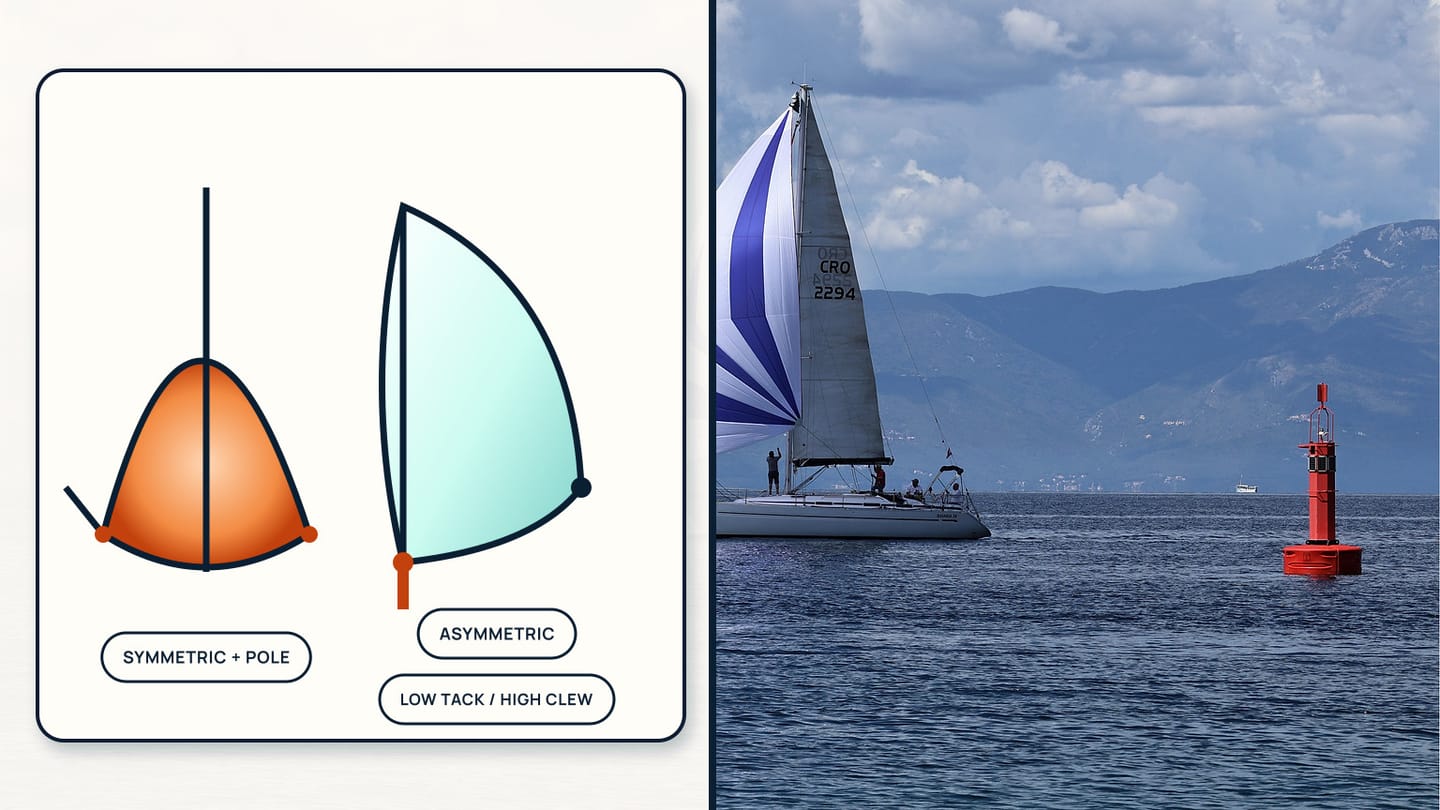
How does shape match the course it serves?
Symmetric spinnakers can be arranged for deep running because the pole moves the windward corner away from the main's shadow. Their mirrored form also allows either lower corner to become the tack. Specific designs still differ: some are cut for reaching and others for running.
Asymmetric sails are more triangular and favour airflow from one side. Many are effective on reaches and broad reaches, while some modern designs sail quite deep on suitable boats. A gennaker is often selected as a broad all-purpose cruising option rather than a specialised racing sail for one narrow angle.
Boat speed changes apparent wind. A fast boat may sail at a true downwind angle while the apparent wind remains farther forward, favouring an asymmetric sail. A heavier displacement boat may benefit differently. The label alone cannot supply a polar diagram.
Ask the sailmaker for the designed apparent-wind and wind-strength ranges for your boat. Do not transfer a published range from a different model. The safest, most useful sail is one the crew can carry within its design and retrieve before conditions exceed it.
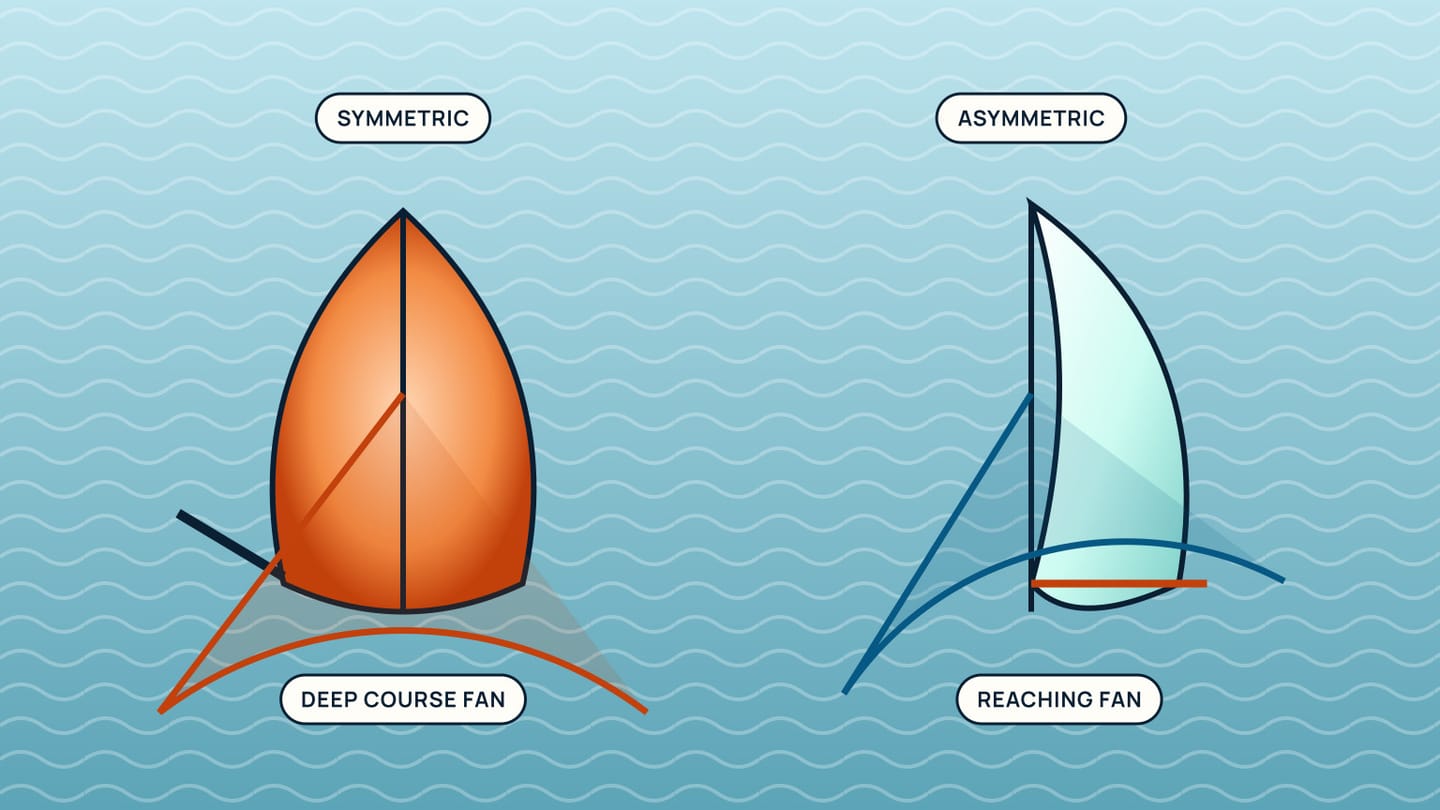
How do rigging and crew work compare?
The symmetric system adds a movable pole, topping lift, downhaul or foreguy, and two lower control lines often called sheet and guy. A gybe transfers the pole and the lower-corner roles. That creates foredeck jobs and several loaded lines to coordinate.
An asymmetric system replaces the movable pole with a fixed or retractable sprit or bow tack point. The tack line controls the tack, and sheets lead from the clew. A gybe moves the clew and sail around the forestay, either in front of it or between sail and stay according to the rigged method.
Cruising gennakers may use a sock or approved furling system to help control deployment and retrieval. Those systems simplify some steps but introduce their own line routes, torsion cables, and failure modes. They require training and inspection.
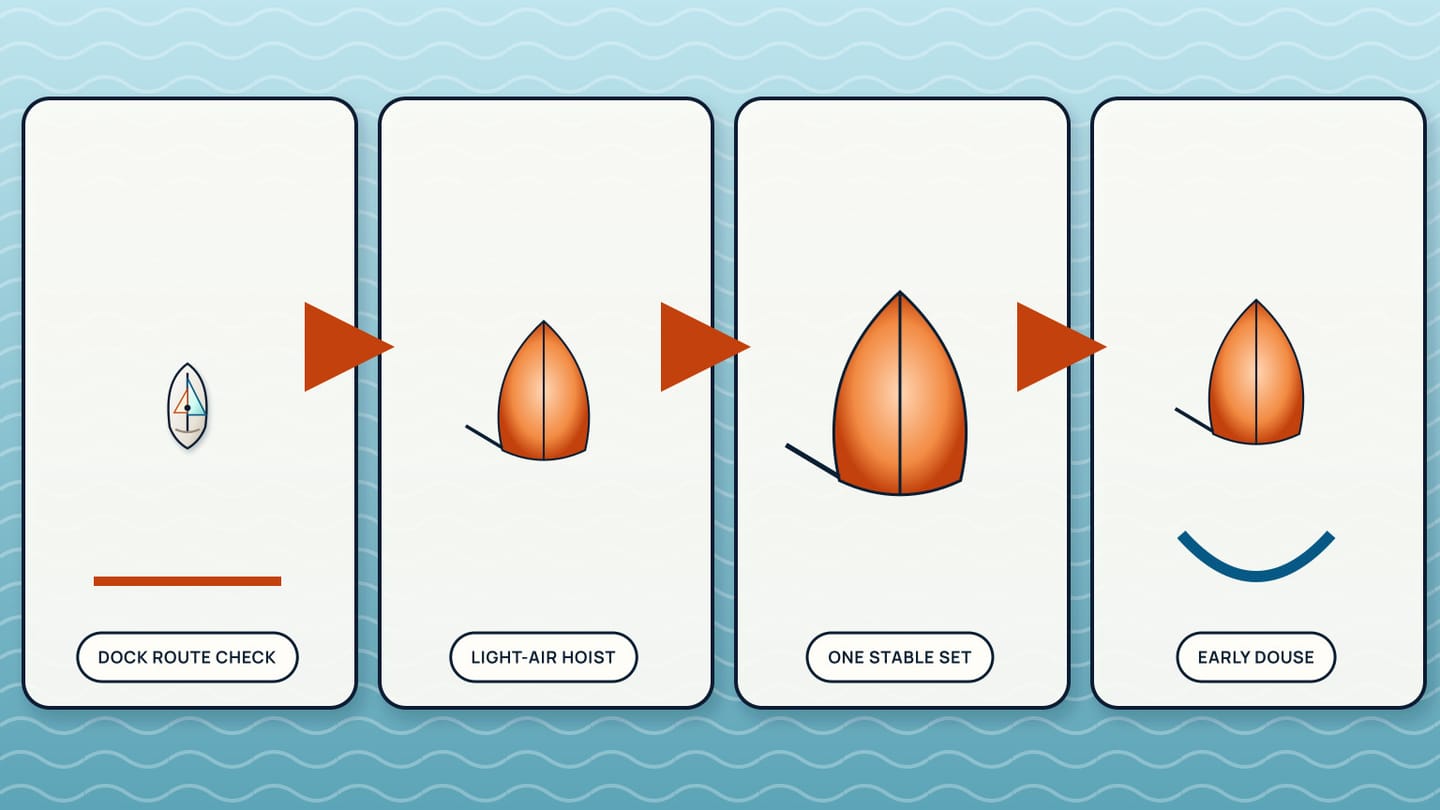
Lay out the full system at the dock. Confirm halyard position, tack attachment, lazy and working sheets, line runs outside the rig, and the drop location. Count crew jobs. If one person must leave the helm, trim two controls, and manage the douse, the inventory may exceed the available crew.
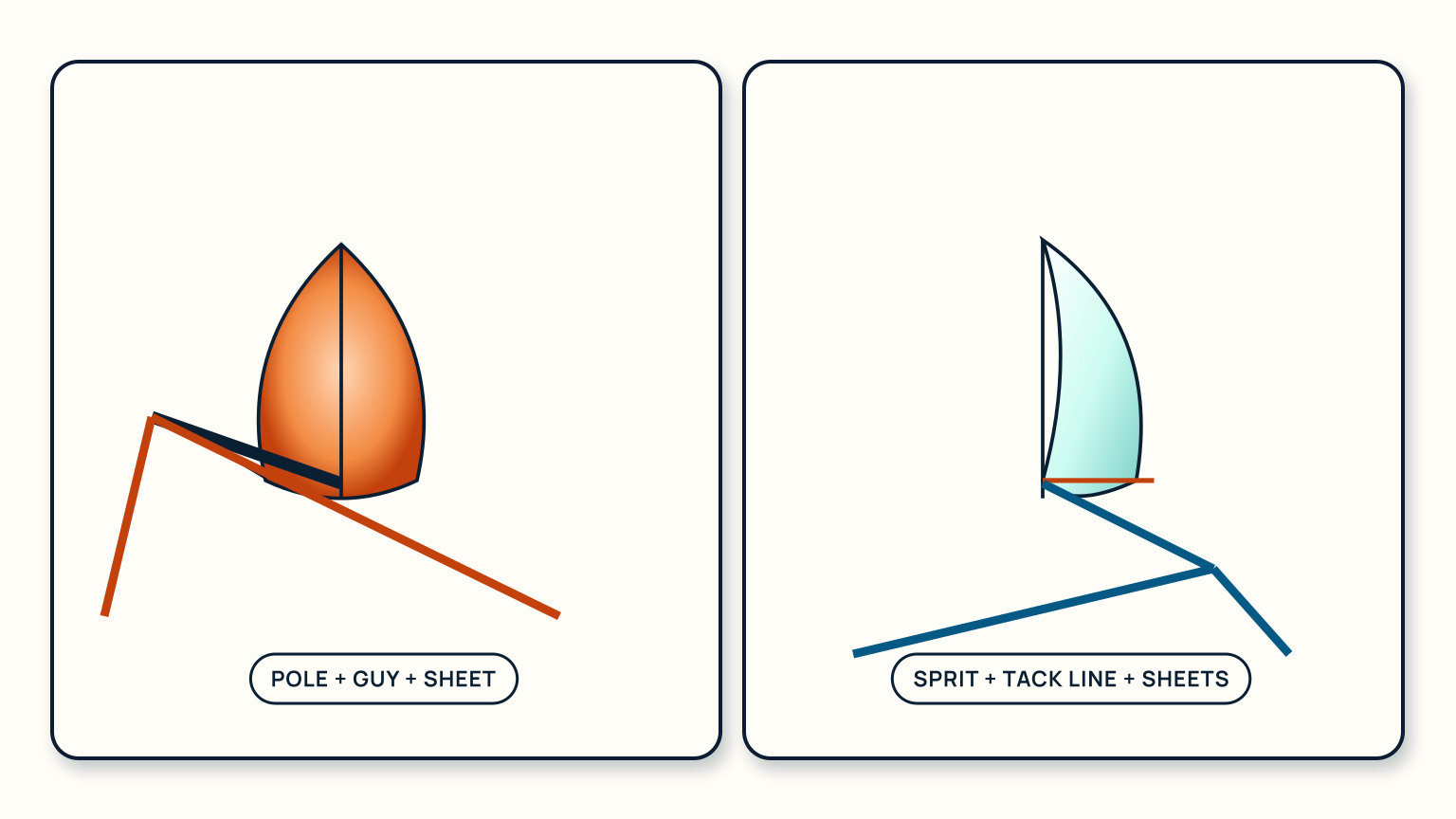
Match the sail to boat, angle, and crew
Begin with the boat. Does it have a rated pole, sprit, tack point, halyard, blocks, and deck layout for the sail? Equipment suitability comes before performance. Ask the designer, manufacturer, rigger, or sailmaker when the attachment is unclear.
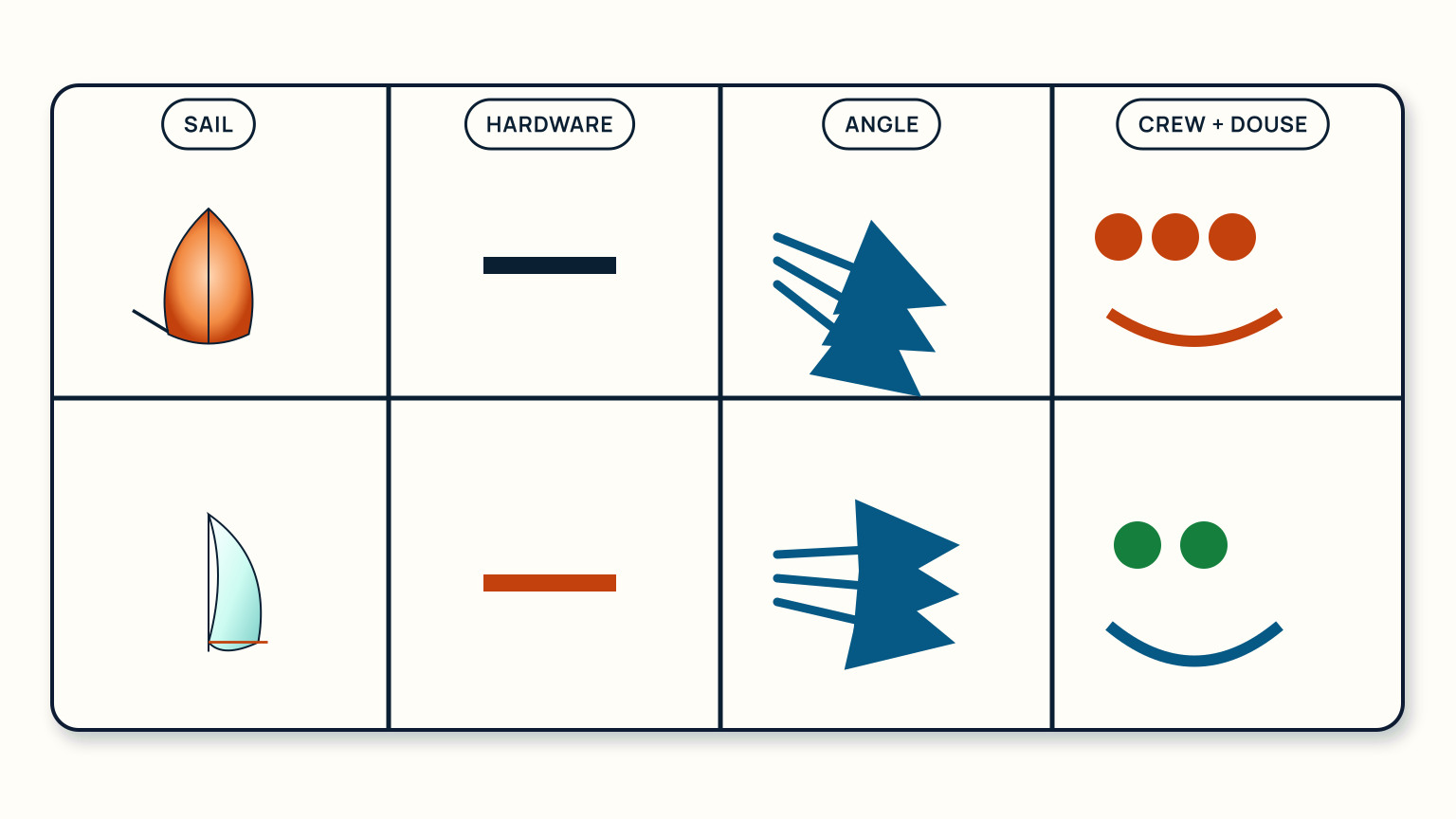
Then define the sailing job. A crew seeking deep downwind performance on a pole-equipped boat may value a symmetric inventory. A short-handed cruising crew expecting reaches may value an asymmetric cruising sail and retrieval system. Neither answer is universal.
Add the handling window. Where can the crew bear away, hoist, and douse with sea room? What wind increase triggers retrieval? Can the sail come down behind the main or into a hatch without someone entering a dangerous position? Work the drop backward before choosing the set.
Finally, compare expected gain with workload. A sail that adds speed but remains in the bag because the crew distrusts the douse is a poor practical match. A smaller or more forgiving design used confidently can produce better passages and better learning.
Keep the first choice deliberately simple
Ask for one sail with a documented range and one trained handling method. Learn its corners, line paths, hoist, trim cue, gybe, and douse before adding another. Complexity grows quickly when bags and sheets look alike on deck.
Practise the drop first at the dock without loading the sail, then in light, steady conditions with an instructor. Set a conservative retrieval trigger. Waiting until the boat is overpowered turns a large area of cloth into the hardest possible lesson.
Use precise language aboard. “Ease the tack line” and “take the working sheet” identify controls. “Fix the spinnaker” does not. Label bags and lines where appropriate, and complete a verbal route check before hoisting.
After each sail, inspect cloth, corners, shackles, sheets, and retrieval gear. Record the course and conditions in which the sail remained stable. That evidence supports the next decision far better than arguing over whether the word on the bag is spinnaker or gennaker.
When comparing quotes, ask every sailmaker for the same evidence: designed apparent-wind range, intended wind-strength range, required hardware, minimum practical crew, recommended retrieval system, and the manoeuvre used to gybe. A larger projected area does not answer those questions. Put the responses beside the boat's existing fittings and the passages you actually sail.
Trace one complete failure-safe path. If the sail wraps, which course reduces load? If the tack line jams, where can it be released? If the sock will not descend, can the crew blanket the sail behind the main and lower the halyard under control? Answers come from training on that system, but their absence is a clear reason to delay a first set.
Price the deck work, not only the cloth. A symmetric sail may require pole and controls the boat does not own. An asymmetric sail may require a rated sprit or tack point. A furling gennaker may need a compatible cable and furler. Buying the sail before confirming the system can leave an expensive bag that cannot be rigged safely.
Run a paper passage through the candidate ranges. Mark every leg's expected apparent-wind angle, the point where the sail would be hoisted, the earliest sensible douse, and the clear-water area needed for a gybe. Add an early wind increase and remove one crew member from the scenario. A sail that fits only the original perfect plan is not the all-purpose answer the crew needs.
Ask how the inventory behaves when not flying. Can the bag be secured near the hoist without blocking movement? Do lazy sheets remain outside the rig and water? Can wet cloth be retrieved and stowed without filling the cockpit? Handling includes these ordinary minutes, not only the photograph of a full sail. Include cleanup time and the next manoeuvre when deciding whether the sail genuinely improves the passage for this crew.
SailStarter's sail and apparent-wind lessons help you understand why these sails fill before you handle one. Take that foundation to a sailmaker or experienced instructor who can match the exact sail, hardware, and retrieval plan to your boat.
Try it from the lesson
Can you spot the next move?
The boat is off to one side of the wind and the main is hard to raise. What change makes the hoist easier?
Why you can trust this guide
. We build each guide from public seamanship and safety sources, then teach the universal principle before any local difference.