Chart your course
Types of Sailboats: A Beginner's Guide to Telling Them Apart

Quick answer
The short version
"Sailboat" can mean anything from a tiny beach boat to a wide cruising catamaran, so a marina may look like a jumble of shapes. You can sort common types of sailboats with three simple questions. First, count the hulls: one is a monohull, two make a catamaran, and three make a trimaran. Next, look underneath. A keelboat has a fixed, weighted keel, while a sailing dinghy (a small, light sailboat) usually has a centreboard that can lift for beach launching or shallow water. Finally, note the rig, meaning the arrangement of mast and sails. A sloop has one mast, a mainsail behind it, and a headsail in front. These clues are independent, so "monohull sloop" is a normal description.
At first, a marina can look like a jumble of hulls, masts, and sails. You do not need to memorise a catalogue of boat designs. Work through three separate clues instead: the number of hulls touching the water, the keel or board below them, and the arrangement of mast and sails above. Each clue answers a different question, so the names combine. A boat can be both a monohull and a sloop, for example. Once you keep those categories separate, unfamiliar boats become much easier to describe. Start with the largest visible shapes, then work toward the rigging details.
How Many Hulls Does the Boat Have?
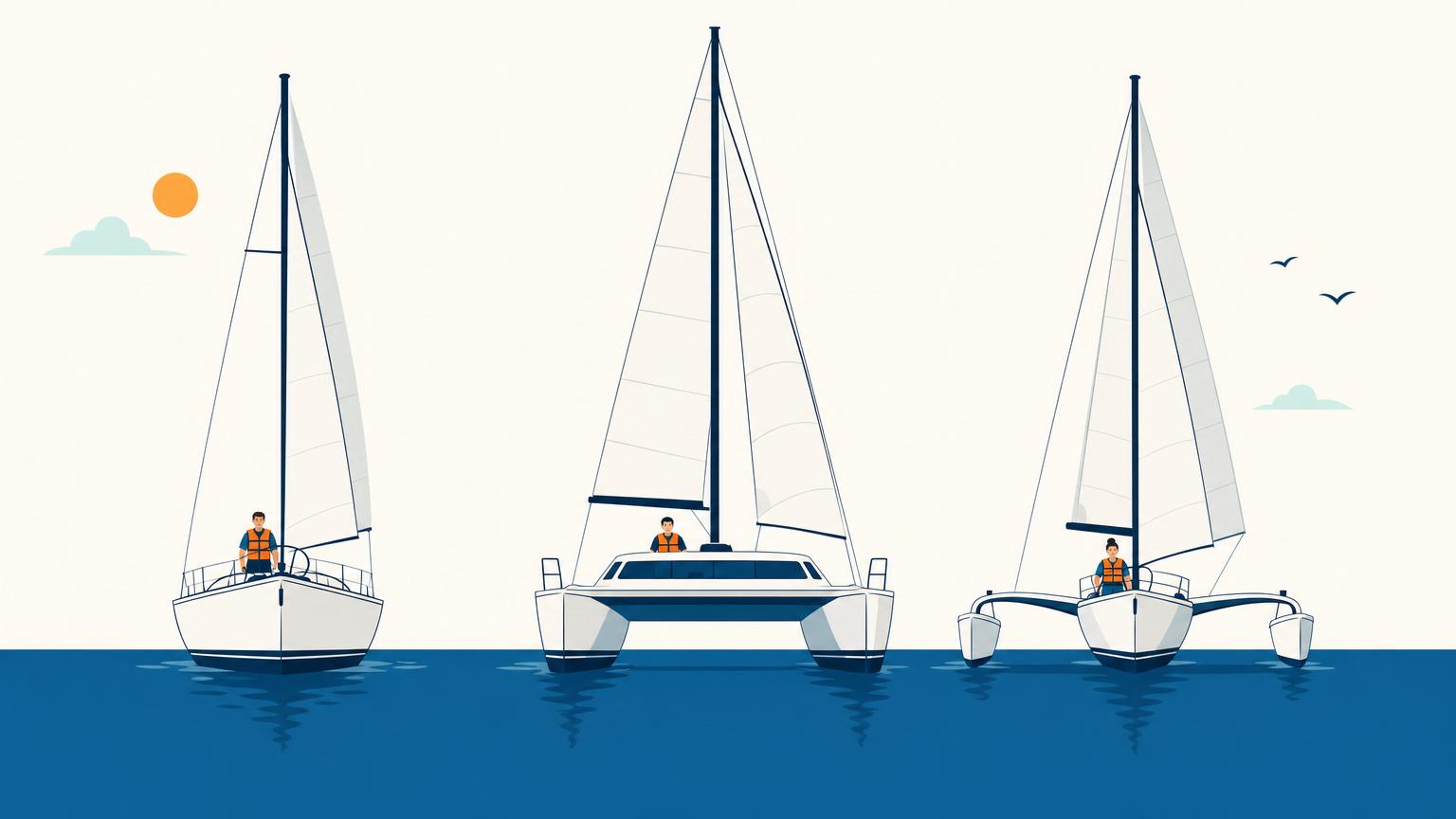
Start with the shapes touching the water. A monohull has one hull. This is the familiar single-body shape you may picture when you hear "sailboat."
A boat with more than one hull is a multihull. A catamaran, often called a cat, has two parallel hulls joined by a deck or a flexible platform. From the dock, you will notice the open space between the hulls and the boat's wide stance. Because the hulls sit far apart, they resist rolling and help the boat stay relatively level.
That steady appearance does not mean a catamaran cannot capsize. In some conditions, any multihull can tip far enough to turn over, and when it does, the tipping point can arrive with little warning, since a multihull's righting strength falls away quickly once it heels past a certain point, rather than fading gradually the way a keelboat's does.
Multihulls also sit differently in the water than a monohull of similar length. Without a deep, heavy keel to carry, a catamaran typically has less hull volume and a shallower draft, and it tends to sail faster off the wind. Some trimarans fold their outer floats in against the main hull, narrowing the boat enough to fit a marina berth or a trailer that a fixed-width multihull could not use.
A trimaran has three hulls: one main hull in the middle and two smaller side hulls, sometimes called floats. So your first sorting question is simple: do you see one hull, two, or three? Within each hull count there are still hundreds of individual boat designs, usually called classes, so hull counting sorts the crowd into three groups rather than naming any single boat. Catamaran vs Monohull for Beginners goes deeper into how that choice changes the sailing experience once you are past simply naming the hulls.
Does It Have a Keel or Centreboard?
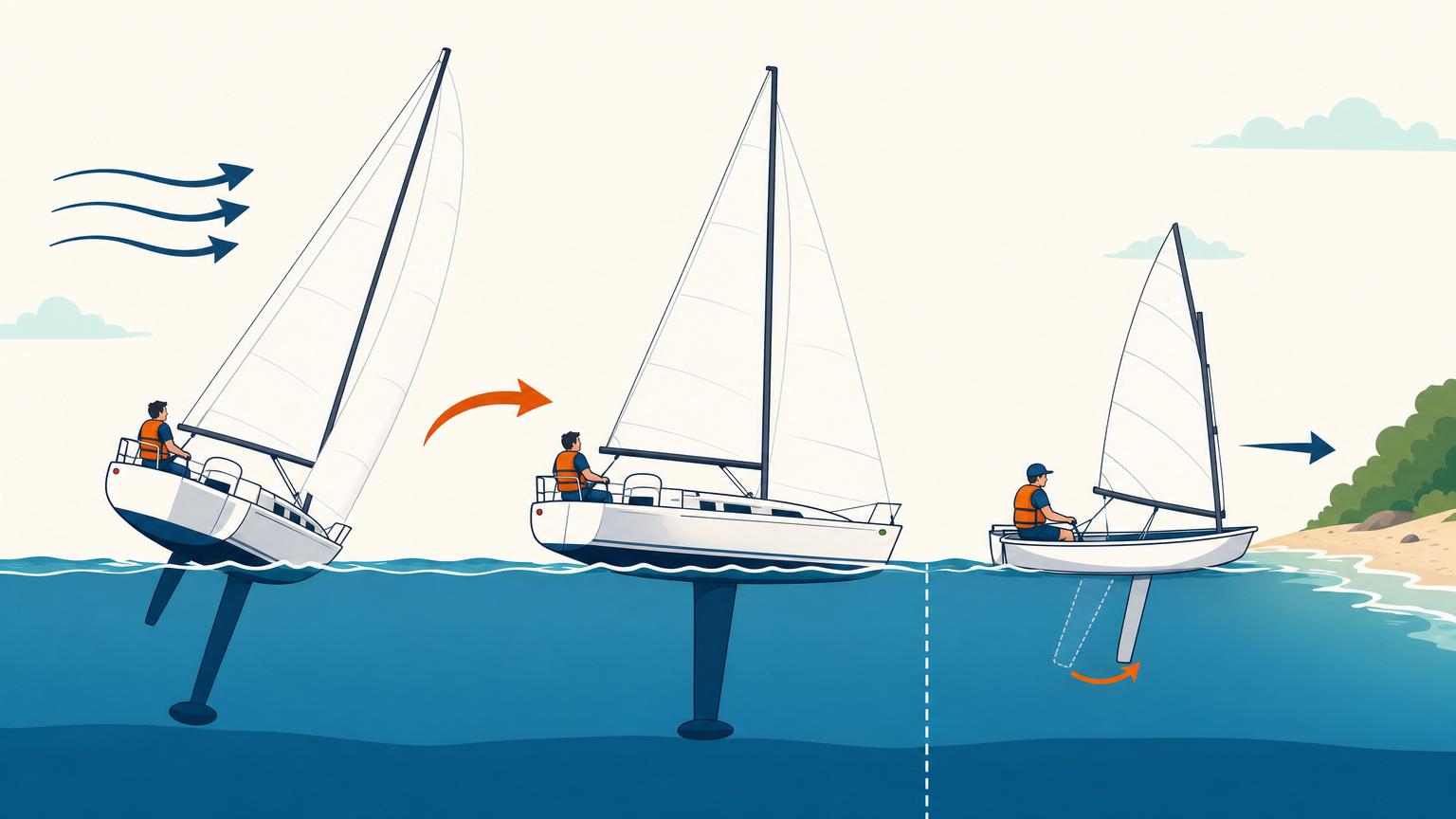
Among common types of sailboats, a larger boat kept in the water at a mooring or marina is often a keelboat. A fixed keel hangs below its hull. It resists sideways slipping and carries heavy ballast, usually iron or lead. When wind makes the boat lean, that weight helps it settle back upright. It also makes the boat hard to capsize and more forgiving for newer sailors across a range of wind conditions.
A keel does more than hang there for weight, too. On a modern boat it is shaped like an airfoil, the same curved cross-section an aircraft wing uses, so that water flowing past it generates lift rather than plain drag. That lift is part of what lets a keelboat point closer to the wind instead of simply being pushed sideways by it.
A sailing dinghy is a small, light sailboat without a weighted keel. Instead, it uses a retractable centreboard (spelled centerboard in the US) to resist sideways slipping. The crew provide "live ballast" by sitting out on the edge to balance the wind's force. Dinghy vs Keelboat for Beginners compares the two directly if you are weighing which is the better place to start lessons. Note that "dinghy" has a second, unrelated meaning too: sailors also use it for the small tender that rows or motors an anchored crew ashore, so a sailing dinghy and a dinghy tied astern of a yacht are not the same boat.
From a beach, you launch with the board raised, then lower it when the water is deep enough. You raise it again when you return to shallow water or pull the boat onto a trailer. Some boards pivot; a daggerboard, a type of retractable board, slides vertically.
That sequence is worth watching once, because the order matters. A crew rigs the sail with the board and rudder blade both raised, wades the boat out past the shorebreak, and only lowers the board once the water is deep enough for it to hang clear of the bottom. Lower it too early over a shallow patch and it drags or fouls; lower it too late and the boat keeps slipping sideways instead of holding a course. Once it is down at the right depth, the boat stops sliding downwind and starts sailing.
This distinction is useful, not absolute. Some monohulls have retractable keels or boards, and a few boats called dinghies have weighted keels.
What Does a Sloop Rig Look Like?
A rig is the arrangement of a boat's mast and sails. It gives you a third way to recognise and name types of sailboats, and it is the newer of the three labels: before the nineteenth century, most vessels were described mainly by their hull, not their rig.
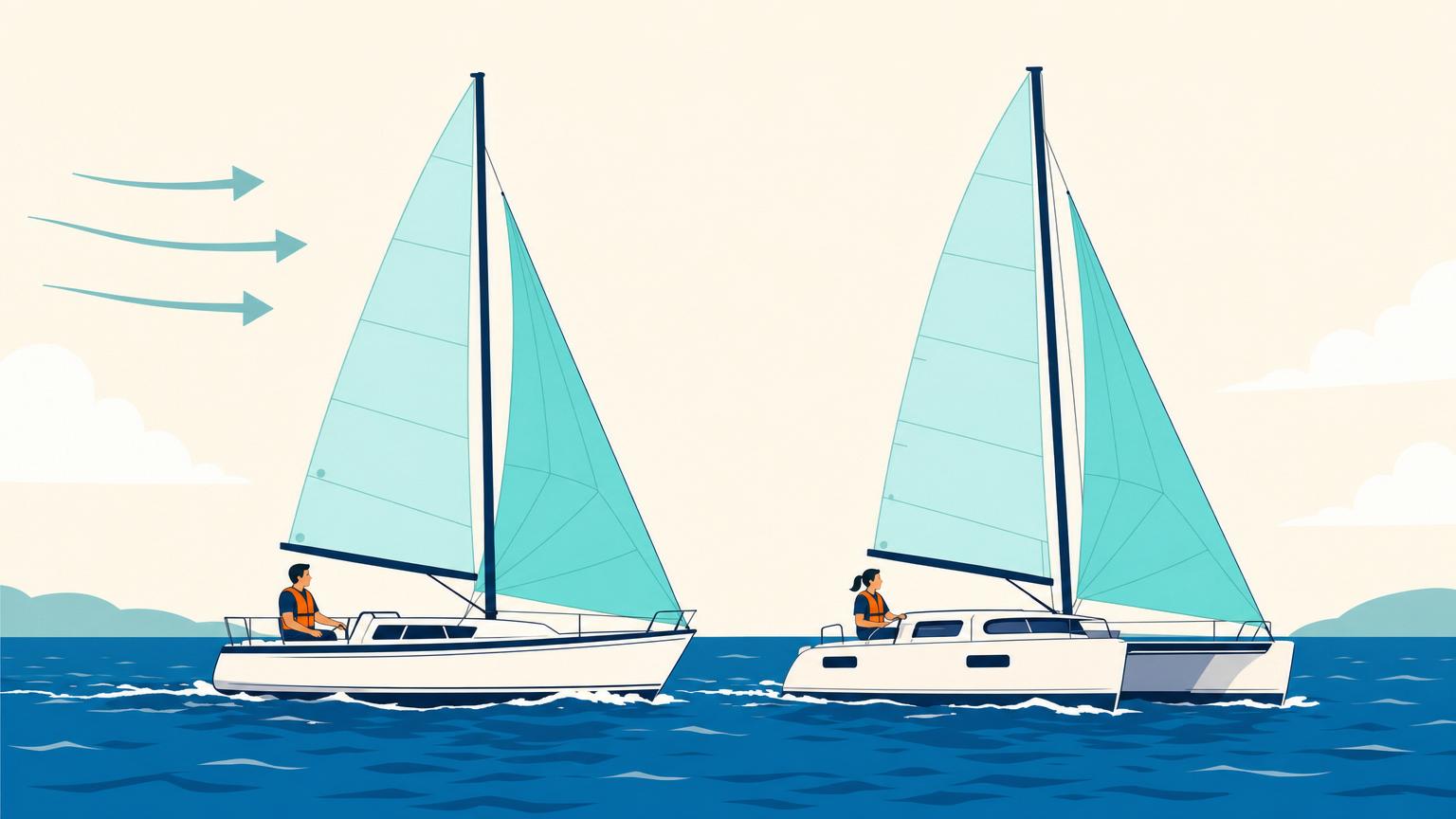
The most useful pattern to learn first is the sloop. From the dock, look for three things: one mast, one headsail set forward of the mast, and one mainsail behind it. On most modern sailboats, the mainsail is the tall triangular sail. With one mast and two principal sails, the sloop is common and relatively simple to handle.
Rig names do not tell you how many hulls a boat has or what sits below the water. Those are separate descriptions. A monohull, catamaran, or trimaran can carry a sloop rig. That is why monohull sloop is a normal phrase: the first word describes the hull, while the second describes the mast-and-sail arrangement.
You will also hear rig names such as cutter, ketch, yawl, and schooner. A quick field guide helps put names to the shapes without memorising them. A cutter looks like a sloop with an extra headsail, carrying two or more sails forward of a single mast instead of one. A ketch or a yawl adds a second, shorter mast behind the main one. A schooner also carries two or more masts, but arranges them the other way round, with the forward mast the shorter of the pair. None of that changes how you name the hull beneath any of them, since a monohull can carry a sloop, cutter, ketch, yawl, or schooner rig just as easily as a catamaran can. For a beginner, recognising the common sloop pattern is a strong place to start, and Types of Sails Explained is the natural next stop once you want to tell the sails themselves apart.
You can now sort the common types of sailboats with three simple clues. First, count the hulls (the main bodies that sit in the water) to spot a monohull, catamaran, or trimaran. Next, look underneath: a keel is a fixed, weighted part below the hull, while a centreboard is a light board that can lift into the boat. Then note the rig, meaning the arrangement of mast and sails. A sloop has one mast, with a mainsail behind it and a headsail in front. These labels answer different questions, so one boat can be both a monohull and a sloop. You do not need to memorise a full catalogue; count the hulls, check what is below, and notice the sails. Sailboat vs Yacht vs Ship is worth a look next if you are also trying to sort out that separate naming question. To keep building the picture, try SailStarter's short beginner lessons on hulls, keels, and sails.
Try it from the lesson
Can you spot the next move?
A wide sailboat glides past on two side-by-side hulls, barely leaning at all. What type is it?
Why you can trust this guide
. We build each guide from public seamanship and safety sources, then teach the universal principle before any local difference.
- discoverboating.com
- americansailing.com
- americansailing.com
- ussailing.org
- rya.org.uk
- sailamerica.com
- en.wikipedia.org
- en.wikipedia.org
- en.wikipedia.org
- en.wikipedia.org
- en.wikipedia.org
- en.wikipedia.org
- en.wikipedia.org
- en.wikipedia.org
- uksailmakers.com
- cautionwater.com
- yachtingworld.com
- yachtingworld.com
- activesgcircle.gov.sg
- practical-sailor.com
- katamarans.com
- gobroadreach.com