Chart your course
The Beaufort Scale for Sailors

Quick answer
The short version
The Beaufort scale turns wind speed into a force number, 0 through 12, so you can read how hard it's blowing by looking at the water instead of checking an instrument. Sailors measure wind in knots (one knot is about 0.5 meters per second, or about 1.15 mph) and every Beaufort force ties a knot range to what the sea itself looks like at that strength. The single skill worth learning first: whitecaps don't exist below Force 3 (7-10 knots). Spot even a couple of white crests out there and you already know the wind has climbed past Force 2, gauge or no gauge. The cited sailing school recommends Force 2 to Force 3 (roughly 4-10 knots) for beginners; Force 4 is a reef-aware transition, and Force 5 (17-21 knots) calls for reefed sail and experienced handling in that guidance.
"15 knots" means nothing until you can feel it, or see it. A forecast's wind figure is a sustained average for a whole zone, checked before you ever leave the dock. The Beaufort scale reads the opposite direction: the force actually happening around the boat right now, off the water itself, no gauge required. That matters more than it sounds like it should, because wind doesn't just get stronger and weaker out there: how strong it feels aboard changes with your own course. Sail off on a broad reach in a building breeze and the whole outbound leg can feel gentle. Turn around to beat back home in that exact same wind, and it can suddenly feel like a different, harder day of sailing. The wind never changed. Only your course relative to it did.
Reading the Water: When Whitecaps Start
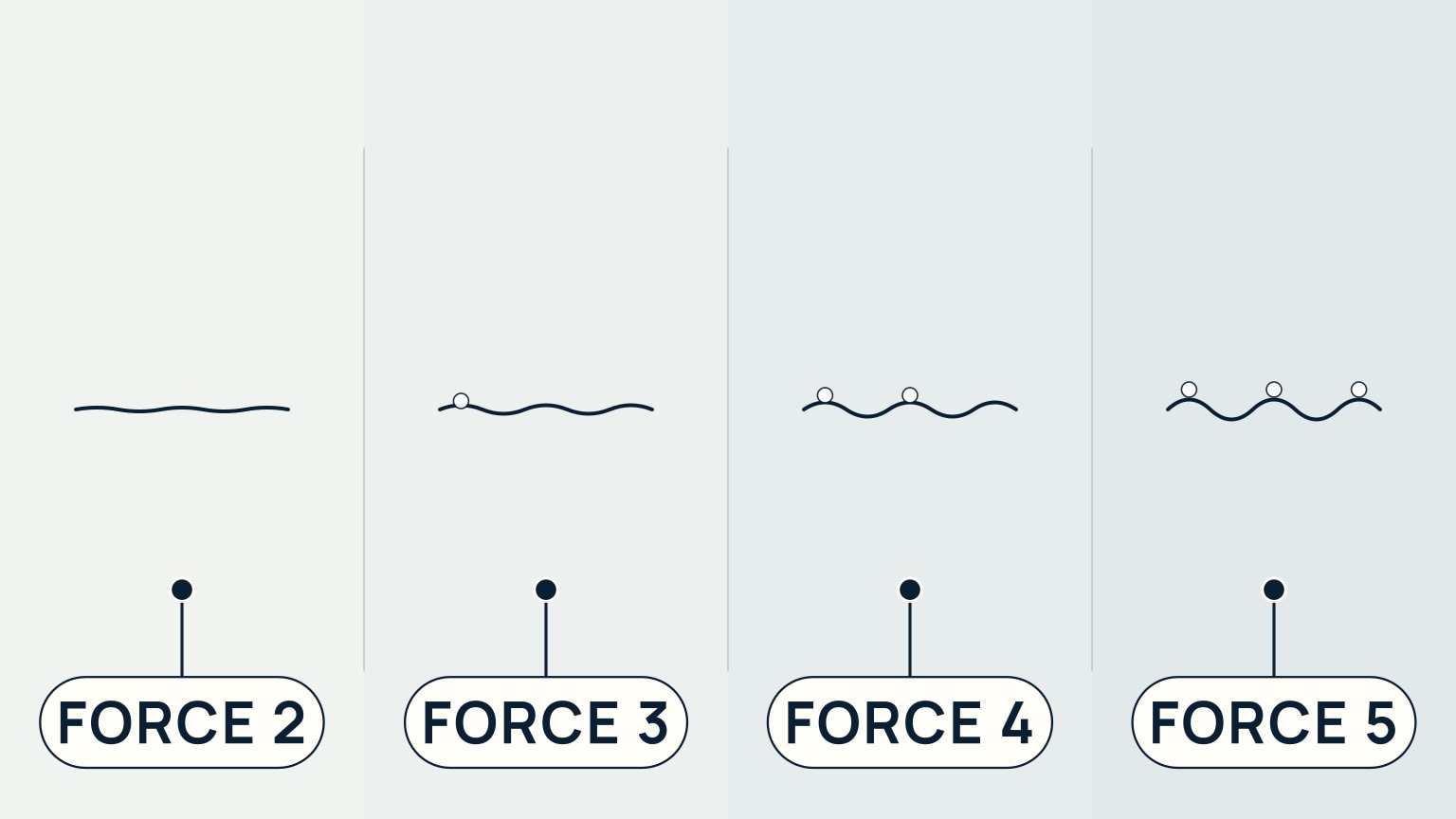
The Beaufort scale runs from Force 0 (calm, 0-1 knot, "sea like a mirror") up through Force 12 (hurricane, 64 knots and climbing), with every step between tied to a fixed knot band and a plain description of what the sea looks like at that strength. You don't need all thirteen memorized to put the scale to use. What you do need is the one transition that changes how a beginner should read the water: whitecaps.
Below Force 3, there's simply no foam to see: at Force 0 through Force 2 (0-6 knots), even the small wavelets keep a glassy, unbroken crest. Force 3 (7-10 knots) is where that stops being true: the official description names "scattered white horses" for the first time, still few and far between. Keep climbing and the coverage climbs with it: "fairly frequent" by Force 4 (11-16 knots), "many" by Force 5 (17-21 knots). Because that jump from zero to a few whitecaps happens at one specific, narrow threshold, it works as a live check on conditions in a way a single glance at flat-looking water never could.
The Beginner Band and the Reef-Early Line
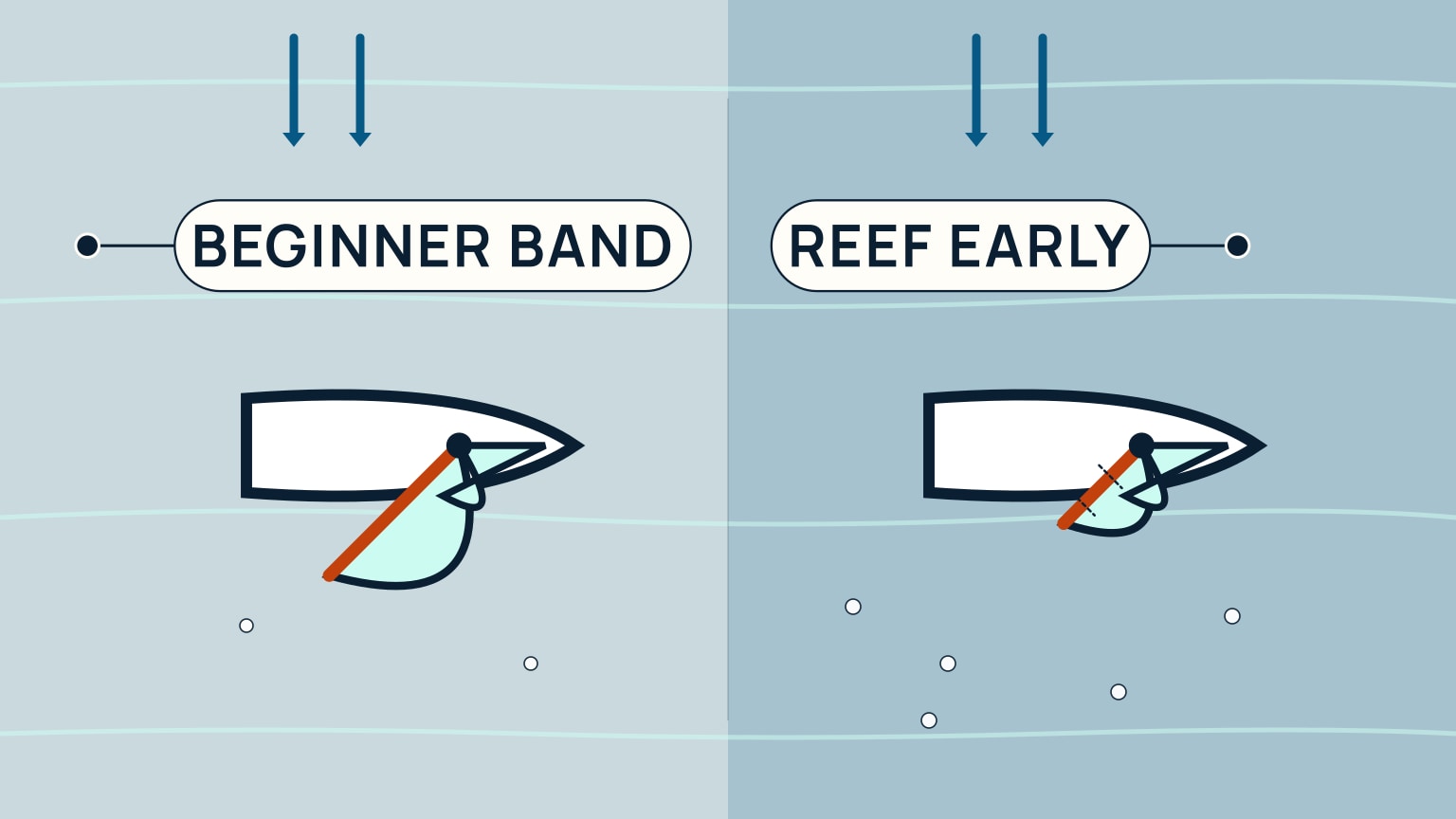
The cited sailing school recommends Force 2 to Force 3 (roughly 4-10 knots) as its ideal beginner range. Force 4 (11-16 knots) is a transition, not an extension of that band: around 15 knots, many boats are already reefed or seriously considering it. At Force 5 (17-21 knots), the school calls for reefed sail and experienced handling, and conditions keep getting more serious from there.
Nobody regulates this: it comes from teaching experience, not a published standard, and it shifts with the specific boat, crew, and stretch of water. A light dinghy and a heavy cruising keelboat simply don't run out of comfort at the same wind strength. Use Force 2-3 as that source's starting point for learning, treat Force 4 as the range where reefing may already enter the plan, and never turn any band into a target to push right up against.
Why the Ride Home Can Feel Like a Different Wind
Turn the scale into a trip plan
Read the forecast first, then use the water as a continuing check. Write down the expected wind range and the strongest part of the forecast before leaving. On the boat, compare that plan with the first clear patch of open water you can see. Smooth crests point toward Force 2 or less. The first scattered whitecaps place the scene around Force 3. Frequent white crests move the estimate into Force 4, while many whitecaps are consistent with Force 5. You are looking for a band, not trying to assign a perfect number to every gust.
Make the same observation after a course change. If the boat feels much livelier when you turn upwind but the pattern of whitecaps has not changed, apparent wind explains much of the difference. If both the ride and the sea surface become more active, the true wind may also be building. The companion guide to true and apparent wind explains why those two observations can disagree.
Use three checkpoints on a short sail: just outside shelter, at the farthest point from home, and before the return leg. At each point, note the force band, your course, the sail carried, and whether steering still feels easy. That short record is more useful than remembering that the day felt “windy.” It also helps you spot a steady rise from scattered to frequent whitecaps before the return becomes hard work.
Common reading mistakes
Do not judge the whole area from the protected water beside a dock or behind a headland. Compare several open patches because shelter can hide the sea state you will meet farther out. Do not treat one breaking wake as a whitecap either. A useful Beaufort observation comes from the repeated surface pattern away from boat wakes.
The scale also does not choose a reefing point for your boat. The cited beginner and reefing bands are guidance from sailing schools and sailmakers, not universal limits. Boat size, sail plan, crew, water, and route all change the decision. If the surface is moving toward Force 4 and the upwind return is still ahead, shortening sail early may be the calm choice. If fast-changing clouds or sharp gusts accompany the increase, use the separate squall guide rather than relying on the Beaufort number alone.
Keep the scale descriptive. “Force 3, scattered whitecaps” tells the next crew member what you observed. “It seems fine” does not. That plain observation makes it easier to compare the next checkpoint and decide whether conditions are steady, easing, or building.
Add the observation time, location, and course so it still makes sense later.
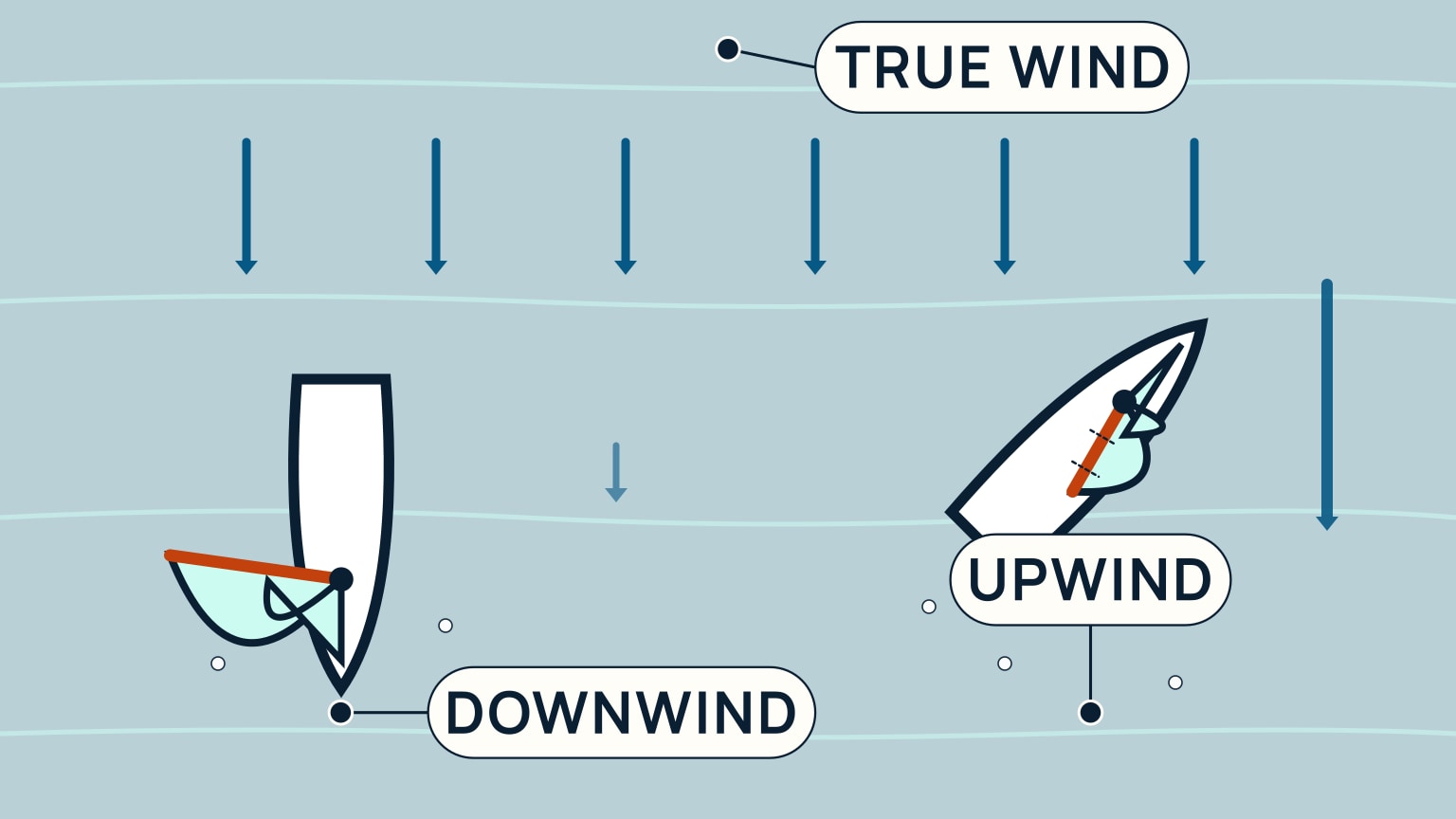
The Beaufort scale alone cannot show how hard the wind will feel aboard. That depends on your course as well as the true wind: your boat's own forward motion adds to the wind you feel heading upwind, and subtracts from it heading downwind. Run or reach off in a building breeze and the outbound leg can feel calm the whole way. Turn around to beat home in that same true wind, and it's suddenly a harder, louder sail: apparent wind is now adding to what's blowing, instead of hiding part of it.
That's also why a boat typically carries more sail comfortably off the wind than it can upwind. The instant you bear away from close-hauled, the sail's forces rotate forward and the heeling load starts dropping; keep bearing away and the swing gets dramatic: one sailmaker's worked example has a boat's felt wind force climbing by more than 2.5 times when it rounds up from a dead run to a course just 60 degrees off the bow, since wind's push scales with the square of its speed, rather than speed alone. Run that logic the other way and it's why experienced heavy-weather sailors often bear away before reefing rather than after: turning downwind buys easier conditions to work in, instead of fighting the sail down while still loaded up hard on the wind. Skip that step and you get the classic beginner trap: a calm-feeling run out with the sail plan you started with, and a beat home in the identical true wind that suddenly needs a reef you never planned for.
The Beaufort scale won't replace a forecast, and it isn't a substitute for reefing early when conditions ask for it. What it gives you is a way to keep checking your own read of the wind against what the water is actually telling you, all day, without needing an instrument in your hand. SailStarter's lesson on wind and the Beaufort scale walks through the same force-by-force scale as a tap-through interactive, plus the apparent-wind mechanics behind the upwind/downwind trap. Worth a look before your next sail.
Try it from the lesson
Can you spot the next move?
You're watching the water and spot the first few scattered whitecaps on an otherwise smooth-looking sea. What Beaufort force are you most likely already in?
Why you can trust this guide
. We build each guide from public seamanship and safety sources, then teach the universal principle before any local difference.