Chart your course
Boat Navigation Lights: What Red, Green, and White Mean
Quick answer
The short version
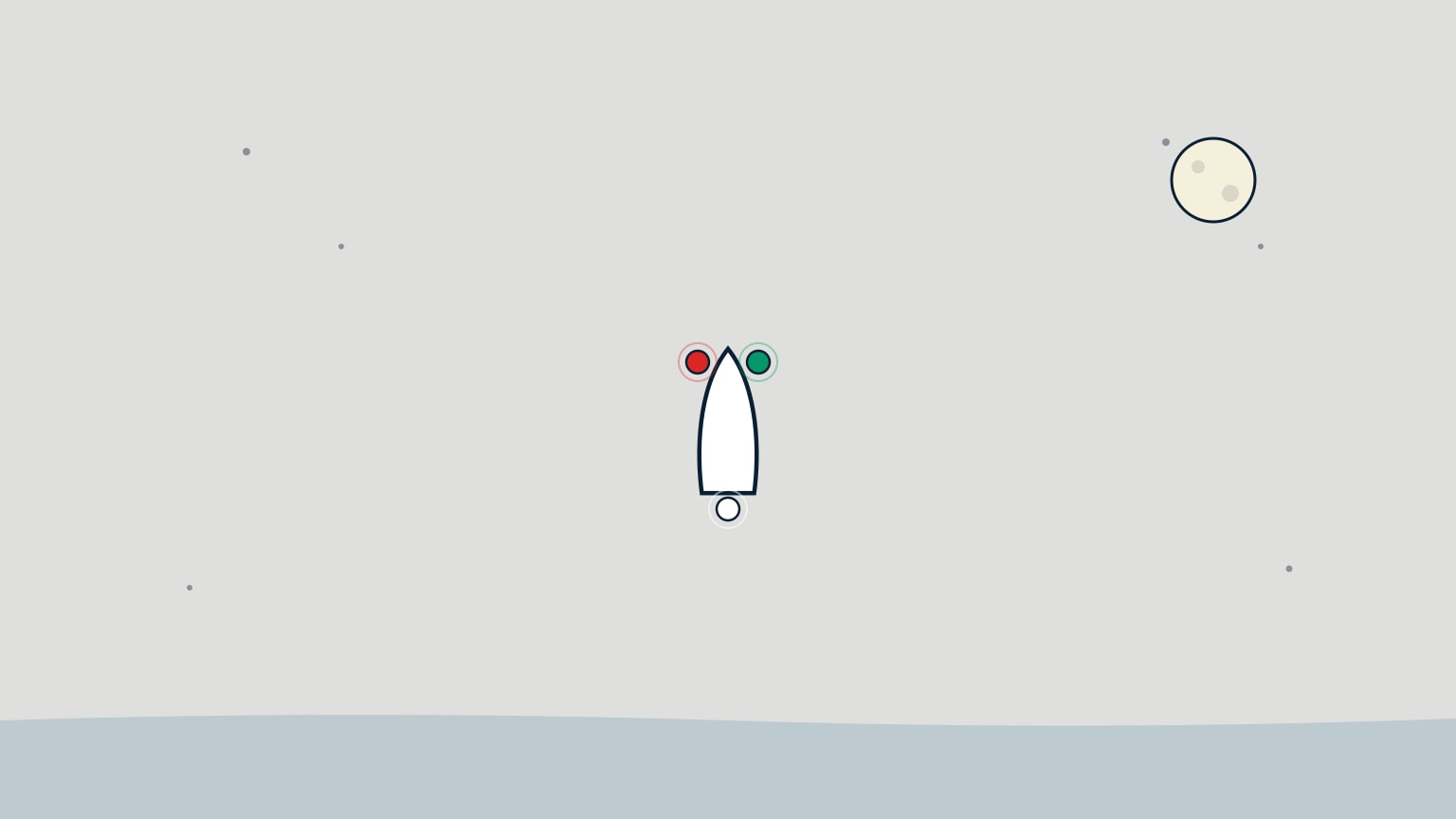
A vessel's navigation lights are simpler than the tangle of colours suggests. Her red light always marks her port (left) side and her green light always marks her starboard (right) side, each shining across a 112.5-degree arc from dead ahead back to just past her beam. A white sternlight covers the 135 degrees behind her. See red and green together and she's heading roughly toward you, bow-on. See only green and you're on her starboard side, watching her cross from your left to your right; only red, and you're on her port side, crossing from your right to your left. A power-driven vessel adds a second white light, the masthead light, forward; a sailing vessel under sail alone never shows it. A single white light with no colour beside it usually means you're overtaking her, or she's riding at anchor.
Every light pattern on the water at night is really the same four shapes, worn differently by different vessels. Once you know the four arcs COLREGs defines, and what a power-driven vessel shows compared with a sailing vessel under sail alone, a stranger's lights stop being a guessing game. This guide walks through the building blocks, the one light that separates power from sail, the aspect-reading skill that turns colours into bearings, and the one case (a lone white light) that needs a second look before you act on it.
The Building Blocks: Four Lights, One Horizon
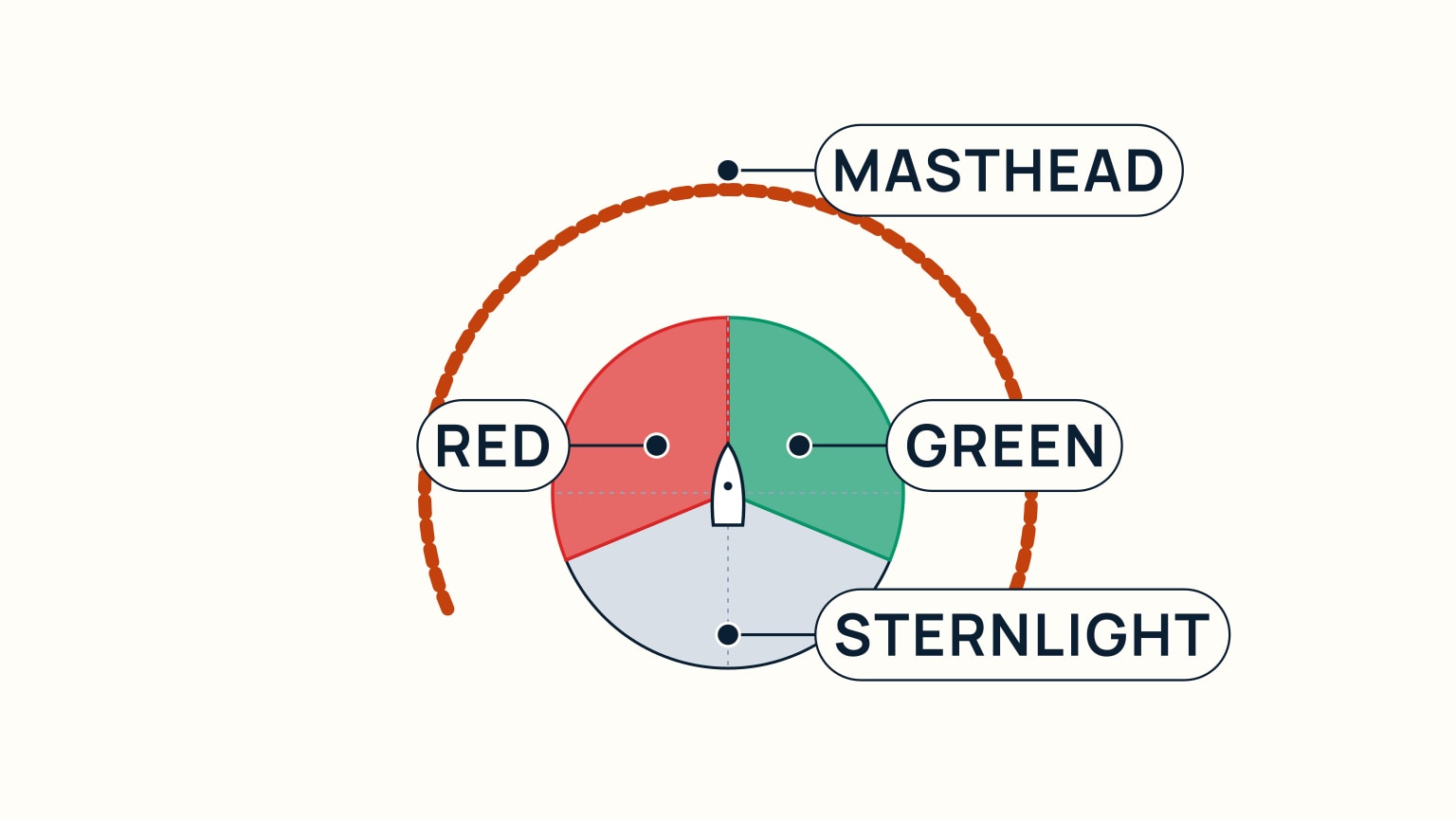
COLREGs Rule 21 defines a vessel's running lights as fixed arcs, not vague glows. Sidelights: a green light on the starboard side and a red light on the port side, each an unbroken 112.5-degree arc running from dead ahead back to 22.5 degrees past that side's own beam. A sternlight: white, centred dead astern, an unbroken 135-degree arc. Add those three arcs together (112.5 plus 112.5 plus 135) and they total exactly 360 degrees: every bearing around a vessel falls inside exactly one of them, with no gap and no overlap.
A fourth light, the masthead light, is a separate white light on the centreline, showing across 225 degrees: the same combined forward span the two sidelights already cover between them. It sits on a different, usually higher fitting, and which vessels show it is the next question.
Power-Driven vs. Sailing: Who Shows the Masthead Light
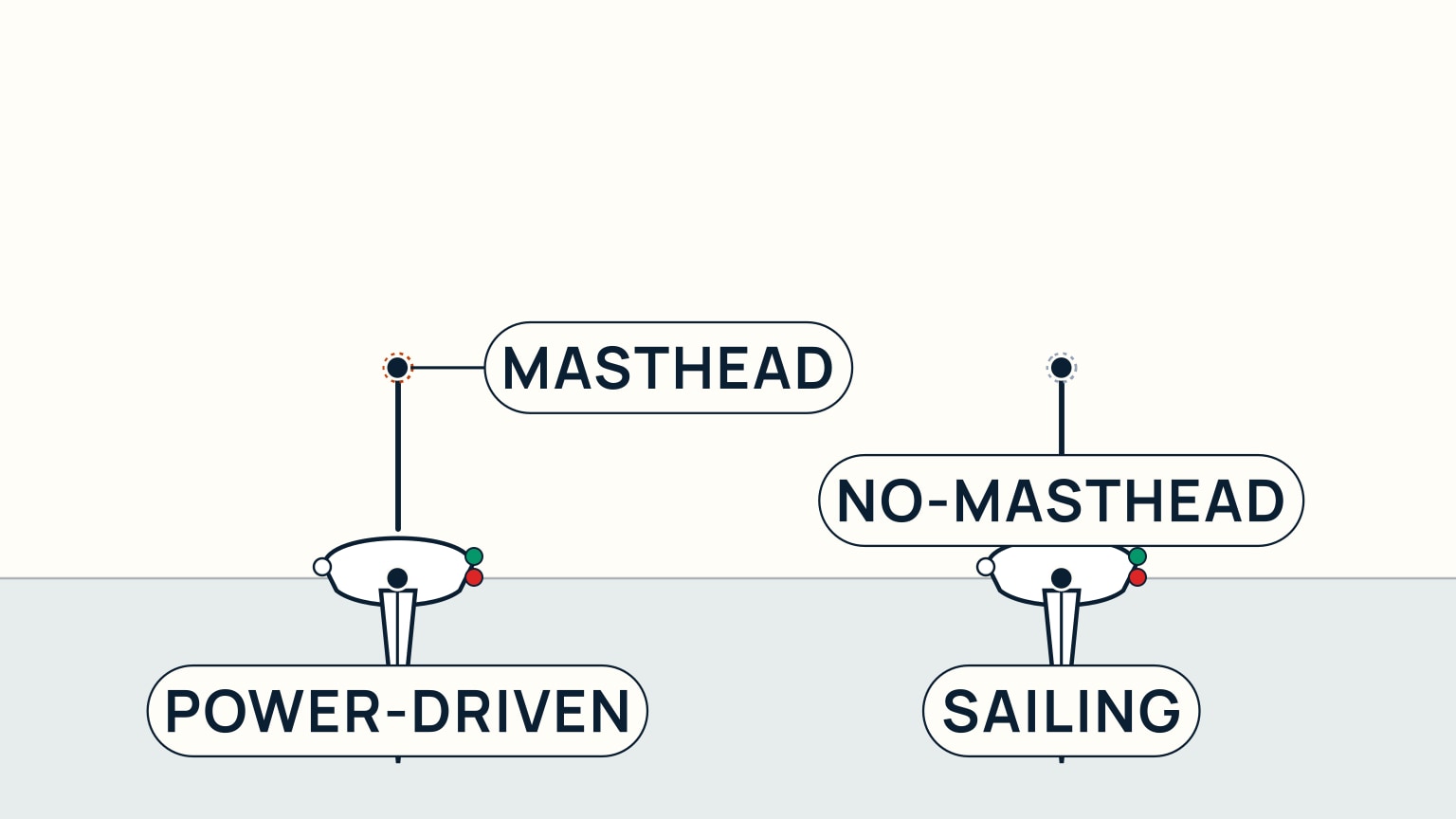
The masthead light is where a power-driven vessel and a sailing vessel underway part ways. Rule 23 has a power-driven vessel show that masthead light forward, plus her sidelights and sternlight. Rule 25's basic required set for a sailing vessel is sidelights and a sternlight, without that white masthead light. That missing light is what separates the two basic patterns at night.
A sailing vessel under 20 meters may combine her sidelights and sternlight into one lantern at or near the top of the mast instead of three separate fittings: the small-sailboat "tricolor" option, doing the same job from one spot high up where it's easiest to see.
None of this depends on whether sails are hoisted. The instant a vessel's engine is doing any of the driving, she counts as power-driven and shows the masthead light. A motor-sailing boat carries the extra light as well as the lights she would show under sail alone.
Reading Another Vessel's Lights: Her Aspect at a Glance
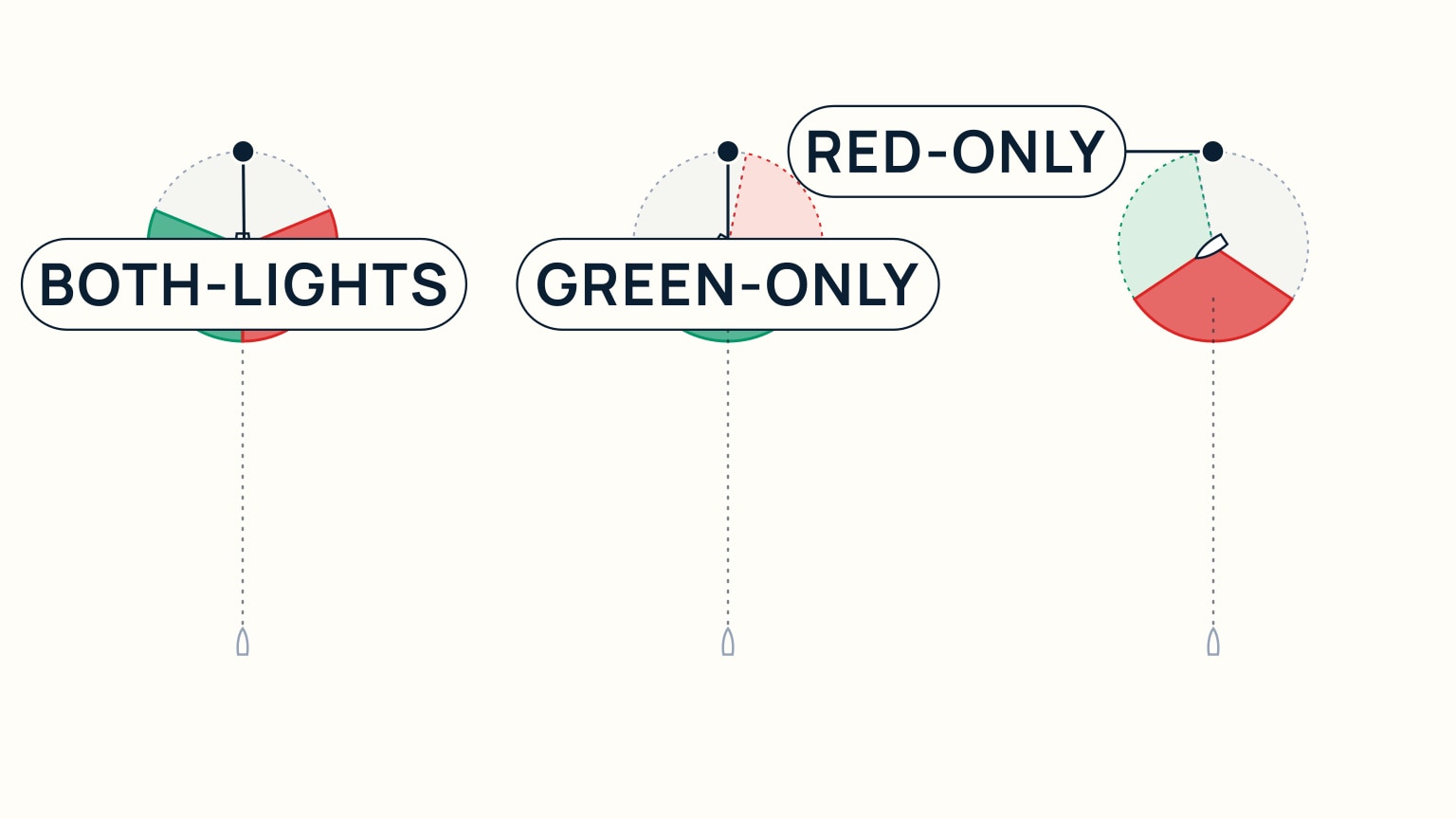
Knowing the arcs matters because they let you read another vessel's aspect (which way she's actually pointing) from nothing but colour. The two sidelight arcs share exactly one boundary, dead ahead, and nowhere else. So seeing her red and green together means your own bearing sits right at that shared point: she's roughly bow-on, heading toward you.
Seeing only her green light means your bearing falls inside her starboard sidelight's own arc and nowhere near her port one: you're on her starboard side, watching her cross from your left to your right. Seeing only red is the mirror case: you're on her port side, watching her cross from your right to your left. Neither case depends on distance or vessel type; it's pure geometry, the same for a dinghy or a freighter.
This is the one place a mix-up is costly: her red is always port, her green is always starboard, full stop, regardless of which way she happens to be heading relative to you.
A Single White Light: Overtaking or Anchored?
A lone white light, with neither sidelight showing, means your bearing falls entirely inside her sternlight's 135-degree arc, more than 22.5 degrees abaft her beam on either side. That's the same sector COLREGs' own overtaking rule defines: you're catching up on her from behind, or she's simply moving away on a similar course.
That same lone white light has a second, ordinary explanation: an anchored vessel shows an all-round white light instead of any running light. It is visible from every direction rather than confined to one 135-degree wedge. Bearing alone cannot tell the two apart, because both appear as a white light without colour. Whether the vessel is moving separates an overtaking situation from an anchored one, so keep watching and compare the contact with the chart where appropriate.
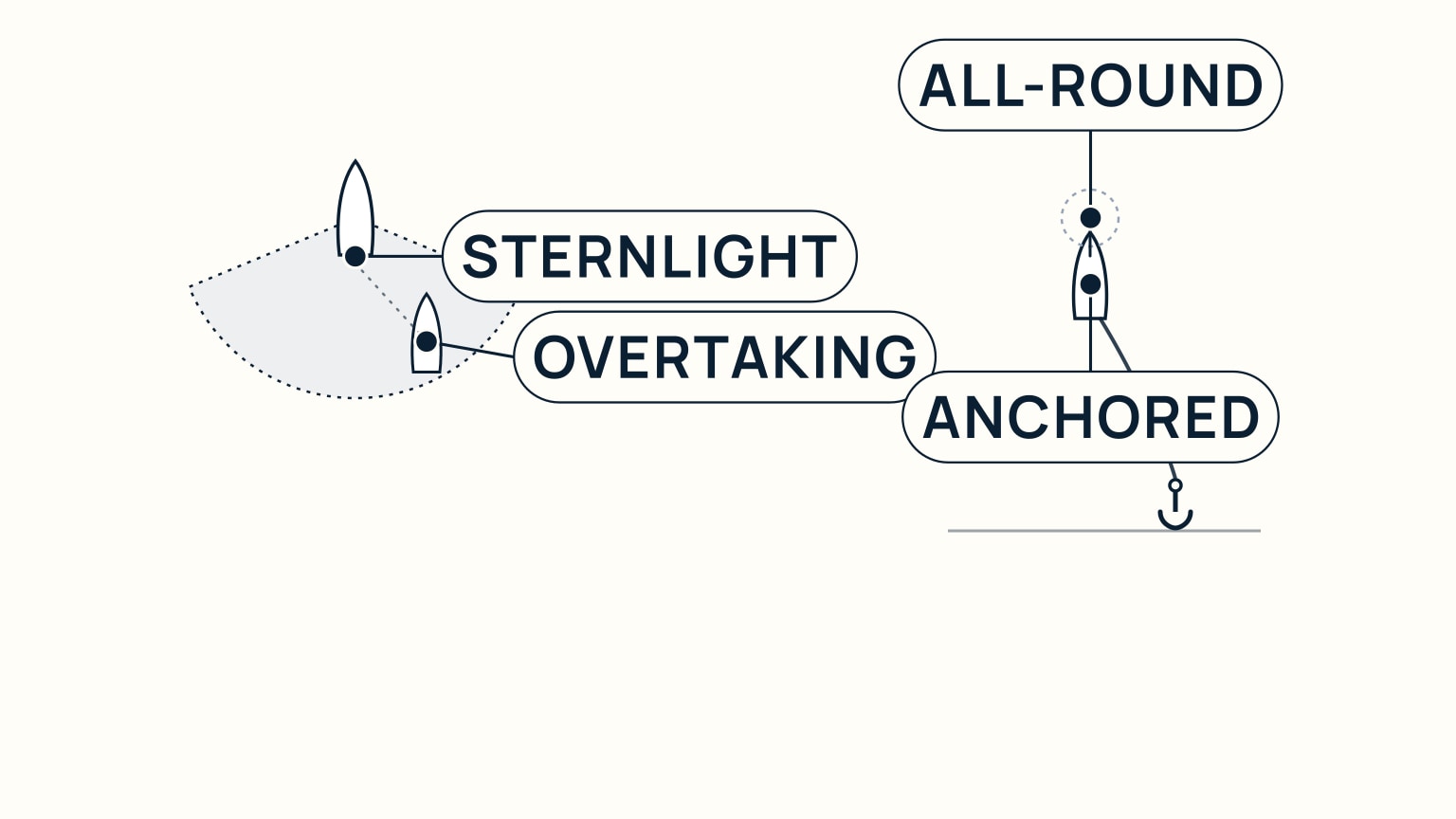
Read a light as a changing observation
A single glance gives you a clue, not a complete traffic picture. Keep watching while you identify the colours, their position relative to each other, and whether the bearing changes. Red alone places you on the other vessel's port side. Green alone places you on her starboard side. Red and green together put you near her bow aspect. A low white light without colours can be a sternlight, while an all-round white light can mark an anchored vessel.
Now connect the observation to time. If a white light keeps a fixed place against the background while your own boat moves, compare it with the chart and continue watching. If coloured sidelights appear, disappear, or swap as the vessel turns, update your picture. Lights describe the vessel's displayed aspect at that moment. They do not tell you that her course will remain unchanged.
Practise without inventing a rule
Use four cards for practice: red, green, red plus green, and white. For each card, say what you can infer and what you still need to observe. This keeps recognition separate from collision-avoidance decisions. "Green means her starboard side" is a sound observation. A complete avoiding action still depends on the full situation and the navigation rules, not the colour alone.
Add the difference between sailing and motoring. A vessel using sails and also being propelled by machinery counts as power-driven under the rules, so her displayed lights follow that status. That is why you should identify the light pattern instead of guessing from a dark sail outline. The night sailing guide explains how to combine light recognition with a deliberate lookout and safe speed.
Check your own boat before darkness
Walk around the boat while there is still daylight. Locate both sidelights, the sternlight, the masthead light used under power, and the anchor light arrangement. Check the controls and the boat's instructions. From the dock, look for anything that could block a light from the angles where it must be seen. A working lamp hidden by equipment does not give another vessel the intended picture.
Then rehearse the change of status. Ask which lights should be shown while sailing, while motoring, and while anchored. Small-vessel arrangements can differ within the rules, including combined lanterns, so learn the installation on the boat you use. If you are also learning the side names, review port and starboard until red-port and green-starboard no longer need a rhyme. The goal is quick recognition backed by continued observation, not a one-colour shortcut.
Four arcs, two vessel types, and one aspect-reading method cover the basic pattern: red to port, green to starboard, white astern or all-round, and a masthead light that only a power-driven vessel adds. SailStarter's lesson on this topic lets you tap through the same four arcs and a set of night-scenario cards until reading a vessel's lights feels as familiar as reading her hull shape by day.
During practice, change only one part of the scene at a time. Rotate the target boat, hide one colour, or replace a sternlight with an all-round light. Say what the new view supports and what still needs observation. This is more reliable than memorizing a picture without understanding its viewing angle.
Repeat the exercise until the side and light can be named without turning away from lookout.
Try it from the lesson
Can you spot the next move?
You see red and green lights together, close to one another. What does that tell you?
Why you can trust this guide
. We build each guide from public seamanship and safety sources, then teach the universal principle before any local difference.