Chart your course
Catamaran Docking for Beginners
Quick answer
The short version
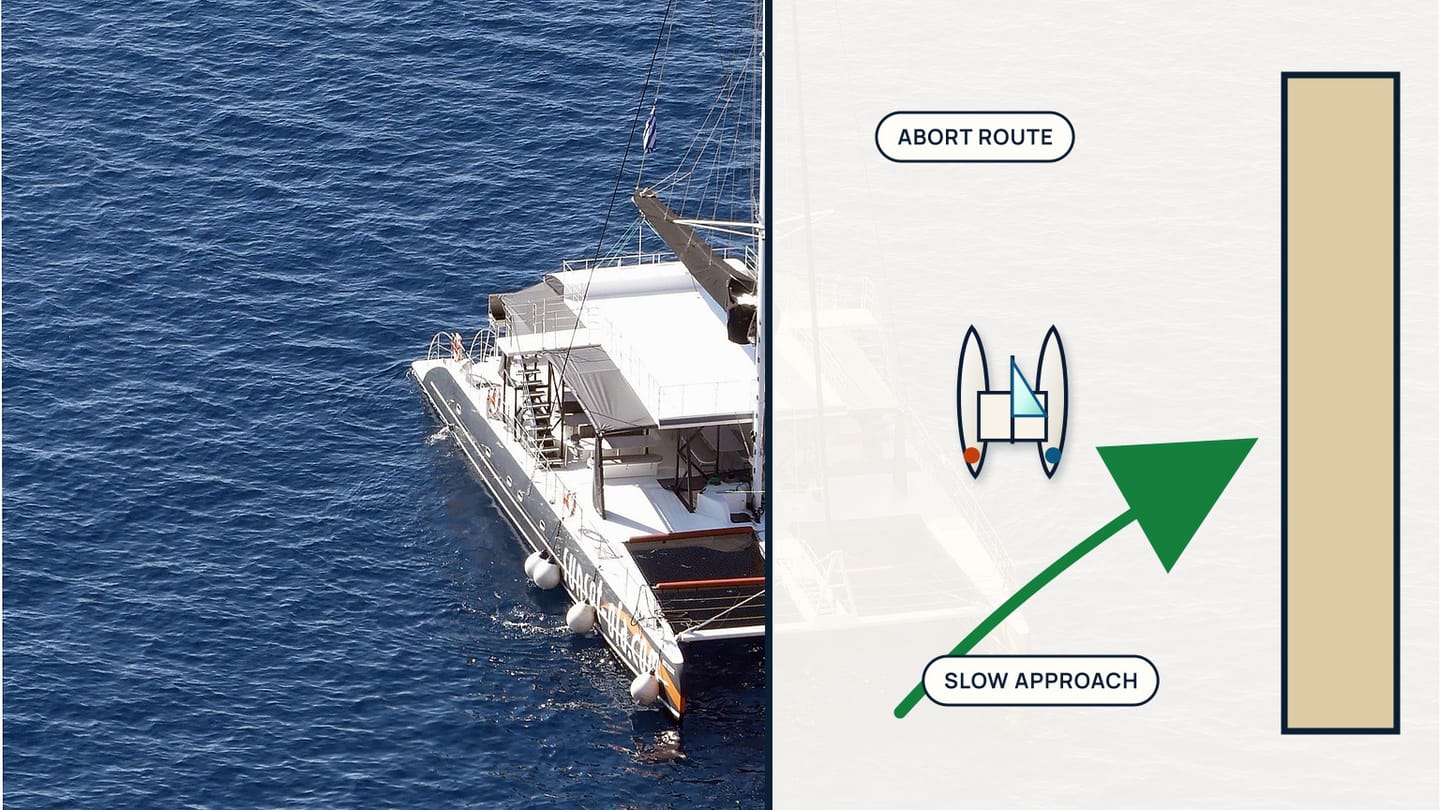
Dock a catamaran by planning the forces before using the throttles. Many cruising cats have widely spaced twin engines, so differential thrust can turn the boat at low speed. Their wide beam and large cabin also create windage and blind areas that matter near a berth. Prepare fenders and named lines, test engine response in open water, choose an approach that controls the stronger of wind and current, move slowly enough to stop, and keep an abort lane. If position or communication breaks down, return to open water and reset.
Twin engines are useful, not magical. Reverse thrust may differ from forward thrust, steering response varies by propulsion layout, and wind can move a high-sided cat sideways while the skipper watches the bow. Learn the exact boat with an instructor before entering a tight marina.
Use this guide with how to dock a sailboat, how to use spring lines, and marina etiquette for beginners. Harbour rules, berth hardware, and hand signals vary. Confirm the local arrangement and the skipper's commands.
Prepare crew, fenders, and the berth
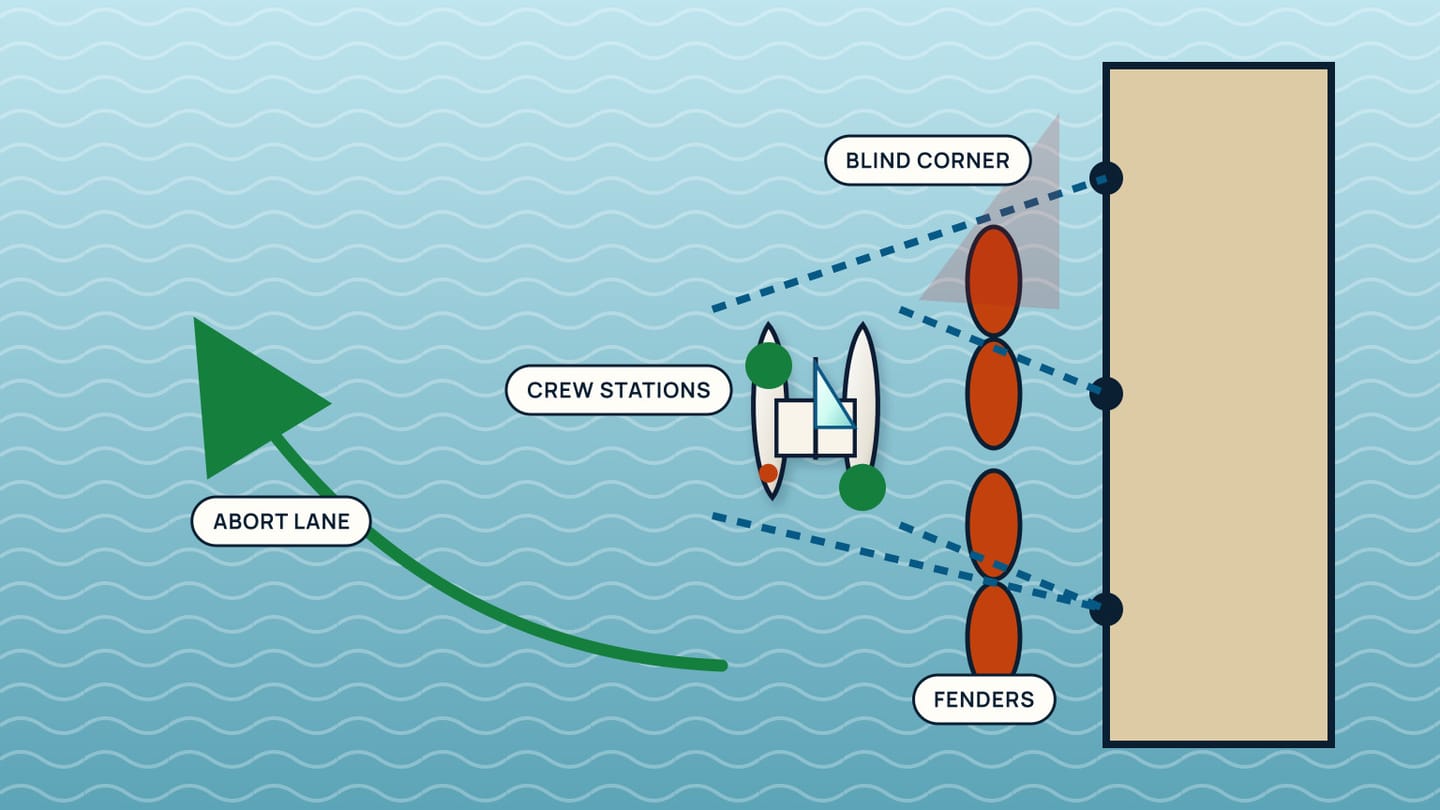
Study the berth from a distance. Note which side will lie alongside, available depth, pile or finger positions, neighbouring bows and anchors, and the route back out. Check wind indicators and current on fixed objects. The wind at the open fairway may differ behind marina buildings.
Rig fenders at the height of the contact surface, with extras near the first likely contact point. Prepare lines for the chosen side and lead them outside rails and obstructions. Name each line by function and position: bow, stern, and the spring that will control fore-and-aft movement.
Assign one job per person. A line handler reports distance and handles only the named line. Nobody jumps, reaches between hull and dock, or wraps line around a hand. If a safe step ashore is not available, the boat remains under engine control and tries again.
Discuss blind spots. The helm may not see the far stern quarter or low dock. Place a caller where that area is visible and agree on distance words and a stop command. The skipper must hear one clear report, not several conversations.
Learn what two engines do before the marina
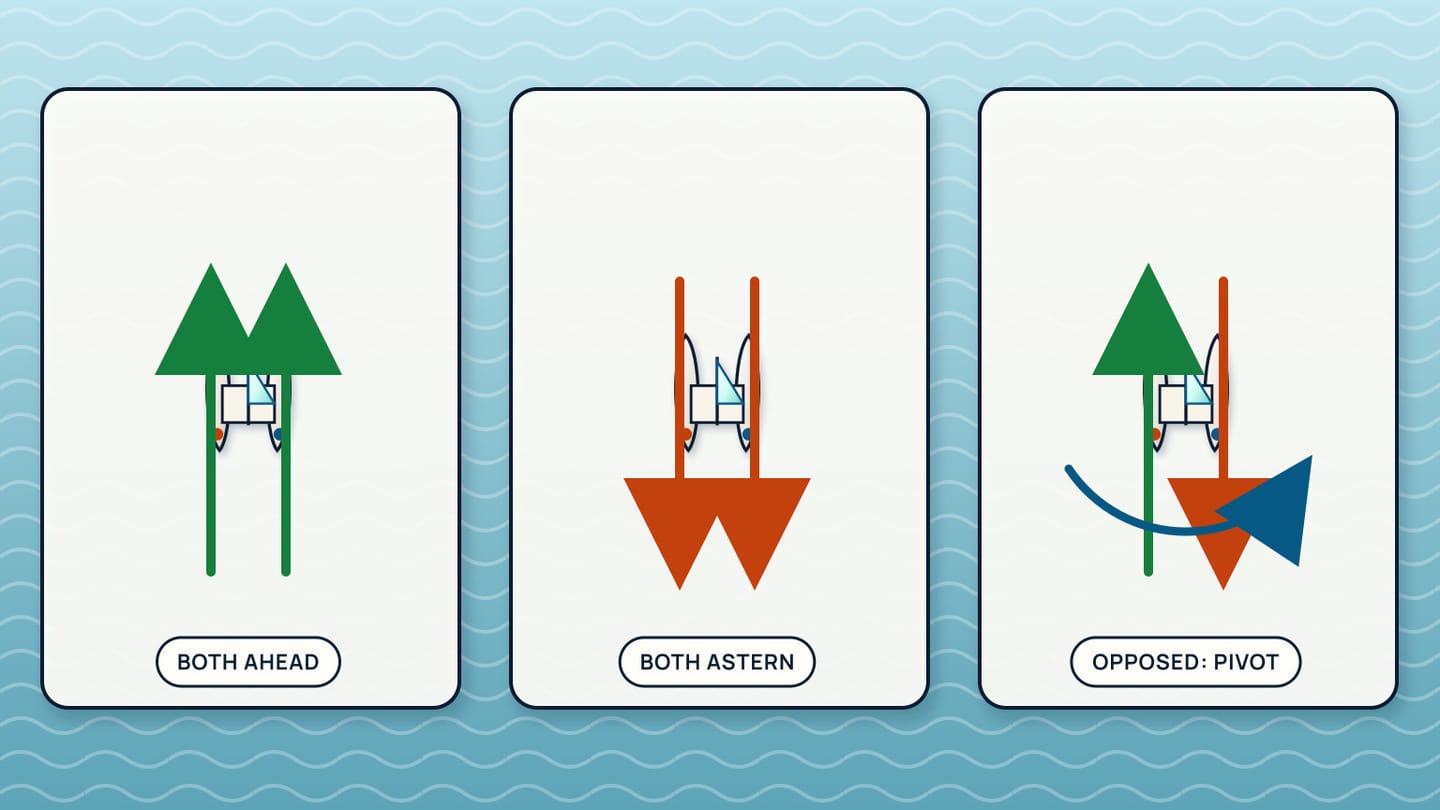
Practise in open water at idle. Engage both engines ahead, both astern, then neutral. Observe stopping distance and delay. Next, use one engine ahead and the other astern to see how the boat pivots. Widely spaced thrust creates a turning moment even with little forward motion.
Use the “two tracks” model. Ahead on the port engine tends to drive the port hull forward and turn the bow to starboard; astern on that engine tends to pull the port stern aft and turn the bow to port. Combining opposite gears rotates the boat. Propeller and saildrive effects can make the response unequal, so observation outranks symmetry.
Keep the wheel centred unless the boat's procedure uses rudders deliberately. Mixing large wheel and throttle changes makes diagnosis harder. Use brief, measured gear engagements and return to neutral so momentum does not build unnoticed.
Know the controls by touch while keeping eyes outside. Confirm which lever drives which hull. A throttle mistake beside a dock develops faster than a verbal correction.
Approach slowly enough to stop and reassess
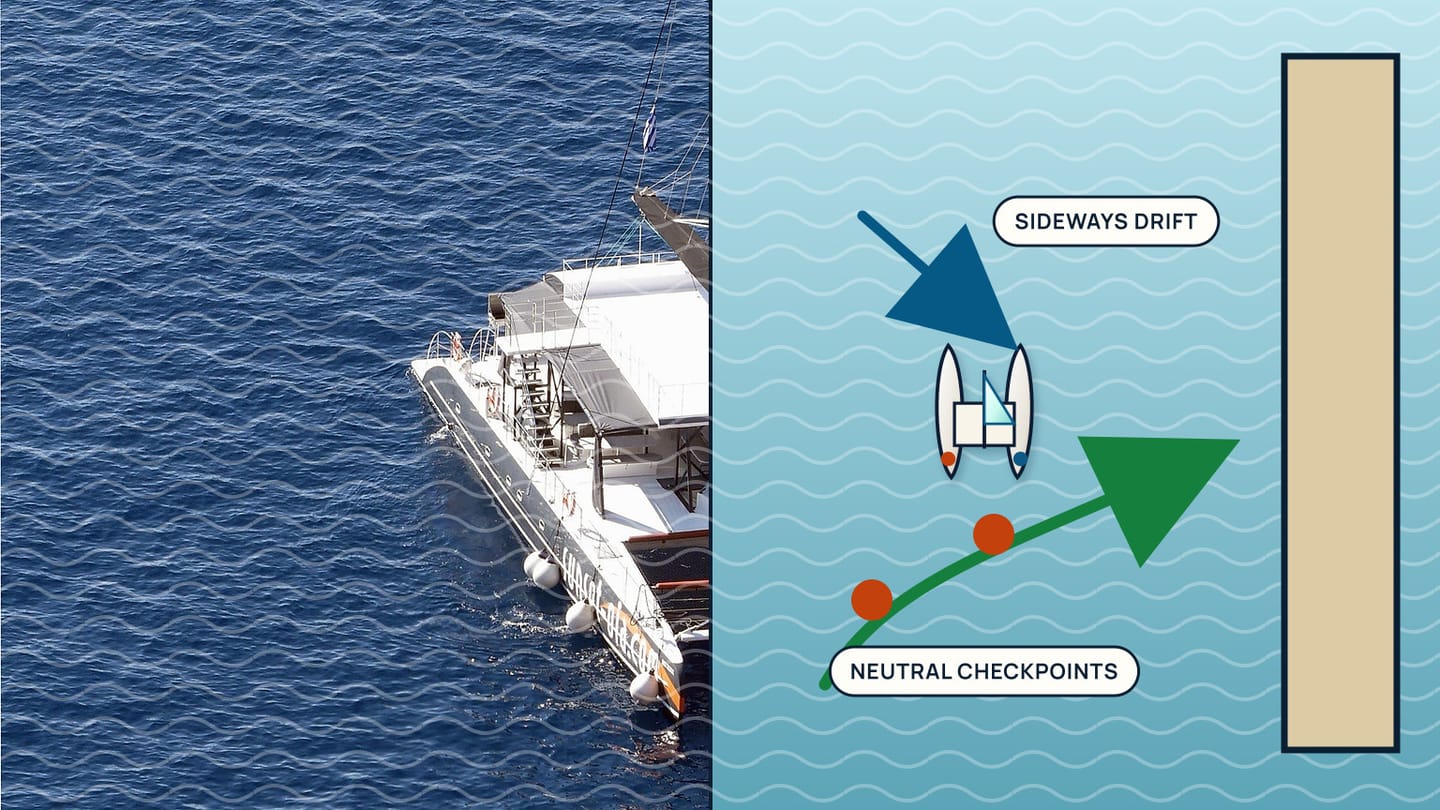
Set up outside the fairway with the boat nearly stopped. Observe sideways drift for a few seconds. That reveals wind and current effect before the berth hides it. Choose an approach that uses those forces predictably rather than demanding continuous correction.
Move at the minimum speed that preserves control. Use short bursts followed by neutral. Speed retained in a wide, heavy platform becomes stopping distance. If the skipper cannot pause and ask, “Where will we be in five seconds?” the approach is too busy.
Aim for a position from which the final movement is small. In an alongside berth, that may mean stopping parallel and off the dock before easing sideways through wind or controlled pivot. The exact manoeuvre depends on boat and berth. Avoid arriving diagonally with both bows and sterns needing different corrections.
Call distances from the closest corner, not the boat's centre. A catamaran's far hull can reach a neighbour while the visible hull looks comfortable. Include height: pulpits, davits, and anchors may project beyond the hull.
Land the first useful line without losing control
Choose the first line for the force you need to control. A well-placed spring can stop fore-and-aft movement and let gentle engine thrust hold the boat alongside. In another berth, a bow or stern line may be the safe first connection. Decide before arrival.
The line handler steps only when the gap and dock are safe. They do not pull a moving catamaran by muscle or try to stop it with the line around a cleat while standing in a bight. The skipper controls momentum with engines; the line controls the final relationship.
Once the line is ashore, confirm its name and lead before loading it. A line led to the wrong cleat can pull the boat away or trap another line. Use agreed commands such as “spring on” and “made,” with a repeat-back.
Keep fenders between hull and dock while settling. Do not shut down propulsion until the required lines are secure and the boat is stable. Then adjust for tide, wash, and expected movement using the marina's accepted practice.
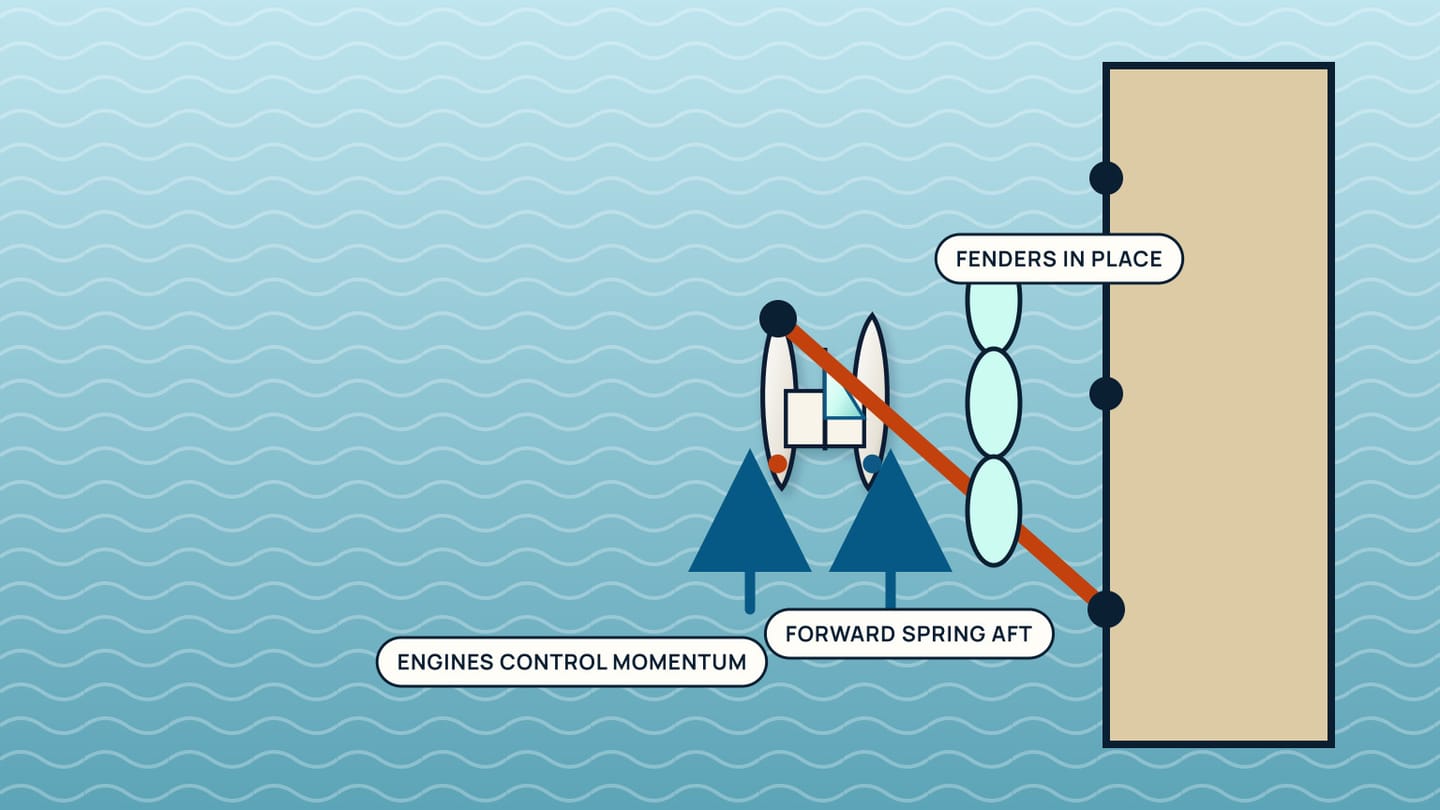
Abort early and return with a simpler setup
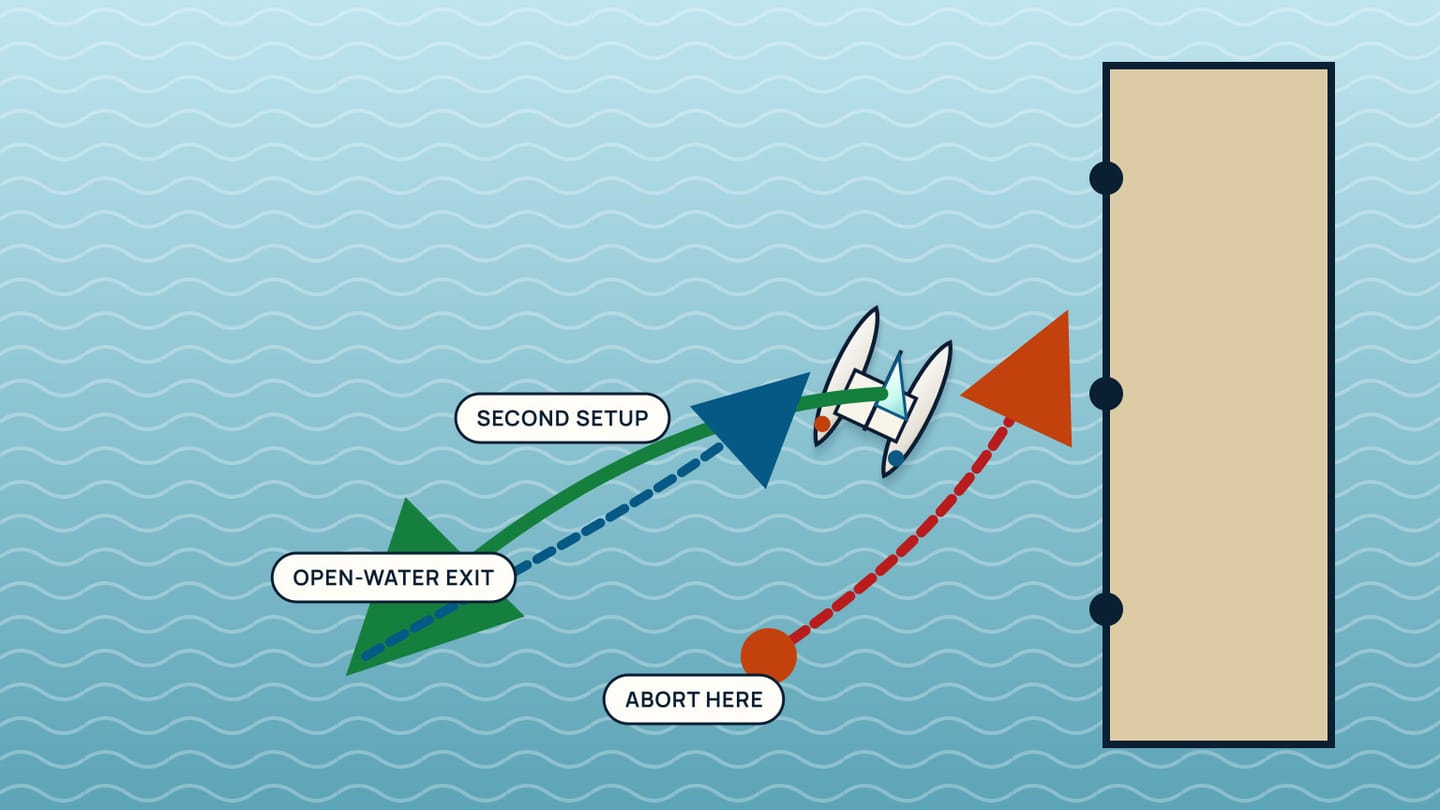
Abort if the boat carries excess speed, a line fouls, a crew member loses sight of a corner, another vessel enters the lane, or wind pushes the boat past the planned position. State “abort” clearly, secure loose lines aboard, and drive into the pre-checked open route.
Do not salvage a bad angle with more throttle beside people or property. Differential thrust can rotate quickly, but the far stern may swing into a neighbour. Open water restores room for the same tool to work safely.
On the reset, change one thing. Approach from farther out, swap berth side, rig a better spring, move a caller, or wait for traffic. Repeating the identical setup with more determination is not a new plan.
After docking, debrief engine response, drift, visibility, calls, and first-line choice. Practise the weak element away from the berth. A calm abort followed by a clean second approach is successful boat handling.
Run the plan from each corner. Ask what the port bow, starboard bow, port stern, and starboard stern will do during every throttle command. When opposite gears pivot the boat, two corners swing through large arcs even if the centre barely moves. The caller for the hidden side reports that arc, not just the gap beside one hull.
Practise stopping as its own manoeuvre. Approach a floating marker at idle, select neutral at a chosen distance, and observe remaining travel. Repeat into and across the wind. Then use a short reverse engagement and compare the change. This gives the crew evidence for “slow enough” on that boat without risking a dock.
Add line failure to the brief. If the planned first spring misses the cleat or falls in the water, nobody tries to recover it beside a turning propeller. The line comes aboard only when safe, and the skipper follows the abort route. A missed throw should change the approach, not the rule about bodies and propulsion.
For a charter boat, repeat the open-water engine test even if the model is familiar. Throttle calibration, propeller condition, engine delay, and visibility may differ. Familiarity with another catamaran is useful context, not proof that this one will stop or pivot the same way.
Rehearse the spoken sequence at the dock before casting off: “setup confirmed, abort lane clear, both engines responding, closest corner reported, first line named.” Each crew member answers only their assigned part. The sequence reveals a missing fender or confused line while the boat is still secured.
During the real approach, silence nonessential conversation. Distance calls should include the corner and trend, such as “starboard stern, two metres, closing.” A number without location can send the skipper's attention to the wrong hull. If the caller loses sight, they say so immediately rather than estimating.
Once secured, compare the planned force with the one actually felt. If wind rather than current dominated, or reverse thrust lagged, move that evidence into the next setup. Docking skill grows from accurate revisions, not from pretending the first plan unfolded exactly.
SailStarter's docking lessons help you see momentum, wind, current, and line function before bringing a large platform near a dock. Use them to prepare for hands-on instruction aboard the exact catamaran, where throttle response and sightlines can be learned safely.
Try it from the lesson
Can you spot the next move?
You're about to belay a dock line on a horn cleat. What comes first?
Why you can trust this guide
. We build each guide from public seamanship and safety sources, then teach the universal principle before any local difference.