Chart your course
Do You Have to Wear a Life Jacket While Sailing?
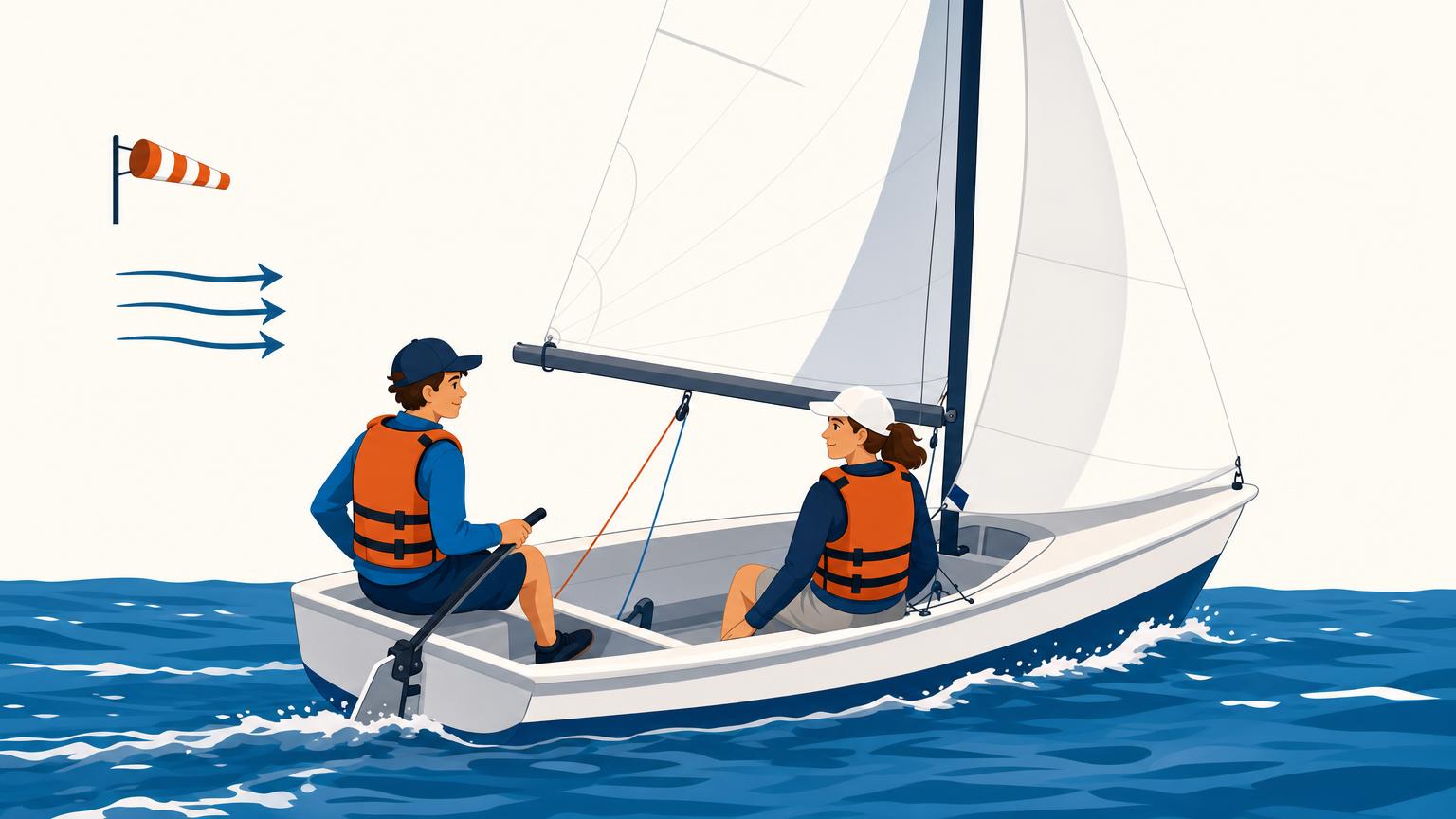
Quick answer
The short version
Must you wear a life jacket while sailing, or is carrying one enough? There is no single worldwide legal answer. Rules can change with location, age, activity, boat type, and the device itself.
Start with two checks. Read the approval label on your personal flotation device (PFD), then check the current rules for the waters where you will sail. Some labels or local rules require a device to be worn in particular situations.
The safer answer is much simpler: wear a correctly fitted PFD before the boat leaves the dock. A device in a locker cannot support you during an unexpected fall or capsize.
You may assume that having a life jacket somewhere aboard means you are covered. The legal minimum may say more, and wearing one gives you protection that storage cannot. A device that is the wrong size, worn out, or wrong for the activity does not meet that minimum either, so the label check and the local-rules check are really two parts of the same question: is this device, worn correctly, actually going to help me today?
So, do you have to wear a life jacket while sailing? Check the current local rule rather than relying on a rule remembered from another place. Then go beyond the minimum and wear one underway.
This article explains why carrying and wearing are different, why a throwable device is not the same as a wearable one, and how to check fit on land and in calm, supervised water.
Understand Carrying, Wearing, and the Approval Label
Carrying means a device is aboard. Wearing means it is fastened and adjusted on your body. That difference matters because a sudden fall, injury, or capsize can leave no time to find a stowed PFD and put it on in the water.
The exact law is local. It may set carriage or wear conditions based on age, activity, vessel type, or operating area. The PFD's own approval label can add conditions too. An inflatable or special-use model may have to be worn to count, while another design may not carry that same condition.
Read the label before departure. Confirm that the device is approved where you sail, suits the planned activity, fits its intended wearer, and is in usable condition. Then check the current local rules rather than assuming a requirement from another jurisdiction follows you.
Approval labels also carry a class and a performance level, because a simple buoyancy aid and a full lifejacket are not built or tested to do the same job. A buoyancy aid suits a competent swimmer close to help and is not designed to turn an unconscious person face up. A lifejacket is tested to turn a wearer, conscious or not, so the airway stays clear of the water, though heavy clothing that traps air can reduce how well even a well-rated device performs that turn. Match the class to the conditions you actually sail in, not to price or color.
A throwable cushion or ring has a different job. It can be tossed to someone already in the water, but it is not fitted to the person when they fall. Never treat a throwable as the practical equivalent of wearing a PFD.
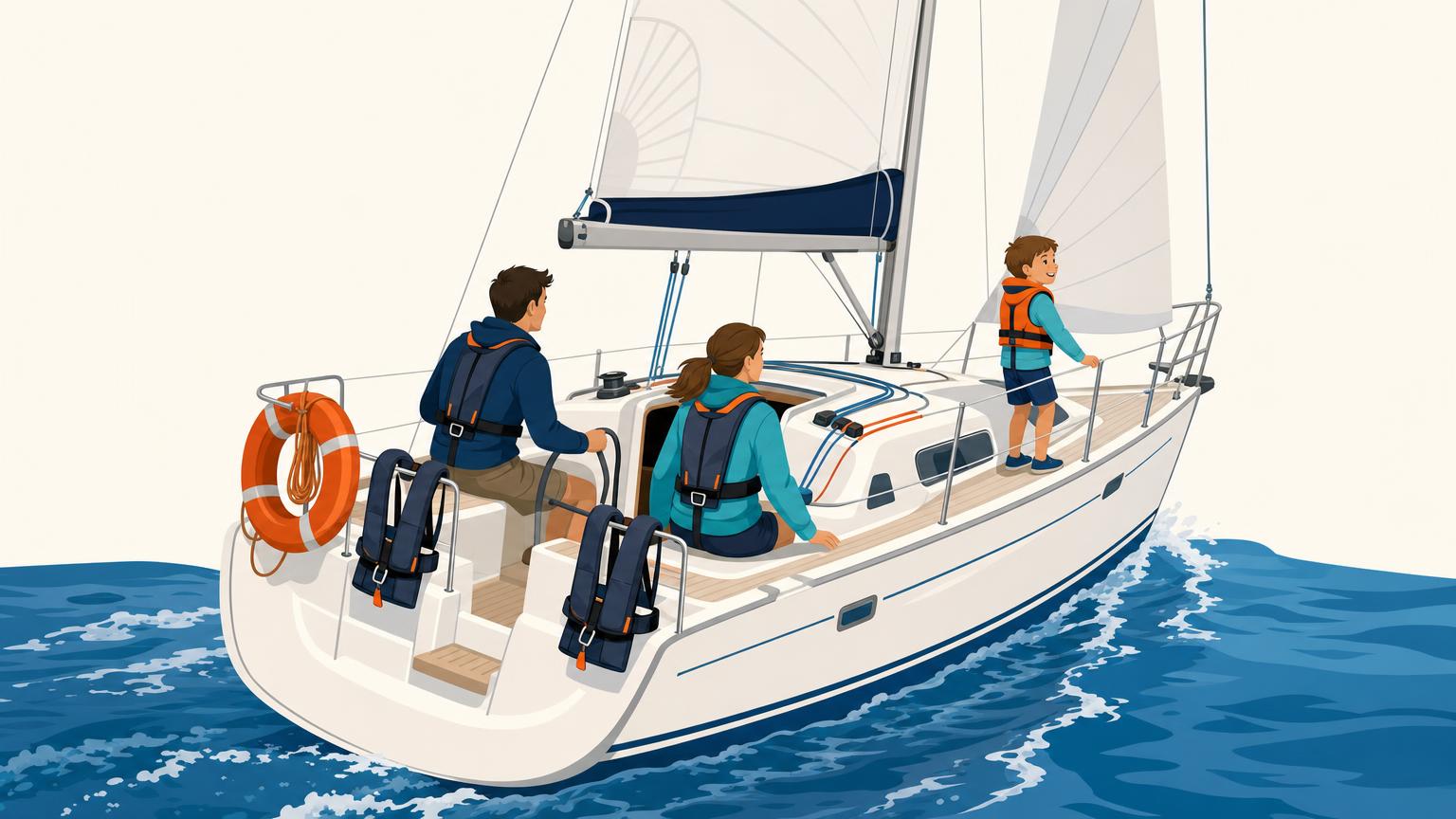
Why Wear a Life Jacket While Sailing?
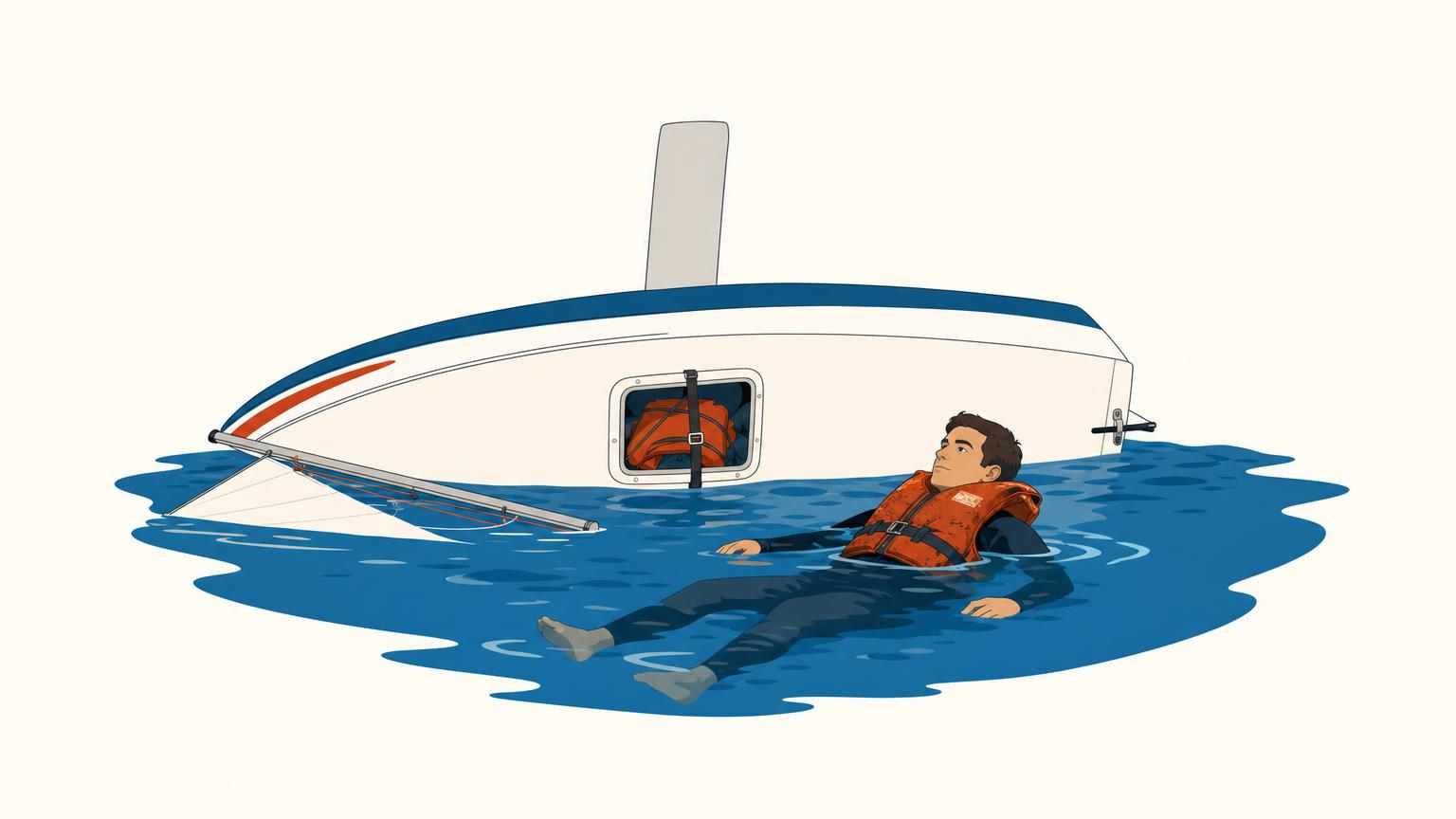
Carrying a personal flotation device (PFD), often called a life jacket, is not the same as wearing it. If you fall overboard or a small sailboat capsizes (turns over), wind, waves, injury, or distance from the boat may stop you from reaching a stowed device. Putting one on in the water can also be very difficult.
A properly worn PFD is already in place to support you and improve your chance of keeping your mouth and nose clear. It is not a guarantee: design, fit, body position, waves, and incapacitation all affect airway protection.
That is why the useful safety rule goes beyond a legal checklist. Put the PFD on at the dock, especially on a dinghy that can capsize, in rough or cool conditions, at night, or whenever you leave the cockpit. The device you are already wearing is the one that can help immediately.
Cold water changes the arithmetic further. Water colder than about 15°C (59°F) counts as cold, and it can shock anyone regardless of swimming ability, even on a warm day. The first minute or two brings an automatic gasp reflex, followed by hyperventilation that most people cannot consciously control. If your head goes under while that gasp happens, water goes straight into your lungs, and without a PFD already holding you up you have nothing keeping your head clear while it passes. See cold water shock: what to do for the full sequence and how to protect yourself once you are in the water.
Rescue also takes longer than most beginners expect. Someone who is injured, exhausted, or still working through cold shock often cannot climb back aboard unassisted, even close to the boat, so the crew needs a real plan for recovery, not only a plan for spotting the person in the water. A worn PFD buys the time that recovery plan needs. Read man overboard: first response for the sequence a crew runs the moment someone goes over the side.
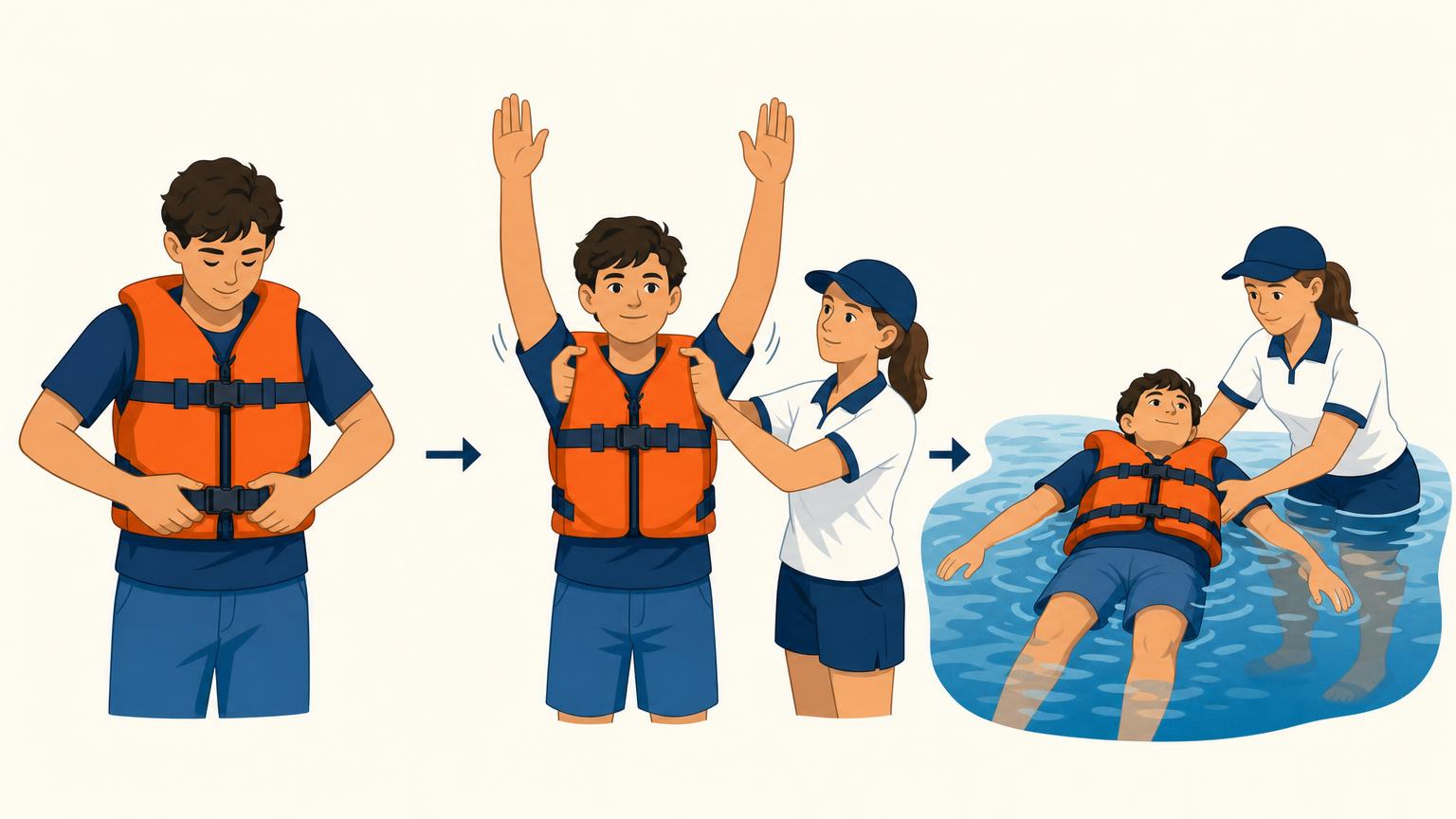
Test the Fit Before You Leave the Dock
A personal flotation device (PFD), often called a life jacket, must stay secure when you move. Before wearing a life jacket while sailing, test it on dry land.
Work from the bottom up. Fasten the entry closure and the bottom buckle first, since that lower strap anchors the device and does the most to stop it riding up, then tighten the remaining straps above it in order and tuck away any loose ends. Raise both arms above your head. Then ask a helper to lift the PFD straight upward by its shoulders. If it reaches your nose or nearly comes off, tighten it or try another size. Check the label for the intended user size and make sure the device does not ride above your chin or ears.
If your PFD has a crotch or leg strap, use it. The main body strap should admit a clenched fist and no more, and the crotch strap is what actually stops the jacket sliding up over your head once you are in the water rather than just hanging loosely around your shoulders. Refit whenever you add or remove a layer of clothing: a PFD tightened over a heavy jacket will sit loose the moment that layer comes off.
Next, test it in a pool or shallow water with someone supervising. Relax and lean back. The PFD should support your body while helping keep your face and airway clear so you can breathe. Different bodies and designs float differently. Choose another size or a device with more buoyancy (more upward support) if your face does not stay clear. A PFD that closes easily still needs to pass both the dry-land and in-water checks.
Check the label for the wearer's weight range too, and allow for the extra weight of boots, tools, or foul-weather gear you will actually be wearing, since capacity is stated for the person alone. If your PFD is inflatable, remember it holds no buoyancy at all until it inflates. After donning it, confirm the manual operating toggle is exactly where you expect to find it, and follow the manufacturer's schedule for checking the cylinder and bladder: typically an owner check every few months of regular use, at least once a year regardless, and a full service through the maker's agent when in doubt. One accident investigation traced a fatality to exactly this gap: a loose waistbelt and an unused crotch strap let an inflated lifejacket ride up over the wearer's face once he lost consciousness. The fix was already printed on the label. The best PFD is still the one that is properly fastened and the one you will actually put on, so choose a design that sits comfortably over your usual sailing layers with a buckle you can operate without thinking about it.
There is no worldwide answer to whether the law makes you wear a life jacket while sailing. Check the approval label and the current rules for your location, boat, activity, and crew. Whatever the legal minimum, a life jacket protects you only when you wear it. A PFD is one item on a longer list of gear a sailboat should carry; the sailboat safety equipment checklist covers the rest. Next, take SailStarter's short beginner lesson on lifejackets.
Try it from the lesson
Can you spot the next move?
You're heading out for a quick sail on a dinghy that can capsize. Should you put your PFD on now, or once trouble starts?
Why you can trust this guide
. We build each guide from public seamanship and safety sources, then teach the universal principle before any local difference.
- marinerslearningsystem.com
- nboat.com
- cdn.standards.iteh.ai
- standards.iteh.ai
- standards.iteh.ai
- standards.iteh.ai
- ccohs.ca
- rnli.org
- rnli.org
- boatsandoutboards.co.uk
- rnli.org
- seattlechildrens.org
- coldwatersafety.org
- ncbi.nlm.nih.gov
- ncbi.nlm.nih.gov
- nfcc.org.uk
- watersafetyusa.org
- nrs.com
- dbw.parks.ca.gov
- discoverboating.com
- paddling.com
- mby.com
- parks.wa.gov
- assets.publishing.service.gov.uk
- mrtsos.com
- defender.com
- sosmarine.com
- tc.canada.ca
- spinlock.co.uk
- boatus.org
- boatingcompass.org
- boat-ed.com
- boatus.com
- naosyachts.com