Chart your course
Halyard vs Sheet: The Simple Way to Tell Sailing's Two Ropes Apart
Quick answer
The short version
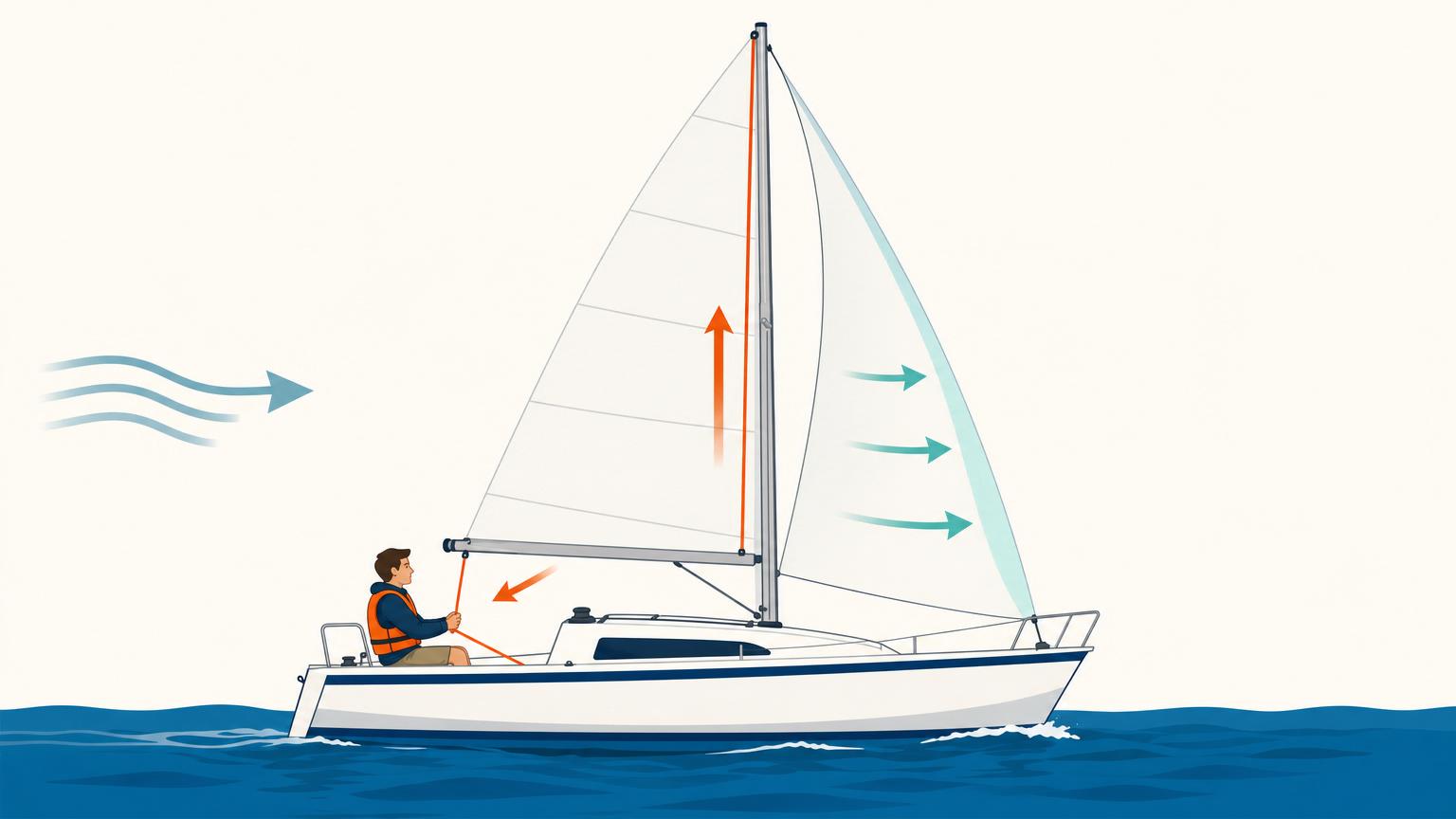
A sailboat can look like it is covered in identical ropes, but the job each line does gives it away. A halyard hoists a sail: halyard and hoist both start with H, so follow the line upward along the mast. A sheet trims a sail by changing its angle to the wind. Each sail has its own sheet: the mainsheet controls the mainsail, and the jib sheet controls the jib. If you hear "trim," pull the sheet in. If you hear "ease," let the sheet out. One common mix-up is thinking the sheet is the sail itself. It is not: the sheet is the line, meaning a rope with a job, that controls the sail, and confusing the two is one of the most common beginner errors on a first sail.
On the small sailboats and sloops you will learn on, each line, a rope with a job, is named for what it does rather than what it looks like. That naming habit runs deeper than halyards and sheets: aboard a sailboat, a coil of fibre only stays a "rope" while it sits uncut and unused. Once a length is cut and given a job, sailors call it a line, and the line usually earns a more specific name still, halyard, sheet, mooring line, drawn from that job. You will meet the two in a fixed order on almost every sail: first the halyard raises the sail up the mast, then the sheet trims its angle once the sail is flying. Learning them in that order matches how you will actually use them on deck.
The two lines differ in job, direction of travel, and the corner of the sail they attach to.
| Dimension | Halyard | Sheet |
|---|---|---|
| Job | Hoists or lowers a sail | Sets a sail's angle to the wind |
| Direction of travel | Runs up the mast to the sail's head | Runs from the sail's clew (or boom) back to the cockpit |
| Attaches to | The head, the sail's top corner | The clew, the sail's lower back corner |
| Named for | The sail it raises (main halyard, jib halyard) | The sail it controls (mainsheet, jib sheet) |
| Command you'll hear | "Hoist" | "Trim" (pull in) or "ease" (let out) |
Follow the Line That Goes Up
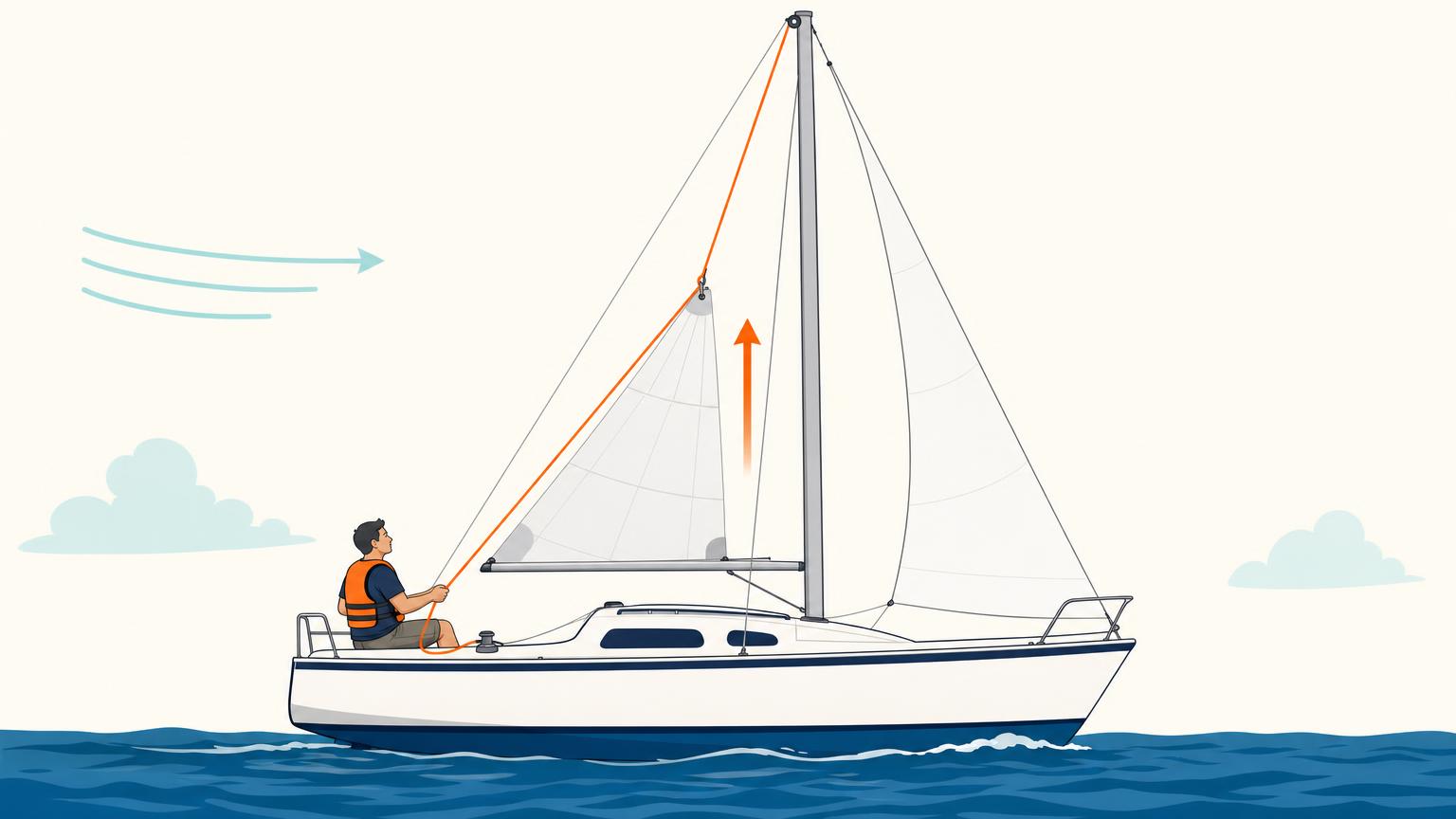
Start with the easiest clue: look up. A halyard is the line used to hoist or lower a sail, and its name comes from the Middle English halier, "rope to haul with." Remember: halyard and hoist both start with H, and both point you toward an upward job.
On a modern triangular sail, the kind you will sail first, the halyard attaches to the sail's highest corner, called the head. From there, it runs through a small wheel, called a sheave, near the top or middle of the mast (the vertical pole that supports the sails) and returns to deck level. Pulling the halyard raises the sail. Letting it run back down lowers the sail, an action some sailors call a downhaul rather than easing, since the word "ease" is reserved for sheets.
You may not be able to trace the entire line with your eyes. Many halyards run inside the mast and appear again through an opening near the deck. That hidden section does not change the test: if the line leads upward through the mast and raises the sail from its top corner, you have found the halyard.
Most boats carry more than one halyard, and each is named for the sail it raises. The mainsail has a main halyard, the jib has a jib halyard, and a boat flying a spinnaker adds a spinnaker halyard. If you sail an older gaff-rigged boat rather than the common triangular rig, expect two halyards on the mainsail instead of one, a throat halyard and a peak halyard, because a four-cornered gaff sail needs both upper corners raised together. That is the exception; on the triangular sails most beginners learn on, one halyard per sail is the rule.
Find the Sheet by Finding the Sail
On the fore-and-aft rigs used on dinghies, sloops, and yachts, a sheet is the line that controls a sail's angle. It is not the sail itself. That mix-up is normal: the word sounds as if it should mean a piece of cloth, but it actually comes from an old word for the lower corner of a sail, unrelated to bedding.
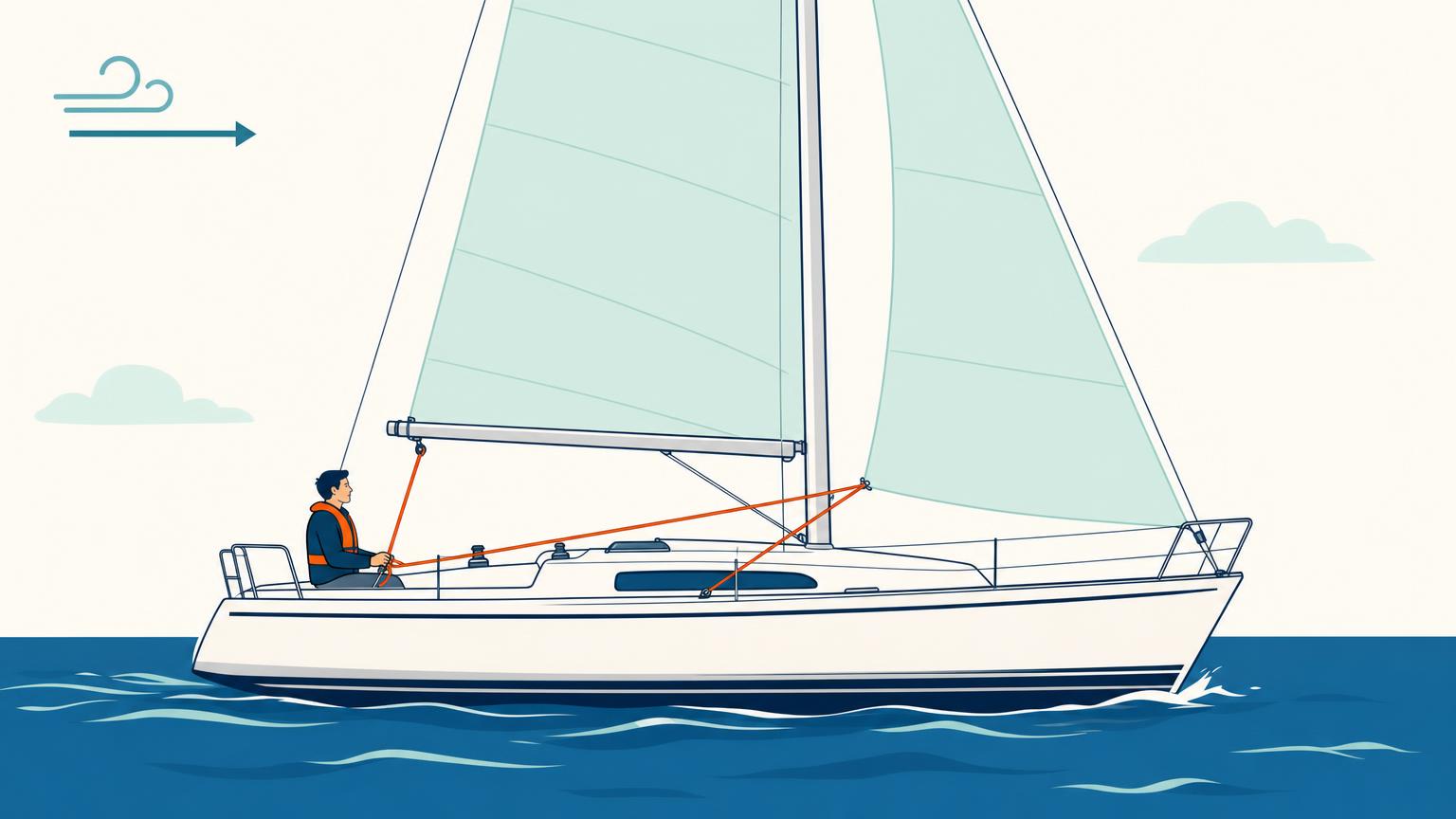
To find a sheet, first find the sail it controls. The mainsail (the large sail behind the mast) has a mainsheet, which connects to the boom, the horizontal pole extending from the mast, or to the sail's own lower back corner on a boat with no boom. If you want the full map of a sail's corners before you go further, parts of a sail covers the head, tack, and clew together in one place. The jib (the triangular sail in front of the mast) normally has two jib sheets, one leading to each side of the boat, but only one carries load at a time. The sheet on the side away from the wind, the working sheet, is under tension; the other side sits slack and is sometimes called the lazy sheet, ready for the next tack.
These sheets work from the sail's lower back corner, called the clew. Halyards and sheets both belong to what sailors call the running rigging, the lines that raise, lower, and shape the sails, as opposed to the standing rigging that holds the mast itself upright. On a small dinghy, you may simply hold the sheet in your hand with no winch at all; on a larger yacht, the same job runs through blocks that add mechanical advantage, because the load on a bigger sail is too great to hold by hand alone. The control is the same regardless of boat size. Only the hardware changes.
The halyard vs sheet test is simple: a halyard lifts the sail, while a sheet sets its angle. Match the sheet's name to its sail, mainsail with mainsheet, jib with jib sheets, and you will know which line you have found. If you learn to sail in a UK or RYA-taught program, you may hear "harden in" used for pulling the sheet toward the centerline instead of "trim." Both describe the same action; the difference is regional vocabulary, not a different technique.
What do "trim" and "ease" mean?
These commands tell you what to do with a sheet, not a halyard.
Trim means pull the appropriate sheet in. As the line comes in, the sail moves closer to the boat's centerline, the middle line running from front to back.
Ease means let the sheet out. As the line goes out, the sail moves farther away from the centerline.
Listen for which sail is named. "Trim the mainsheet" means pull in the line that controls the mainsail. "Ease the jib sheet" means let out the line that controls the jib, the triangular sail in front of the mast.
If you hear only "trim" or "ease," check which sheet the person means before you act, especially on a boat with more than one sail set. The quick memory hook is simple: trim pulls in; ease lets out. Both actions adjust the sail's angle. The halyard has a different job: it raises or lowers the sail, and "trim" or "ease" never describes what a halyard does.
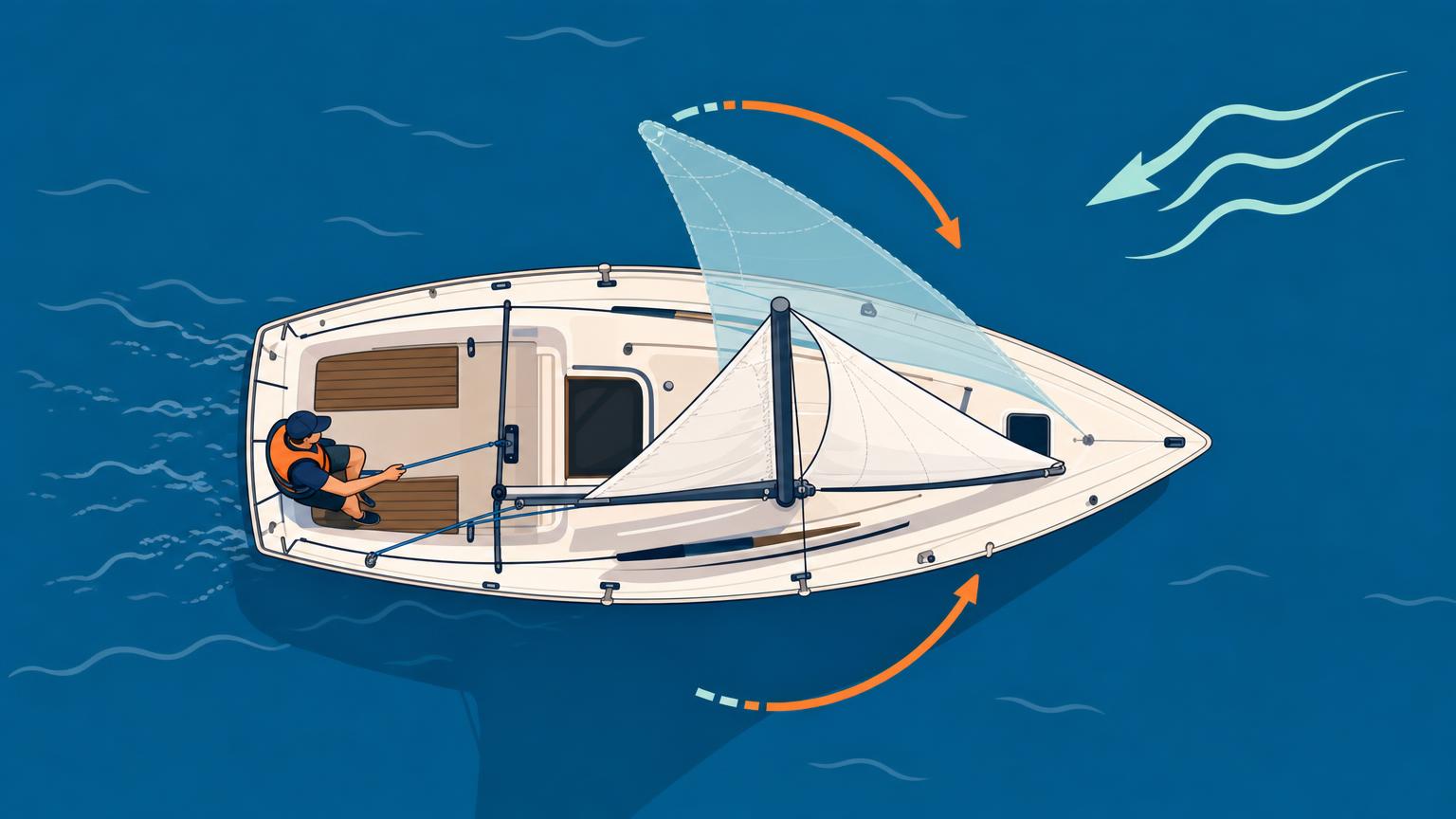
One safety habit belongs with the mainsheet specifically. When the boat turns so the wind crosses behind it, called a jibe, the boom and the mainsheet can swing across the cockpit, sometimes with real force if the turn is not controlled. Keep your head below the boom's arc during that turn, and treat any sudden mainsheet slack as a cue to duck rather than to investigate. That single habit, learned early, protects you long before you understand every detail of trimming.
Telling a halyard from a sheet becomes simple once you follow the job instead of the appearance. A line is a rope with a purpose on the boat, and the purpose is the name: halyards hoist, carrying a sail up the mast and holding it there, while sheets trim, pulling in or letting out to change a sail's angle once the sail is flying. The sheet is the line, not the sail, and mixing that up is common enough to be worth saying twice while it is still new. Each sail has its own sheet: the mainsheet for the mainsail, the large sail behind the mast, and the jib sheet for the jib, the triangular sail in front of the mast, with a spinnaker adding its own halyard and sheets again if the boat flies one.
Once the two names feel automatic, the next useful skill is watching how experienced crew move between them without announcing every step, easing a sheet through a tack while someone else tends the halyard on a sail change. SailStarter's short "Halyards and Sheets" beginner lesson lets you trace one line upward to the sail's top, then pick out the line that controls its angle, a practical next step for making these names feel natural on deck. Pair it with SailStarter's guide to your first day as sailing crew, which covers how to repeat an instruction back correctly before you act on either line, so the two guides reinforce each other.
Try it from the lesson
Can you spot the next move?
The mainsail is down and you need to raise it to the top of the mast. Which line do you pull?
Why you can trust this guide
. We build each guide from public seamanship and safety sources, then teach the universal principle before any local difference.
- en.wikipedia.org
- merriam-webster.com
- dictionary.cambridge.org
- en.wikipedia.org
- inavx.com
- en.wikipedia.org
- nauticalknowhow.mysailingcourse.com
- lifeofsailing.com
- mauripro.com
- en.wikipedia.org
- en.wikipedia.org
- nomadsailing.co.uk
- grenadabluewatersailing.com
- americansailing.com
- americansailing.com
- 1066.co.nz
- ipfs.io
- en-academic.com
- cdn1.sportngin.com
- predictwind.com
- usni.org
- etymonline.com
- thefreedictionary.com
- anclademia.com
- sailingvirgins.com
- en.wikipedia.org
- sailingvirgins.com