Chart your course
How to Tell Wind Direction When Sailing (No Instruments Needed)
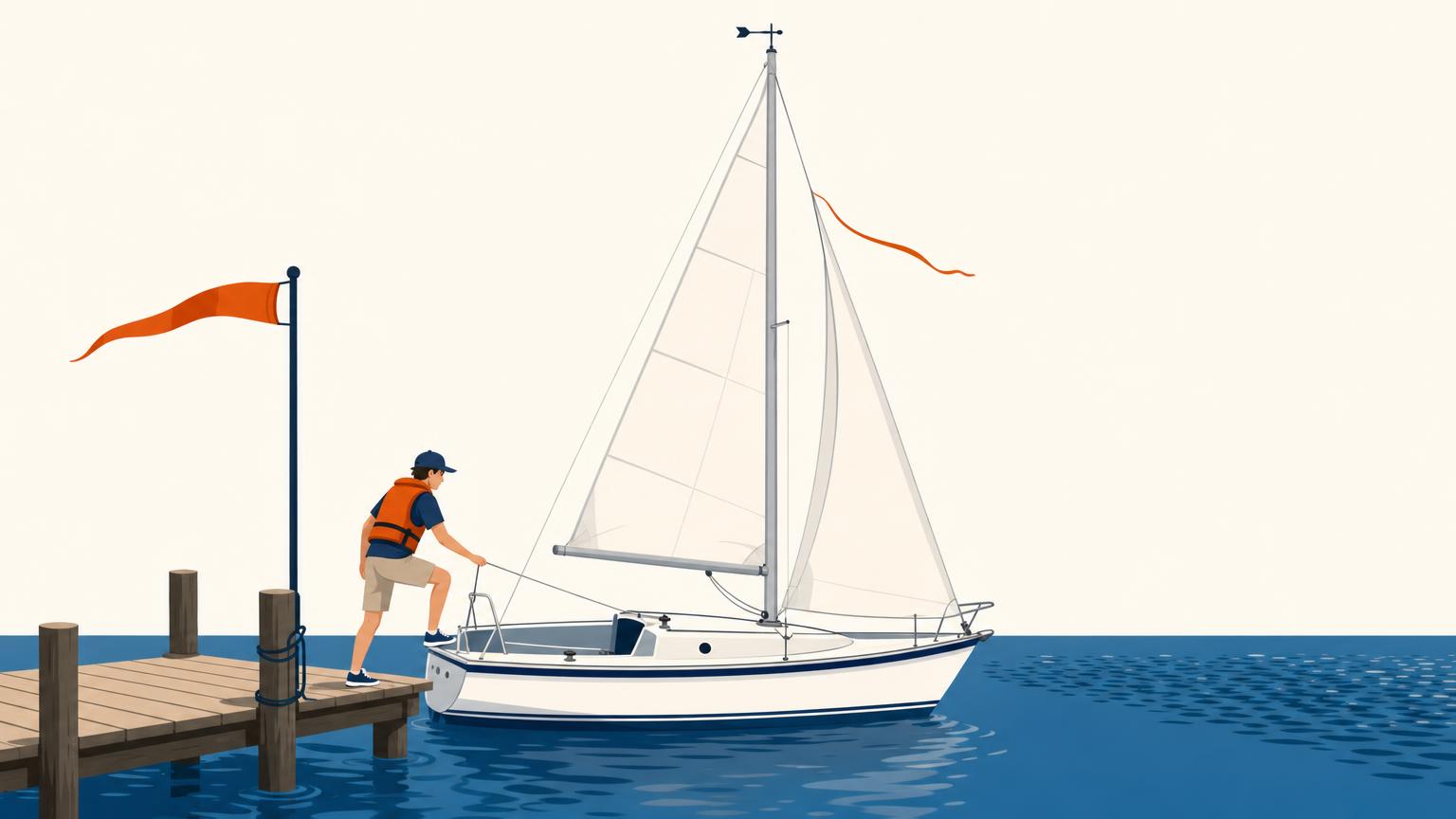
Quick answer
The short version
Before you step aboard, look for a dock flag, drifting smoke, moving leaves, or small ripples crossing the water. Flags and ripples travel with the wind, so trace their movement back to find where it comes from. Once aboard, compare that view with a telltale (a short ribbon or thread that streams in the airflow) and the small vane at the masthead, which points toward where the wind comes from. With no gear at all, turn slowly until the breeze feels even on both cheeks. Wind direction means the direction the wind comes from. Keep checking several clues together, because the wind can shift as you sail.
A flag streams from the end of the dock while fine ripples slide across a smooth patch of water. You have not stepped aboard, but the wind is already leaving clues. Telling wind direction while sailing starts with noticing those small movements. It matters because a sailboat cannot sail directly into the wind, the reason every point of sail is defined relative to where the wind is actually coming from.
You will begin with the broad view: flags, smoke, trees, and ripples around the shore. Then you will move closer. A telltale (a short ribbon or strand on a sail or the rigging, the wires and lines that support the mast) flutters with nearby airflow. High above, a masthead fly swings into line; this small vane is a pointer that turns toward where the wind comes from. If you have no gear at all, slowly turn your head until the breeze feels even on both cheeks. These clues support one another, helping you keep track as the wind changes.
Read Wind Direction from the Shore and Water Before Casting Off
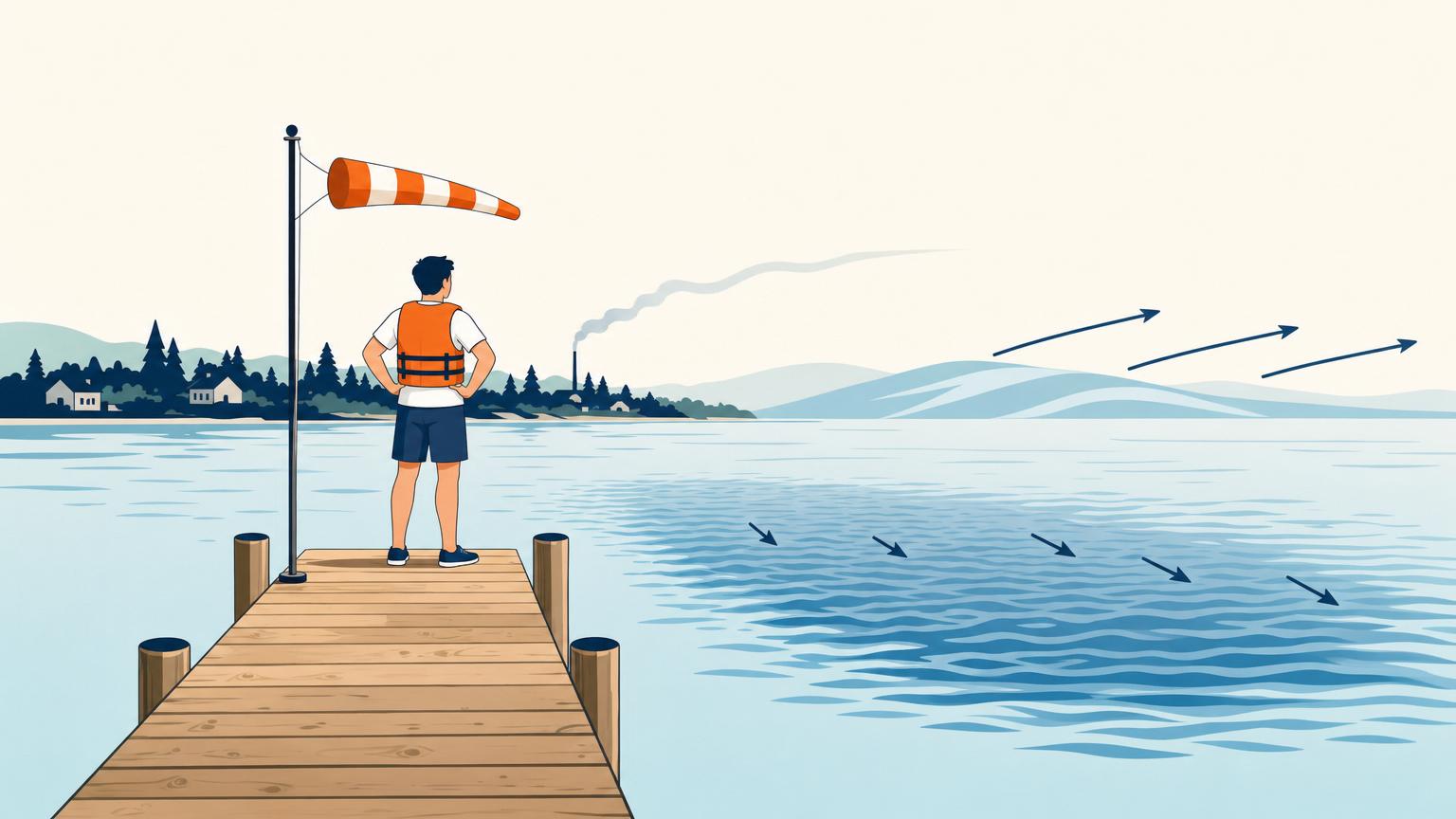
Before you step aboard, pause and look around. Wind direction means where the wind comes from. That convention helps you read a dock flag: the fabric streams away from the wind's source, so trace it backward to find where the wind is coming from.
Smoke can show the same pattern. In the lightest breeze, smoke may drift while flags still hang limp and wind vanes have not begun to move. Moving leaves confirm that some breeze is present. Long grass or branch tips leaning one way can offer a rough direction check.
Choose clues in exposed places, such as the end of a dock. Buildings and dense trees can shelter nearby flags and plants, making them less useful than clues in open air.
How obvious these clues are also depends on how much wind there actually is. In the lightest air, smoke or a wisp of steam may drift steadily while a flag still hangs limp and a wind vane has not started to turn: smoke reveals a breeze that other clues have not caught up to yet. As the wind builds, leaves begin to rustle and you can feel it on your face, and a little more again and light flags extend and small twigs move constantly. None of that means the lighter clues stop working. It means you should not dismiss a calm-looking flag as proof of no wind until you have also checked smoke, ripples, or your own face.
Then scan calm water for a darker, ruffled patch travelling across the smooth surface. Sailors sometimes call these dark patches cat's paws: a gust darkens the water because the tiny ripples inside it scatter light differently than the smoother surface around it, and the patch moves fast, driven by the puff that made it. Tiny ripples show what the wind is doing now. Their lines sit across the wind. Point one arm straight out at right angles to those lines, toward the side the ripples come from. That is where the wind is coming from. Use these small ripples for wind direction, not large swell, which may have travelled from a storm far offshore and can keep arriving at a shore with no local wind at all, so a rolling swell tells you almost nothing about the breeze around you right now. The split figure labels the windsock and ripple crests. A blue arrow appears above the windsock; on the water panel, a blue arrow labelled Wind flow crosses the white lines labelled Ripple crests.
Read a Telltale Up Close
A telltale is a very light ribbon or strand, often made from wool or nylon yarn. It makes moving air visible. While you are sailing, it can be one of the fastest ways to tell where the wind is coming from, and once you can read one it becomes the same skill used to check sail trim on every point of sail.
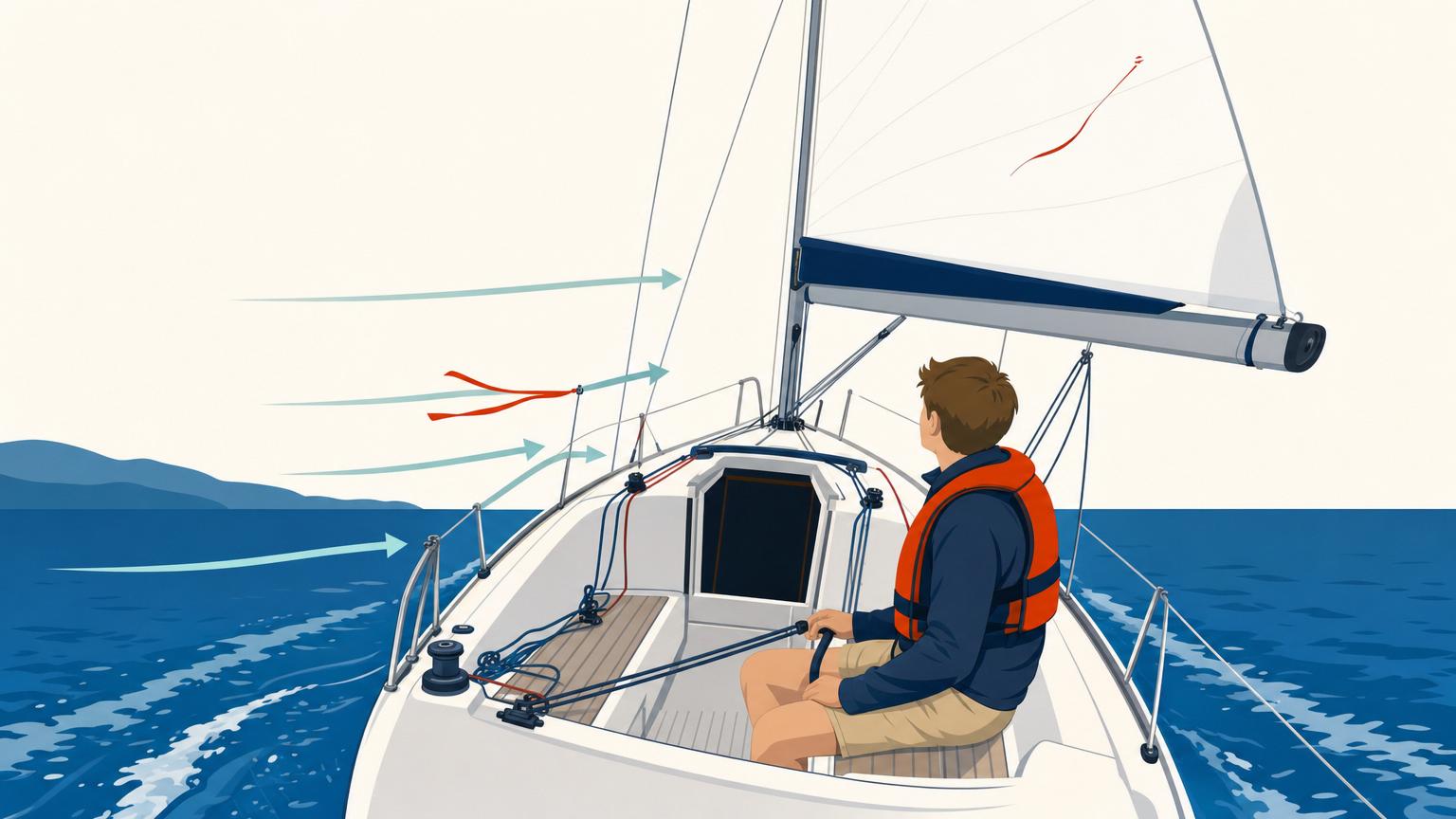
Look beside the cockpit at the shroud, a wire that supports the mast. A telltale tied there is often near eye level. It streams away from the wind, toward the downwind side: the side the wind is blowing toward. So the wind is coming from the opposite direction. Use this as a quick nearby clue, but check another sign too: air coming off the sails can bend the ribbon.
You may also see short strands on both sides of a sail, usually near its forward edge. These show how air is moving across the sail rather than simply pointing out wind direction. When the airflow is smooth, the strands stream back and lie close to the sail. When it is disturbed, a strand may flutter, lift away from the sail, or point forward. The paired real-sail close-up shows taut yarn streaming aft under a blue airflow arrow, then a strand lifting away in disturbed flow.
On a headsail these strands usually sit a hand's width or so back from the luff, the sail's forward edge, and a boat often carries three matched sets spaced up the sail so you can compare airflow high and low at a glance. Port and starboard telltales are sometimes tied at slightly different heights, which makes it easier to tell at a glance which side you are looking at rather than confusing the two. On the mainsail they usually sit further back, roughly at the midpoint between luff and leech, because the mast itself disturbs the airflow closest to it; some boats also carry a telltale at each batten along the leech. None of these positions is a rule you must measure with a tape, but recognizing the pattern helps you find them quickly on an unfamiliar boat.
Check the Masthead Fly at a Glance
Look to the top of the mast for a small rotating wind vane. Sailors call it a masthead fly or wind indicator, and often call it a Windex. You will see these vanes on many kinds of sailboat, from small dinghies to America's Cup boats.
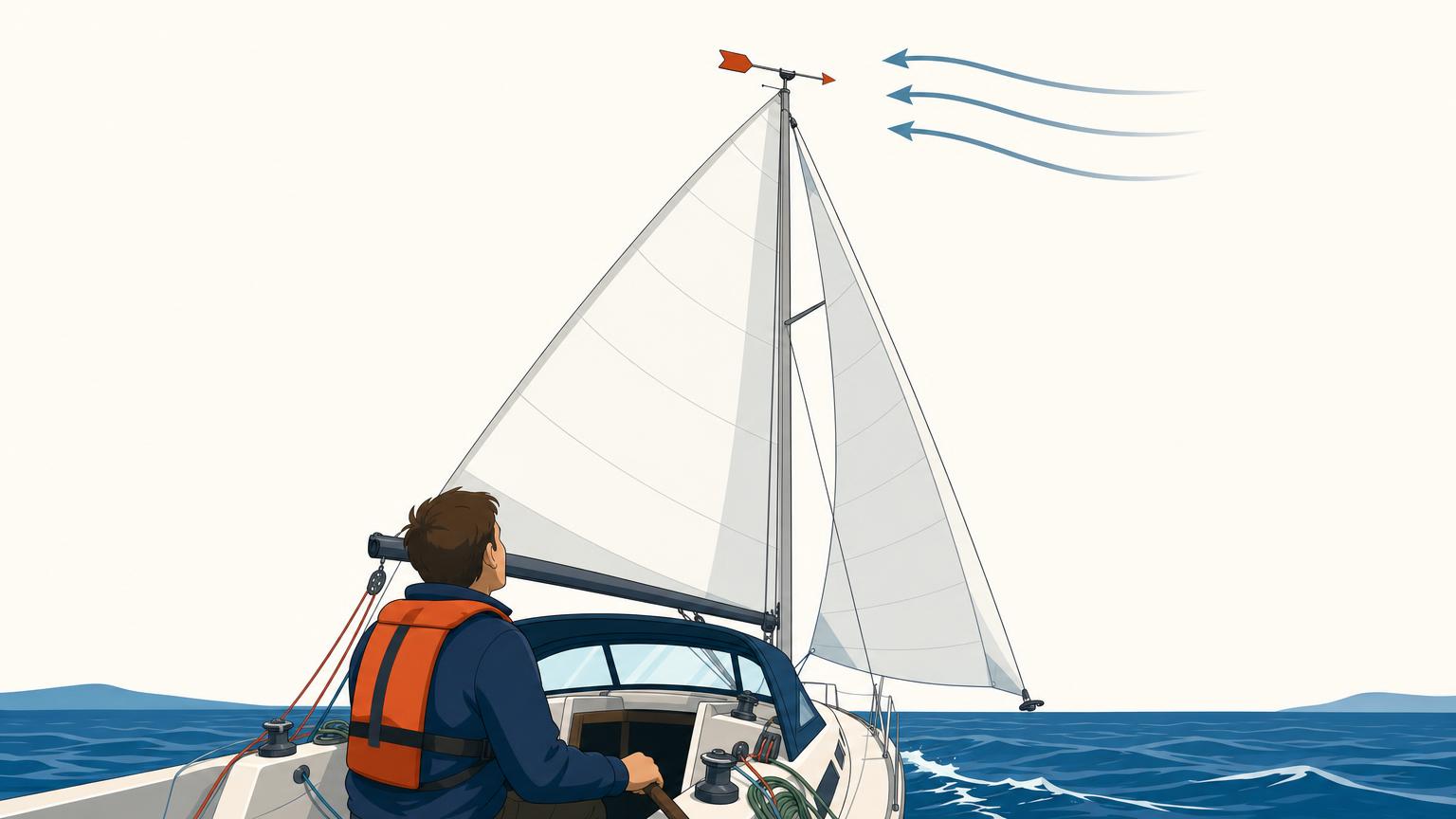
A sailboat's masthead vane gives you wind direction at a glance. It swings into line with the airflow, and the pointer aims into the wind; toward where the wind is coming from. That is the opposite of a flag, which streams away with the wind.
Because the vane sits high above the sails, it is clear of much of the disturbed air around them. This can make it a clean, useful clue while sailing, and it is often the most reliable one of all when you are sailing downwind, a point in the sail plan where the ribbons on the shrouds get pushed around by turbulent air spilling off the sails and become harder to trust. The drawback is simple: you must look a long way up and briefly take your eyes off the water. Telltales (the ribbons on the rigging) are easier to keep in your normal line of sight. Use the masthead fly alongside those ribbons, the water, and the breeze on your face. The tight masthead crop anchors its label directly on the vane pointer. The pointer faces where the wind comes from, while the blue arrow shows the air moving away in the opposite direction.
The vane itself is built to catch the lightest air. Its arm carries a large, very light fin that turns on a low-friction bearing, closer in feel to a compass needle than to a garden weathervane, so it keeps working in breezes too faint for a flag to lift. That sensitivity is exactly why it is worth the glance upward even when the wind feels barely there.
Turn Until the Breeze Feels Even
Once you are settled aboard, your face becomes a simple wind checker. Turn your head slowly from side to side. Notice the breeze on your cheeks, neck, and ears. You can briefly close your eyes if that helps you focus.
Keep turning until the breeze feels equally strong on both cheeks. Listen too: the wind should sound about the same at each ear. When both sides match, your face is pointing toward the direction the wind is coming from.
Do this check often. The wind can change direction and strength, so one reading will not last forever. Compare what you feel with the other clues around you. Does a nearby ribbon agree? Is the masthead fly pointing the same way? Do the small ripples on the water support your reading?
These clues work together. With practice, a quick turn of your head can confirm what your eyes already noticed, or show you that the wind has shifted. The photograph shows a woman facing left, a blue arrow pointing from left to right into her face, her hair trailing right, and the label Wind on your face.
This is worth taking seriously rather than treating as a beginner's fallback. A sharp sense of the wind's direction and strength is one of the most useful skills you bring aboard, instruments or not, and it only improves with repetition. Make the face check a habit on every outing, not just when the other clues are unclear, and it will start to happen automatically rather than as a deliberate pause.
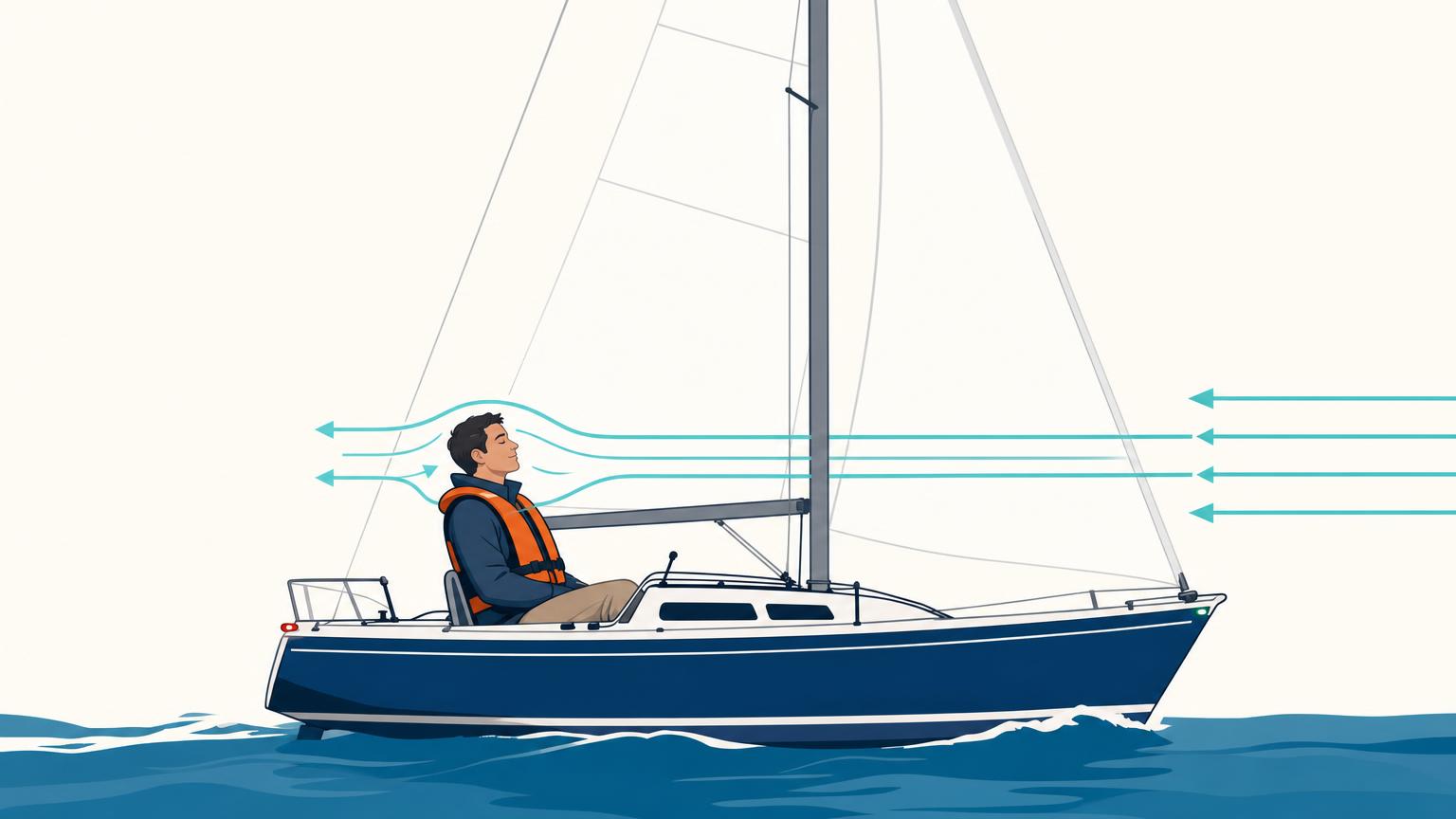
You now have several independent ways to find the wind's direction. What you feel and see is the wind as it exists right where you are; if you want to understand why it changes course through the day near shore, sea breeze is a good next read. Before you cast off, a flag ashore, drifting smoke, or small ripples crossing the water can already reveal its path. Once aboard, a telltale (a ribbon or thread on the sail or rigging) shows nearby airflow, while a masthead fly, a small vane at the top of the mast, gives you another quick check. With no gear at all, you can turn until the breeze lands evenly on both cheeks and the rush of wind sounds equally loud in each ear. These clues work together, helping you notice when the wind shifts and stay aware as you sail. Try SailStarter's short beginner lessons to keep building this practical on-the-water sense.
Try it from the lesson
Can you spot the next move?
A short ribbon on a supporting wire of the mast streams out sideways. What is it showing?
Why you can trust this guide
. We build each guide from public seamanship and safety sources, then teach the universal principle before any local difference.
- w1.weather.gov
- weather.gov
- spc.noaa.gov
- weather.metoffice.gov.uk
- rmets.org
- metone.com
- weather.gov
- geo.libretexts.org
- epod.usra.edu
- epod.usra.edu
- geo.libretexts.org
- rwu.pressbooks.pub
- speedandsmarts.com
- ussailing.org
- goodoldboat.com
- pbo.co.uk
- sailcare.com
- improvesailing.com
- davisinstruments.com
- sailzing.com
- windexdevelopment.com
- ronstan.com
- en.wikipedia.org
- dummies.com
- windexdevelopment.com
- cityofventura.ca.gov
- practical-sailor.com
- lifeofsailing.com