Chart your course
Points of Sail Explained: The Sailor's Clock Face
Quick answer
The short version
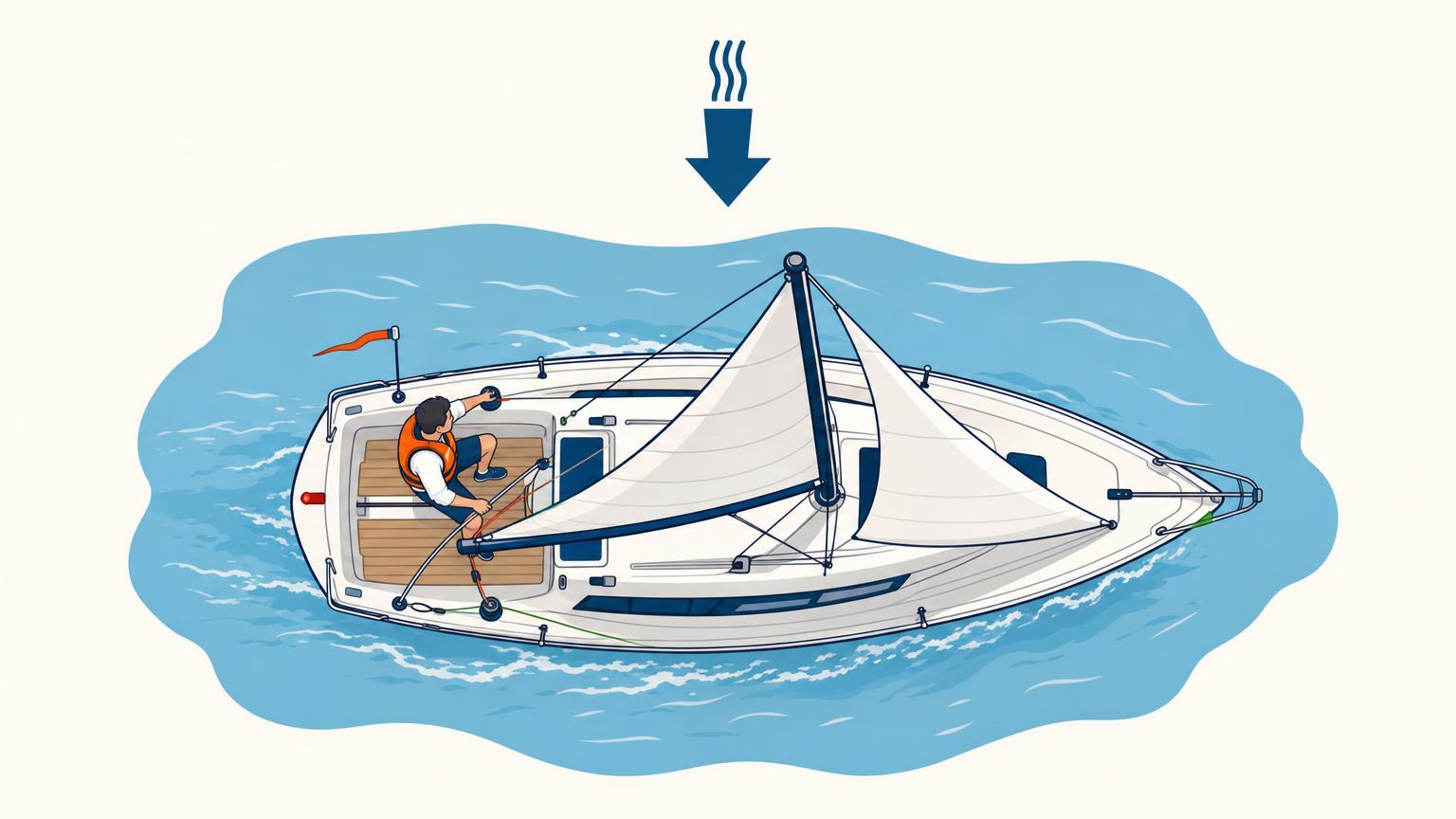
“Points of sail” are names for your boat’s course in relation to the wind. Imagine your boat at the centre of a clock, wind coming from 12 o’clock. Pointing at 12 puts you in the no-go zone; a stopped boat there is in irons. Around 1:30 you are close-hauled, sails pulled in tight. At 2 you are on a close reach, at 3 a beam reach, and at 4:30 a broad reach, easing the sails farther out at each step. At 6, wind directly behind you, you are on a run, mainsail let all the way out. The same names apply on either side of the clock, mirrored for whichever side the wind blows over.
If you have ever looked up at a sail and wondered whether to pull it in or let it out, start with the wind angle. The point of sail name depends on where the wind comes from, not on your speed or boat type. As the bow turns away from 12, the sails move from tight to progressively farther out, and the way the sail generates power changes with them. This guide connects each clock position to a name, a sail position, and a clue you can feel or see aboard, short of tacking upwind or steering out of a stall. If you are still finding 12 o’clock in the first place, how to tell wind direction while sailing is a good place to start.
How Does the Points-of-Sail Clock Work?
At first, sail trim can feel like guesswork. Then you notice the pattern: every wind angle has a name, and each name suggests a sail position.
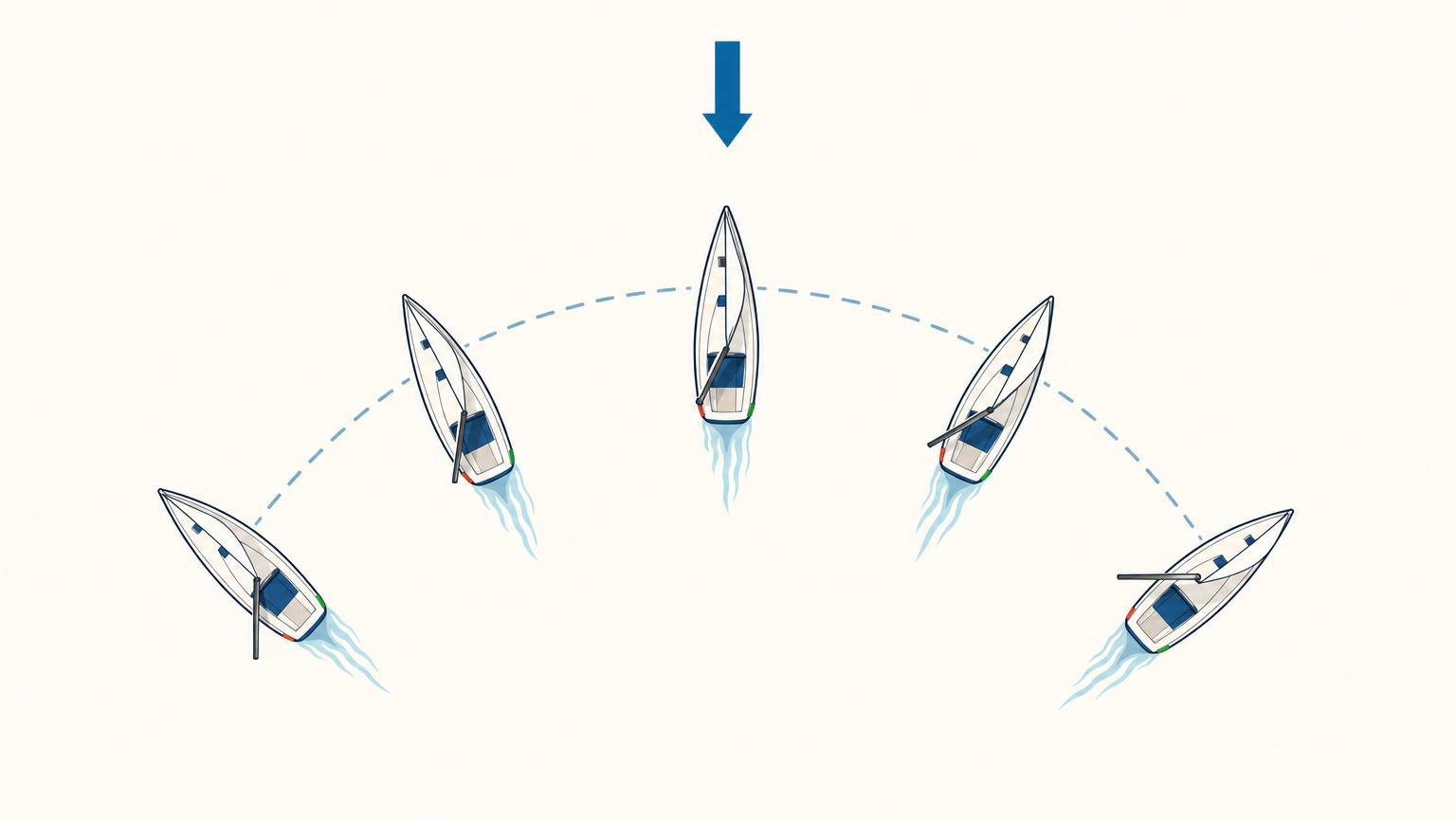
Picture the boat at the centre of a clock. Put the wind at 12 o’clock. The bow is the clock hand. Points of sail name where the bow points relative to that wind, not the boat’s speed or type. The names from close reach through broad reach share a family name too: sailors call the whole band reaching, so “a reach” can mean any of the three unless you say which.
Near 1:30, you are close-hauled, with the sails tight. You may feel wind on your face and see the telltales, small strips of yarn or fabric on the sail, streaming back. Around 2 is a close reach, still called “full and by” on older boats. At 3 comes a beam reach, then a broad reach near 4:30. Each turn away from 12 has its own paired name: heading up (toward the wind) calls for sheeting in, and bearing away calls for easing out.
At 6, you are on a run. The wind comes from behind, the mainsail is let all the way out, and the boat may heel less but roll more: flatter, quieter, wind on your back.
At 12, the boat cannot sail directly into the wind, and a band roughly 90 degrees wide around that heading will not drive it either. A boat caught there stalls in irons, a condition, not a course you sail. The same names repeat on the other side, beam reach at 9, broad reach near 7:30. The clock is a memory aid, not exact bearings: the diagram below places boats at the six named headings, the blue wind fixed at 12, and the no-go wedge symmetrically around it.
What Happens at 12 O’Clock?
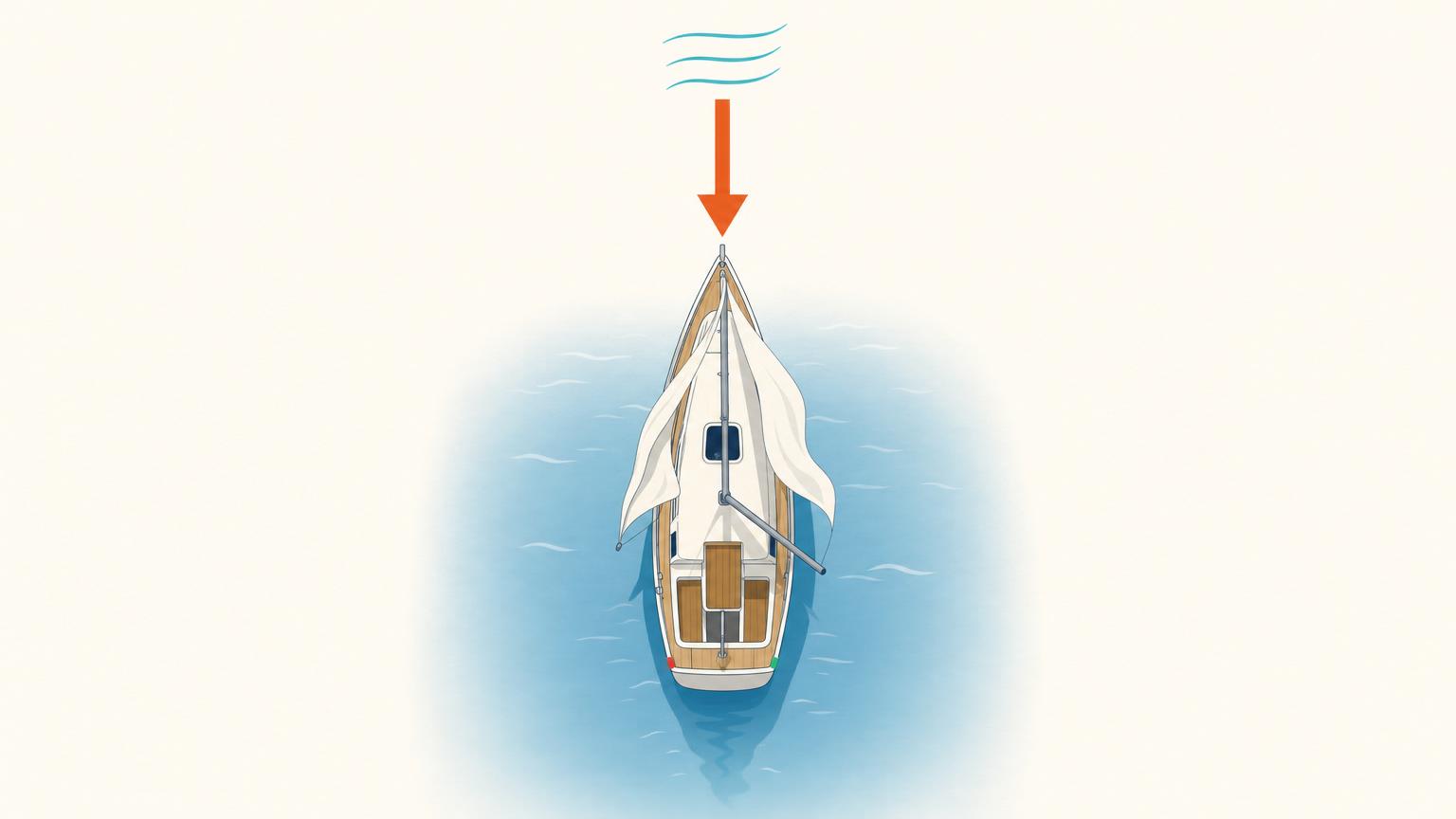
Picture the wind arriving from the top of the clock. When the bow points straight toward 12, it points directly into the wind. A sailboat cannot sail on this heading, or anywhere in the roughly 90-degree band around it, because the sails have no useful angle left to grab wind. Rather than a usable point of sail, sailors say the boat is in irons.
You can recognize this state by watching the sails. They lose their smooth, curved shape and begin to flap. This is called luffing, airflow that was moving smoothly over the sail breaking up. Even sails pulled in as tight as they go cannot stay filled while the bow points directly into the wind. See why is my sail flapping for a closer look at why.
With no useful drive from the sails, the boat slows and may stop, even moving backward if it stays there. That stalled feeling tells you the bow has drifted to the top of the clock. It happens to nearly every new sailor at some point, often from steering too high, and it is not a sign of a broken boat, just a heading with no drive. As the bow points away from 12 again, the sails take shape and pull once more. The real photograph makes the diagnosis concrete: the white boat-course arrow points toward the bow while the blue wind arrow points straight back at it, and the red telltales hang instead of streaming.
What Are Close-Hauled and Close Reach?
Around 1:30, you are close-hauled, the closest usable course to the wind, right at the edge of the no-go zone. The sails are pulled in tightly, near the centre of the boat. You may notice the wind clearly on your face and a livelier motion than farther off the wind.
Close-hauled is usually described as around 45 degrees off the true wind, but treat that as a rough middle, not a fixed rule. Published figures run from roughly 30 to 55 degrees, since a boat’s ability to point depends on how efficient its sails and keel are, and light wind widens the angle you need to hold.
Look at the telltales to judge whether you have found that edge: small strips of yarn or fabric on the sail, in a pair on either side of the jib. When trimmed well, both stream aft together. A windward telltale that flicks or breaks up means you turned too close to the wind. Ease the sheet slightly or bear away to settle it. A leeward telltale misbehaving instead means the sail is trimmed too loosely. Sailors call staying right on that edge sailing “in the groove.” Sail trim by point of sail covers those adjustments further.
Now let the bow bear away, or turn farther from the wind, toward about 2 o’clock. You move onto a close reach, a course between close-hauled and beam reach older sailors sometimes still call “full and by.” The wind arrives less directly from ahead, so you ease the sails a few inches rather than keeping them pinned in tight, and the boat typically picks up speed as it does.
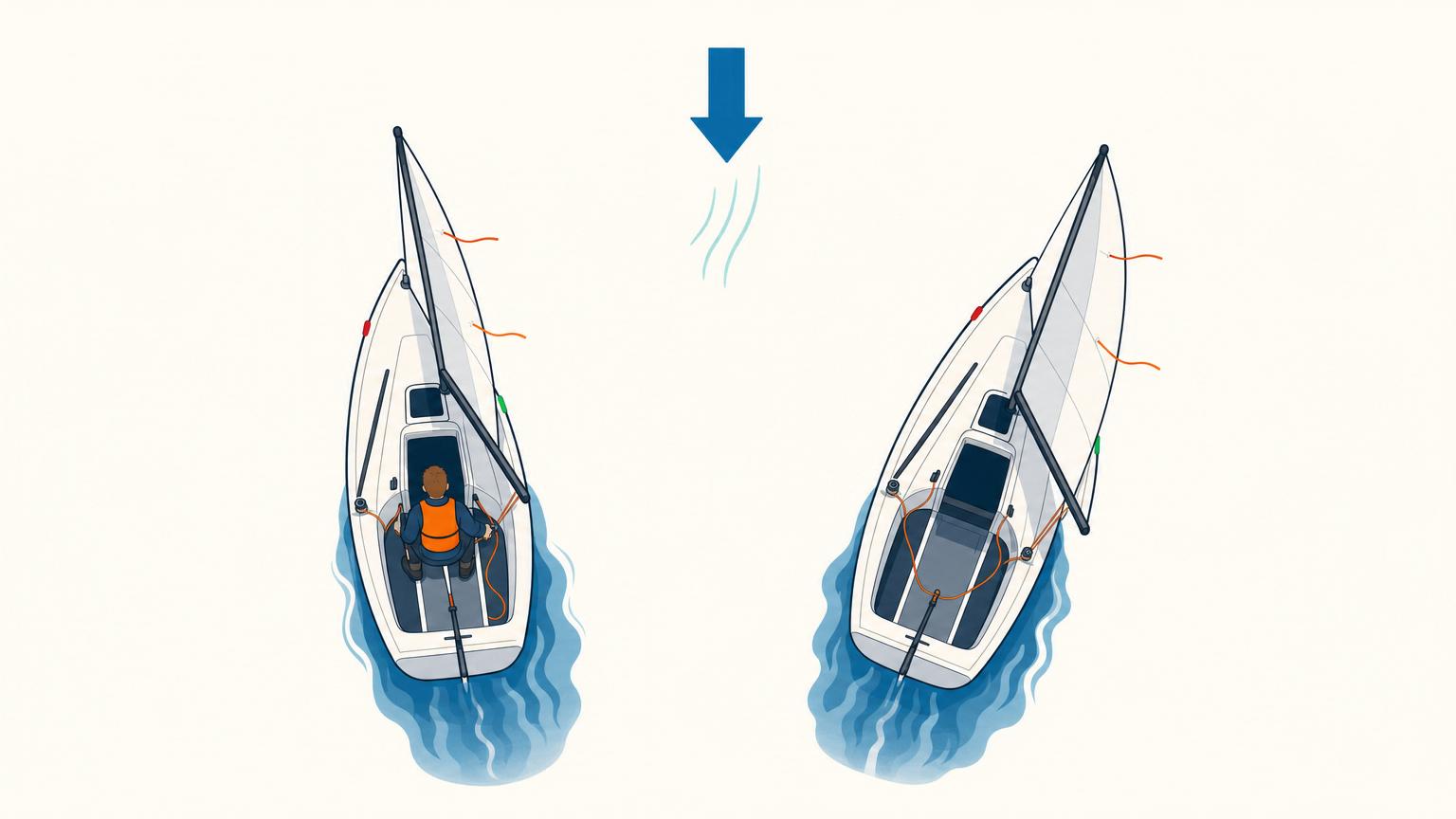
The clock positions are a memory aid, not fixed measurements. The pattern still holds: close-hauled means tight sails at the edge of what will draw, and close reach means you have turned away a little and eased the sails to match. Two plan-view boats sit beneath one fixed blue wind arrow: the close-hauled boat points nearer the wind with its orange sail pulled in, while the close-reach boat bears away with its sail eased.
What Are Beam Reach and Broad Reach?
At about 3 o’clock, the wind crosses the side of the boat at a right angle. This is a beam reach. The side is called the beam, which gives this point of sail its name. Look for two simple clues: the bow points across the wind, and the sails sit roughly halfway out. Many sailors call beam reach the sweet spot of the clock, since the boat sits flatter and steadier here than closer to the wind while still moving briskly.
Now turn the bow farther away from the wind, toward 4:30, a turn called bearing away. As the bow changes direction, you ease the sheets, the lines that control the sails, so the sails open farther from the boat. Watch the windward and leeward sides through this turn: the side the wind is leaving gets more room, so the sail keeps drawing air smoothly.
At 4:30, you are on a broad reach. The wind now comes from behind the side of the boat, but not from directly behind, and the sails are well out, though not as far as they will be on a run. This is also as far around the clock as a sail still works mostly as a wing, pulling the boat forward through lift the way it does close-hauled and reaching. Go any farther downwind and the sail’s job changes.
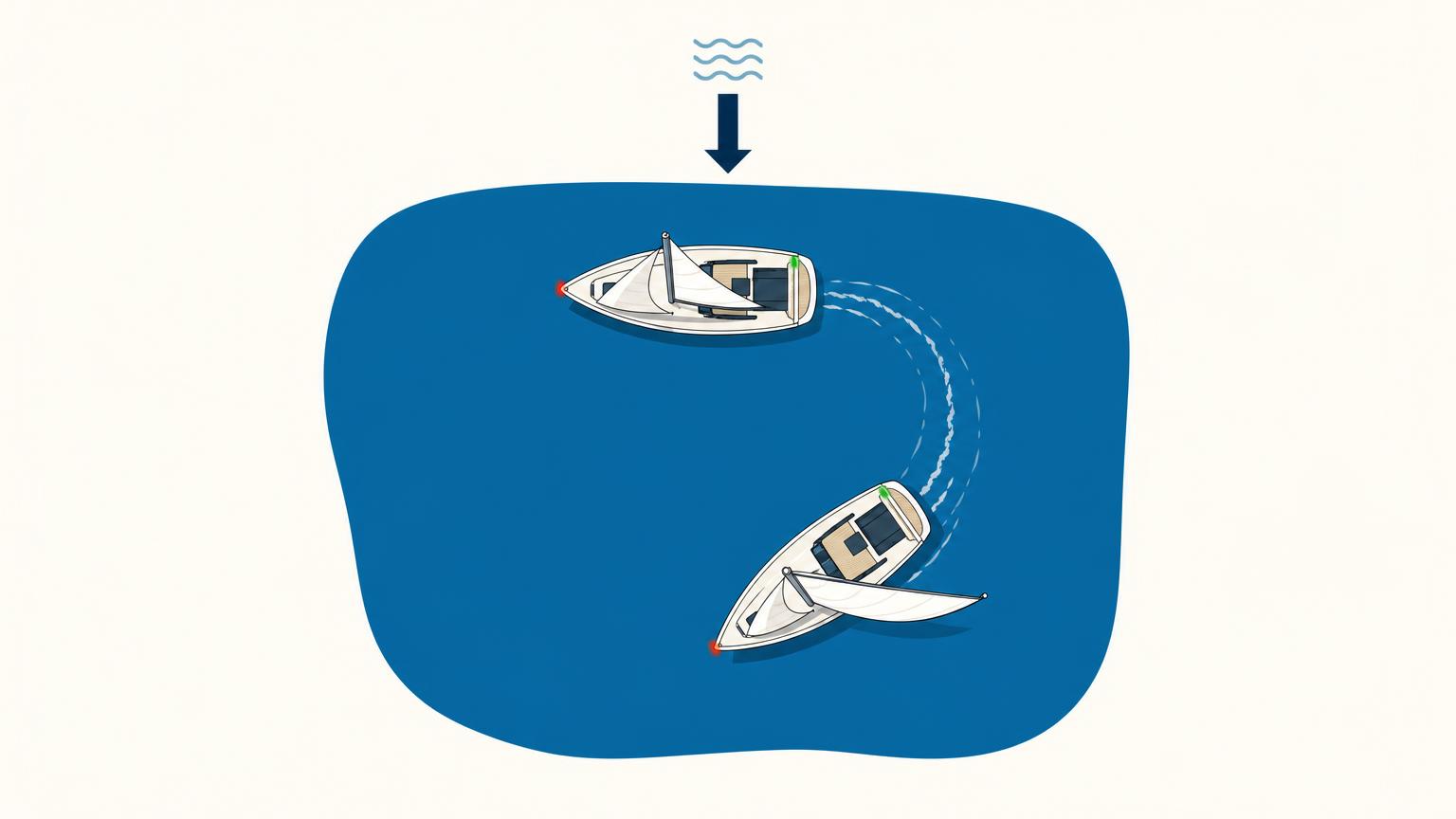
Watch the pattern rather than chasing an exact clock position: as the bow turns away from 12, the sails open step by step. A common mistake is leaving them trimmed for a tighter angle after bearing away; a sail still sheeted for close-hauled usually sits too tight and costs speed. Halfway out suggests a beam reach, farther out with the wind from behind the side suggests a broad reach. Two plan-view boats keep the same blue wind reference: the beam-reach sail lies halfway out, and the broad-reach sail opens farther as its course turns downwind.
What Does Running Downwind Look Like?
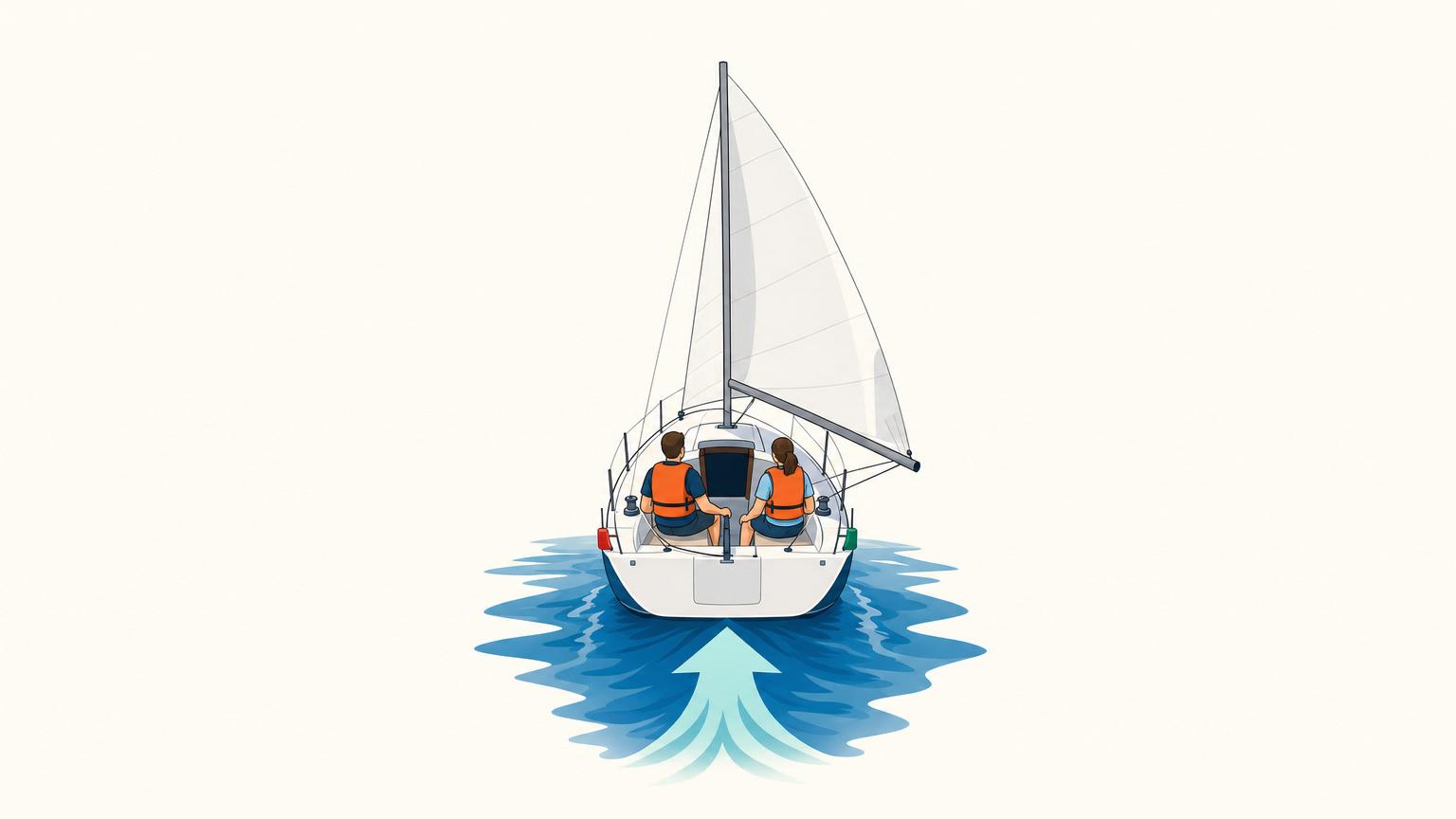
At the bottom of the sailor’s clock, the boat points directly away from the wind. This point of sail is called a run, or running downwind. The wind arrives over the stern, the back of the boat, and the mainsail is let all the way out. Some boats set the jib on the opposite side from the mainsail on a run, called “wing on wing” or “goosewinged,” so the boat catches wind on both sails instead of the mainsail blanketing the jib.
You may notice the wind on your back rather than your face, and the boat can feel flatter and quieter than it did closer to the wind. What has changed is how the sail works: closer to the wind it acts like a wing, using lift to pull the boat forward, but running dead downwind it acts more like a parachute, catching the wind and being pushed along by drag. Telltales are also less useful here, since the airflow behind a sail set for a run is already disturbed; a masthead wind indicator, reading clear air above the sail, is steadier on this point.
Look at the whole clock-face pattern: the sails were tight near the top, then eased farther out through each reach. At 6 o’clock, that progression is complete. The wind is directly behind you, the mainsail is fully out, and your course has a simple name: a run. The recognisable plan-view boat makes the relationship concrete: wind from astern and boat course point the same way, while the boom and orange sail open fully across the marked centreline.
Once you picture the wind arriving from 12 o’clock, the points of sail become a simple way to name your course by its angle to that wind, not by your speed or boat type. Near the closest sailable angle, you feel wind on your face and see the telltales streaming back evenly. As your bow turns away from the wind through each reach, you ease the sails farther out step by step, and the sail’s job shifts from pulling like a wing to pushing like a parachute at your back. Turn too far the other way, toward 12, and the sails start to flap, or luff, and the boat can stall there, a state sailors call being “in irons.” Naming the point of sail you are on is the habit this article builds. SailStarter’s short lesson 2.3, Points of Sail, walks through the same clock face if you want to test the pattern.
Try it from the lesson
Can you spot the next move?
The bow faces into the wind. The boat is stuck there, stopped or nearly stopped, with its sails flapping. What condition is it in?
Why you can trust this guide
. We build each guide from public seamanship and safety sources, then teach the universal principle before any local difference.
- en.wikipedia.org
- rya.org.uk
- americansailing.com
- americansailing.com
- americansailing.com
- hobie.com
- dummies.com
- iancadams.com
- sailingvirgins.com
- lbyc.org
- en.wikipedia.org
- en.wikipedia.org
- lakestclairsailingschool.com
- surfertoday.com
- offshoresailing.com
- kavas.com
- filovent.com
- allatsea.net
- nwboatschool.org
- saltyandwindy.com
- en.wiktionary.org