Chart your course
Red and Green Buoys: Which Side Do You Pass?
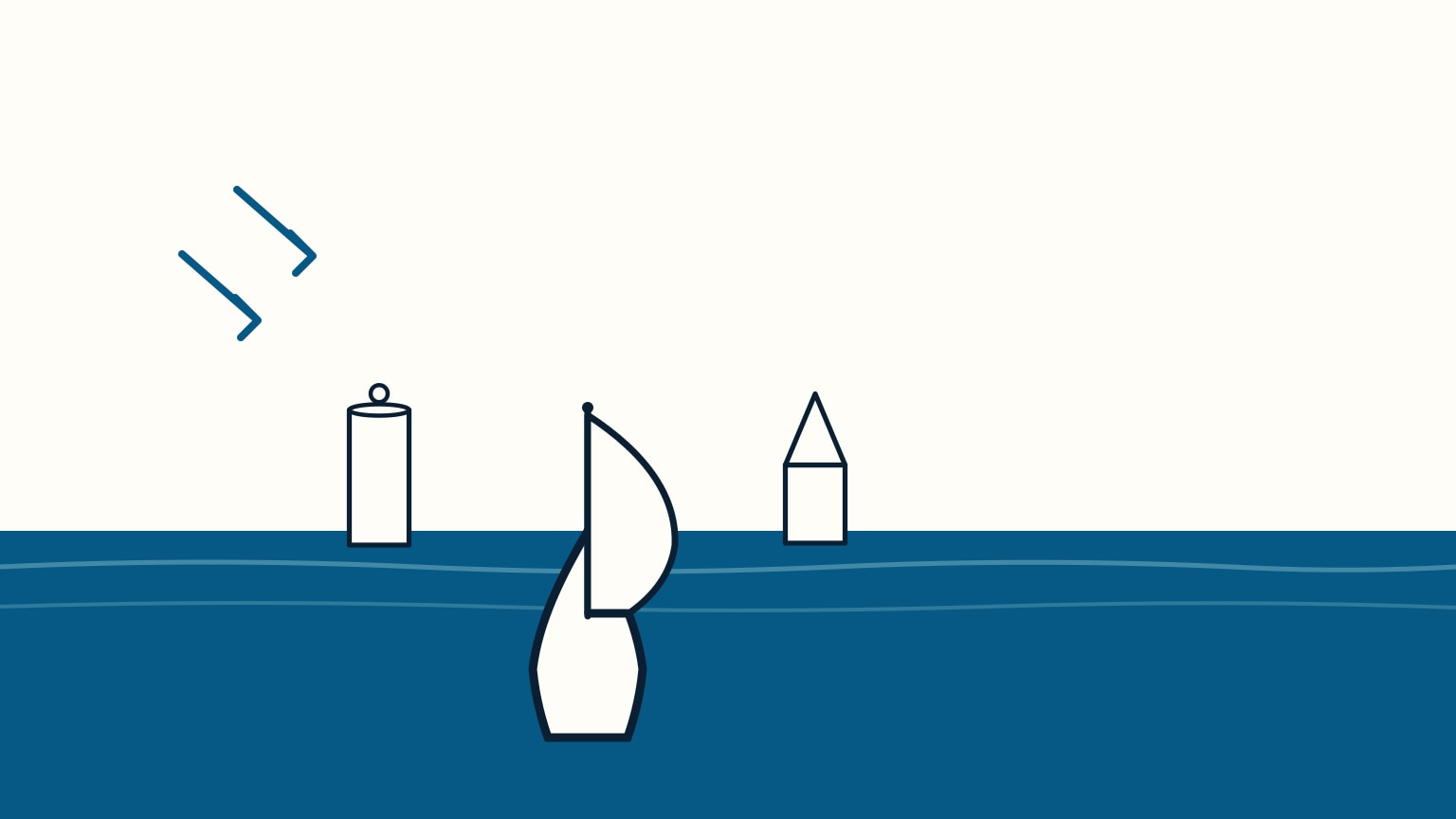
Quick answer
The short version
Red and green buoys mark the two edges of a channel. But which colour belongs on which side depends on where you're sailing. Every lateral buoy's meaning is read against the direction of buoyage, generally the direction of a boat returning from open sea; where that direction isn't obvious, the chart prints an arrow showing it. From there, the world splits into two systems. In IALA Region A (Europe, Africa, most of Asia and Oceania), returning from sea you keep red marks to port and green to starboard. In IALA Region B (the Americas, Japan, Korea, the Philippines), it's reversed: green to port, red to starboard. Shape backs up colour either way: a flat-topped can always marks one side, a pointed cone or "nun" the other, in both regions.
A stop sign is red in Bangkok and in Boston. A buoy isn't. Sail from a marina in England to one in Florida and the colours on either side of the same kind of channel entrance swap, while the shapes stay exactly where you'd expect them. Two different, internally consistent regional systems assign the colours that way, and knowing which one you're looking at is the whole trick. This article walks through the reference every lateral buoy's colour depends on, compares the two world regions side by side, and explains why the classic "red right returning" trick only works in one of them, plus how shape, light, and a plain unlit post carry the same message when colour alone won't do.
Direction of Buoyage: The Reference Every Colour Depends On
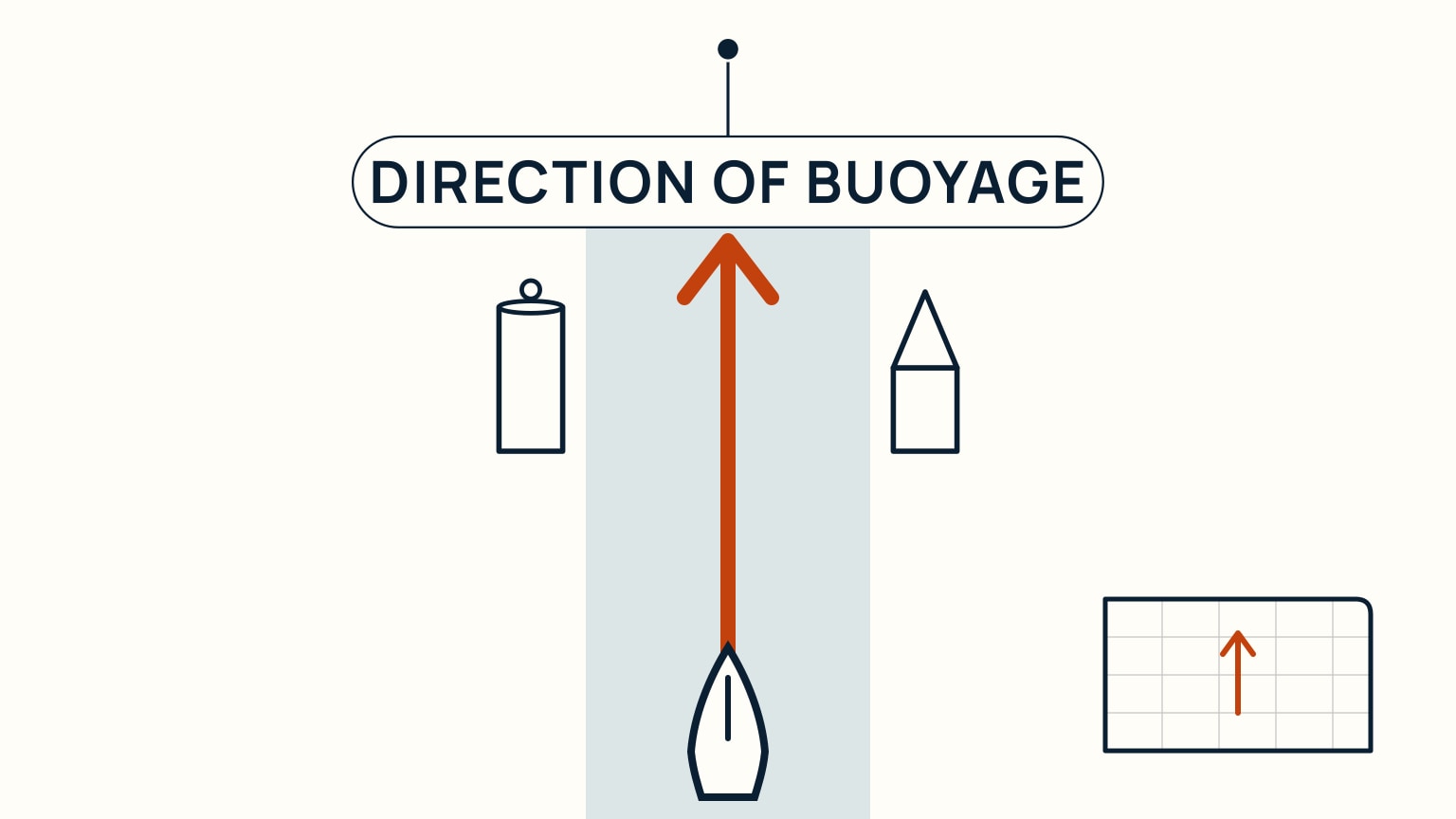
A lateral mark's colour means nothing on its own. It only makes sense read against a reference called the direction of buoyage. Generally, that's the direction a boat takes returning from open sea, or heading upstream into a river or estuary.
Lateral marks aren't only for the two sides of a straightforward channel, either. The same red-and-green system marks a junction or fork where a channel splits, shows the safe side to pass a charted hazard, and marks a safe centerline across a wide stretch of open water where the "edges" aren't obvious at all. In every one of those uses, the mark's colour still only means something once you know the direction of buoyage you're reading it against. Cardinal marks use compass directions instead of colour to show the safe side of an isolated hazard.
Where the geography doesn't make that direction obvious, the chart itself settles it: a dedicated arrow symbol is printed on the chart, the same sheet you'd already be reading for its title block and symbol legend. The same buoy, on the same channel, means the opposite side depending on which way you're travelling through it. That's true everywhere, before any regional colour system even enters the picture.
IALA Region A vs IALA Region B: Colours Swap, Shapes Don't
The world's lateral buoyage is split into two regions, and every mark you see belongs to one of them.
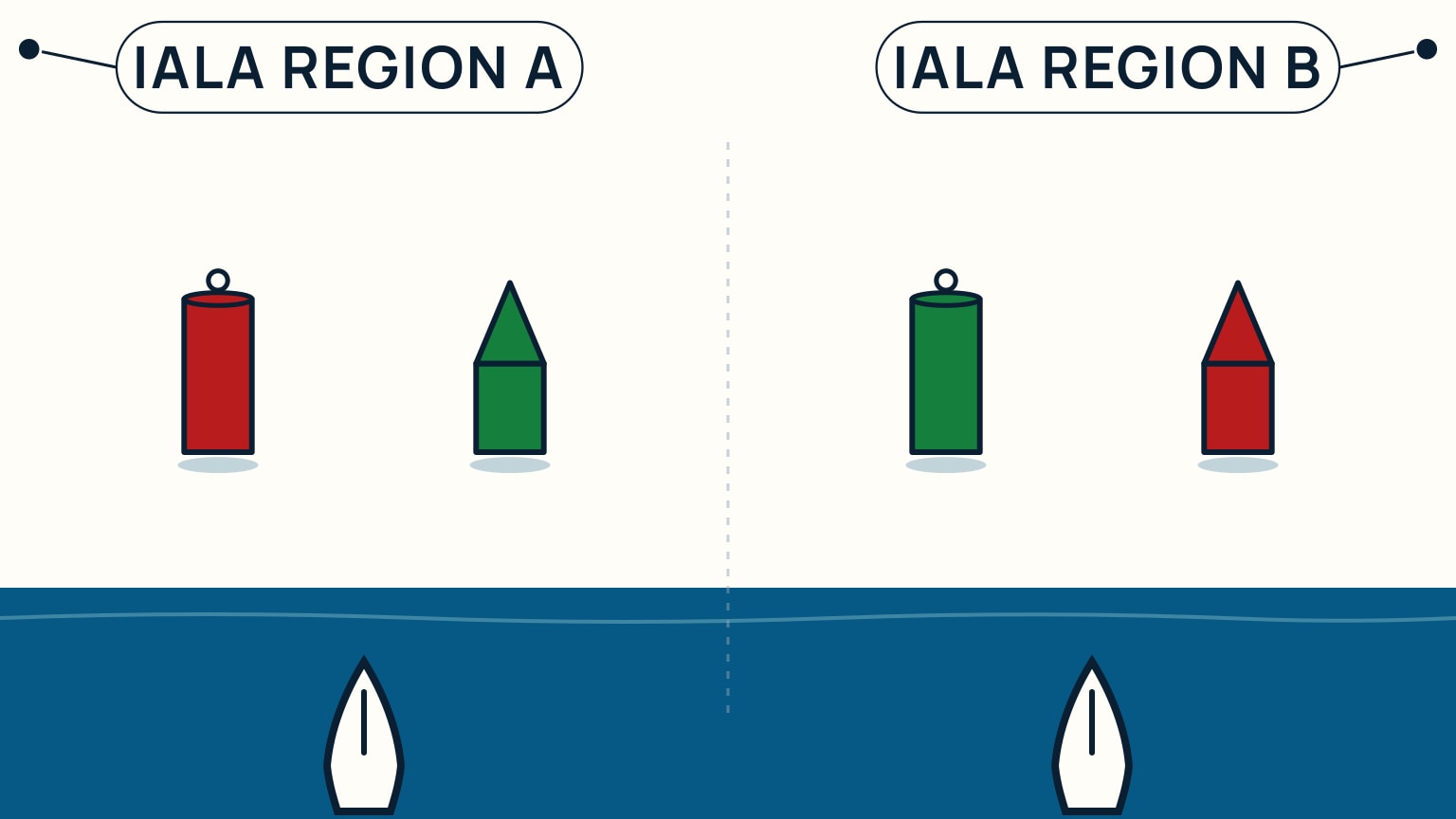
In IALA Region A (Europe, Africa, and most of Asia and Oceania), returning from sea, you keep red marks to port and green marks to starboard. In IALA Region B (the Americas, Japan, Korea, and the Philippines), it's reversed: green marks to port, red marks to starboard.
Shape doesn't flip with colour. A can (cylindrical, flat-topped) always marks the port-hand side; a cone or "nun" (pointed) always marks the starboard-hand side. So Region A's port mark is a red can, and Region B's port mark is a green can; same shape, opposite colour. Neither region is the default; a sailor needs to know which one they're in.
Picture the same beginner sailing two charters a year apart. Learning in Region A waters, they get used to keeping red cans to port without thinking about it. The next year, chartering in Region B waters, that same red colour now marks the starboard-hand side, on a cone-shaped mark instead of a can. Nothing about the buoy misled them; the region they were sailing in simply changed, and the colour-to-side pairing changed with it.
"Red Right Returning" Only Works in Region B
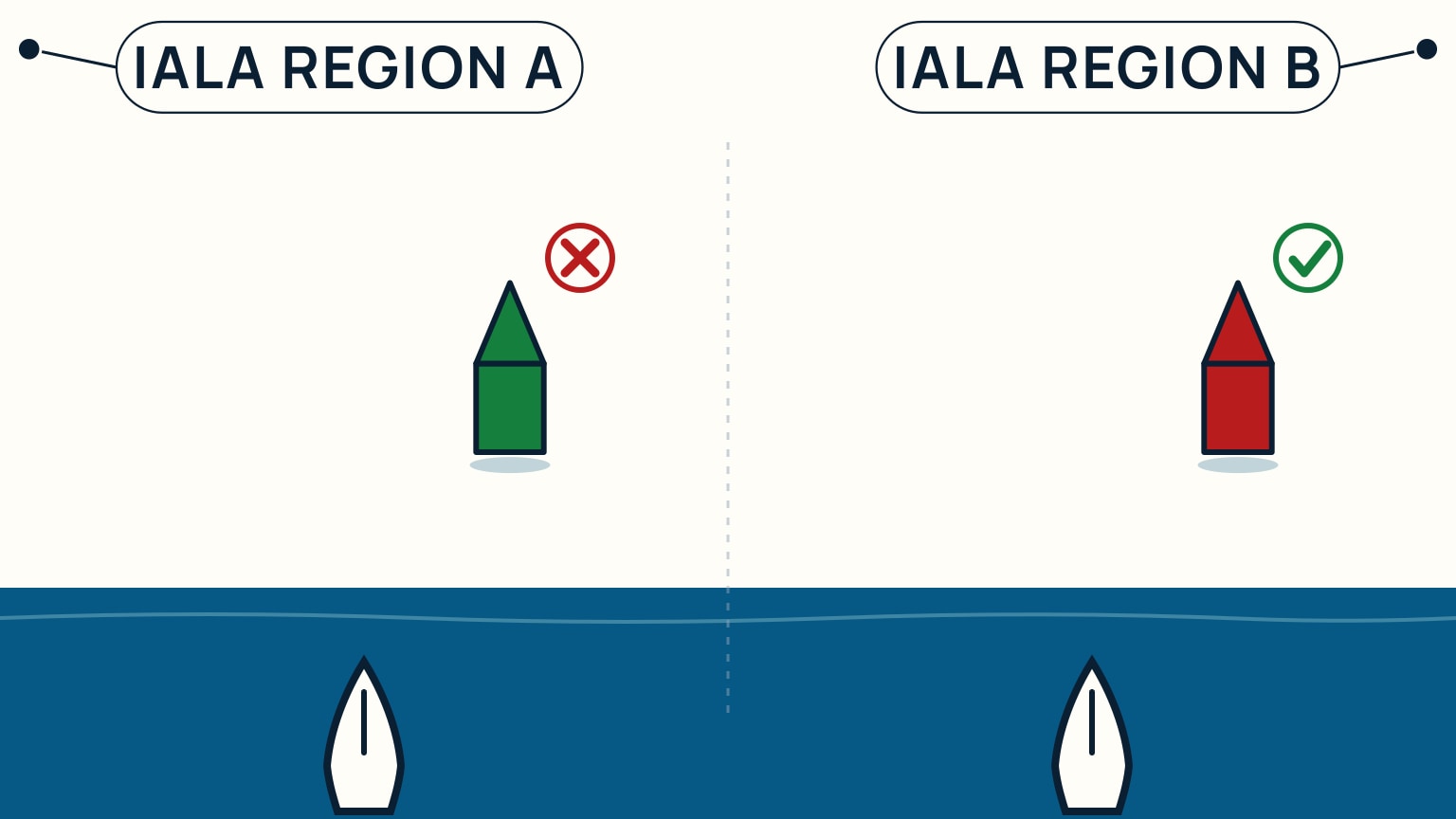
"Red right returning" (keep red to starboard, your right hand, when returning) is a real, accurate, widely taught mnemonic. It's also a Region B rule, not a universal law of the sea.
A sailor who has that phrase memorized and then charters a boat in Region A waters would confidently, calmly pass a buoy on the wrong side, because in Region A red belongs to port, not starboard. Region A has its own regional teaching phrases pointing the opposite way, for the same reason: every short mnemonic like this is built for one region and breaks in the other.
It's also worth remembering that "returning" itself depends on knowing the direction of buoyage, the same reference from the first section. Get that wrong and even a mnemonic for the right region won't save you.
Shape, Topmark, and Light Carry the Same Message
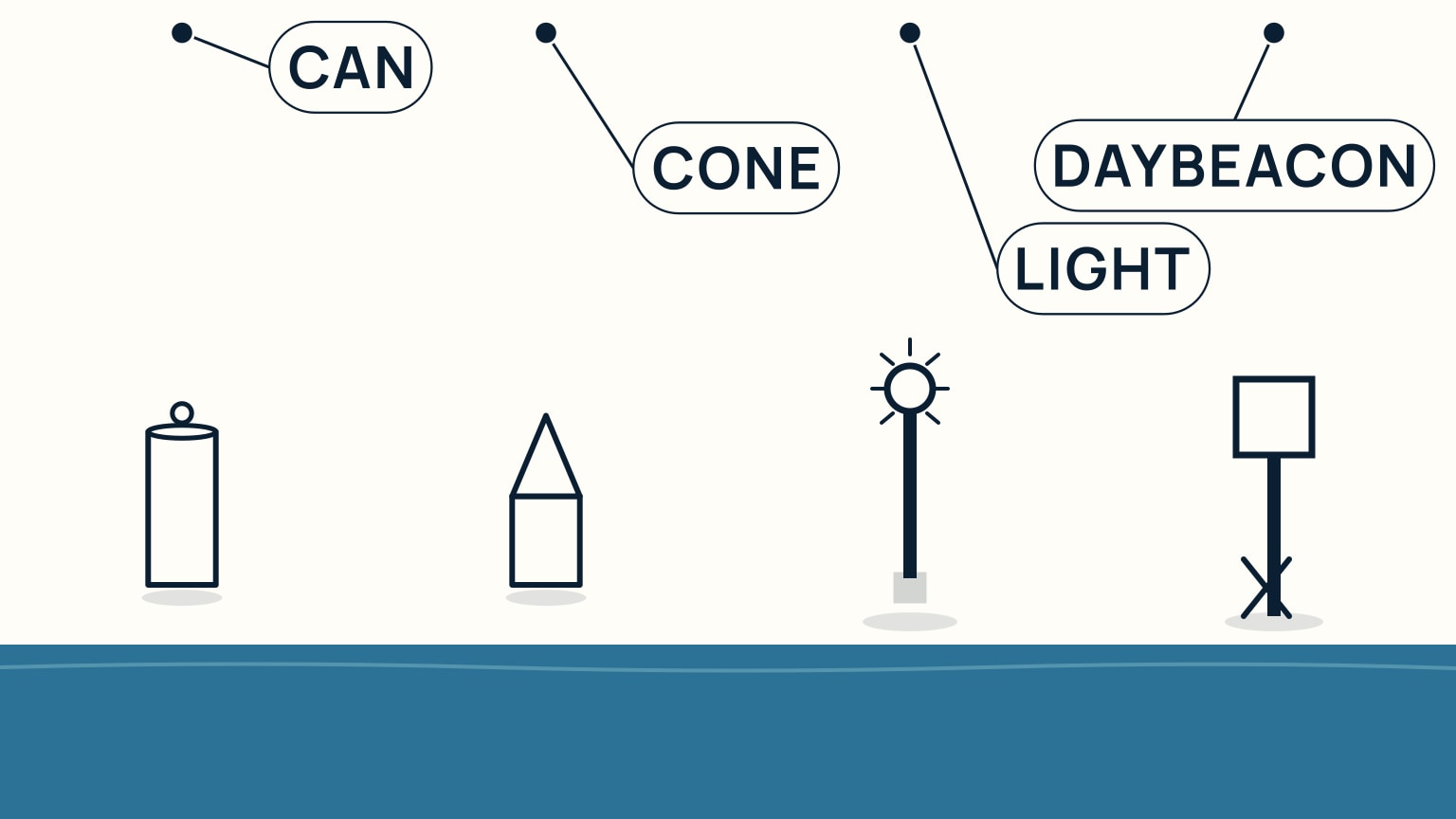
Colour is only one channel of information, and it's the one that fails first in glare, dusk, or fog. Shape backs it up without needing colour at all: a can's flat top marks one side, a cone or nun's pointed top marks the other, in either region.
A topmark (a small shape, often a sphere, fixed above a mark) reinforces identity further, which matters most on a beacon, a fixed post with no colour advantage in poor light either. On a starboard-hand mark, the topmark itself is conical with the point facing upward, echoing the cone shape of the mark it sits on, so the two reinforce rather than duplicate each other.
Buoy and beacon are two different kinds of aid to navigation, worth telling apart. A buoy floats, moored to the bottom; a beacon is fixed in place, usually driven into the bottom itself. A lit mark's light is the same colour as its side, and its flash rhythm and period are printed on the chart beside the mark's symbol, in a short code such as "Fl G 6s" for a green light that flashes once every six seconds. Learning to read that code is what lets you confirm a mark's identity after dark, when its colour and shape are both hard to judge. A daybeacon is simply the unlit version of a beacon: a shape fixed to a post rather than a floating, lit buoy, carrying exactly the same lateral meaning as its coloured, lit cousin.
Where a Channel Splits: Preferred-Channel Marks
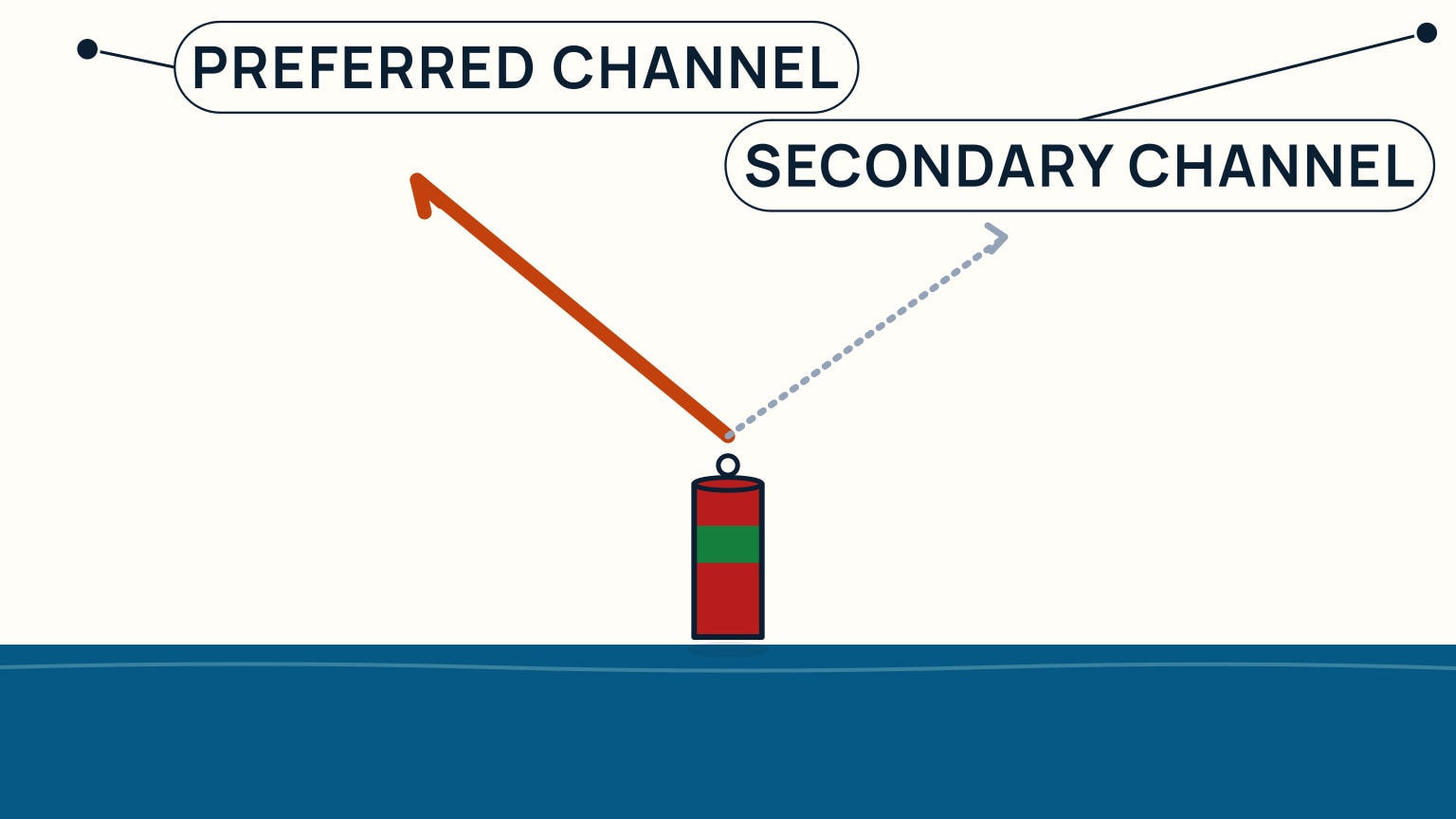
At a fork in a channel, a single buoy or beacon carries bands of both colours instead of just one. The international buoyage authority calls this a modified lateral mark, and the rule for reading it is the same in both regions: look at the dominant colour, the one covering most of the mark's body, and its shape, then read that pairing exactly as you would an ordinary lateral mark of the same colour and shape.
In IALA Region A, a mostly-red can, banded with green, is kept to port for the main channel, exactly like any other red can; a mostly-green cone, banded with red, is kept to starboard, exactly like any other green cone. In IALA Region B, a mostly-green can, banded with red, is kept to port for the main channel, exactly like any other green can; a mostly-red cone, banded with green, is kept to starboard, exactly like any other red cone. Some US material describes this same mark by its top-most band instead of its dominant colour, which usually points to the same answer but is a plain-language shortcut rather than the standard's own wording. When you're not sure which one you're looking at, dominant colour and shape are the reading to trust. Shape still carries its ordinary meaning either way, and a lit mark flashes in a pattern of two flashes followed by one, a rhythm reserved for exactly this kind of mark in both regions and used for nothing else on an ordinary lateral light.
None of this needs memorizing perfectly on the first pass. What helps is one standing habit: read the chart in front of you (its direction-of-buoyage arrow, its symbol legend, and the mark's own colour and shape) rather than lean on a rule half-remembered from somewhere else. A mnemonic is a good shortcut once you know which region it belongs to, and a bad one the moment you cross into the other. Buoyage details are also corrected and occasionally revised, so it's worth a quick check of current local charts or notices before you sail somewhere new to you. SailStarter's short lessons work through exactly this kind of reading, buoy by buoy, until picking the right side stops being a guess.
Try it from the lesson
Can you spot the next move?
You're entering a harbor in Region A, returning from the open sea. A red, flat-topped buoy sits ahead. Which side do you keep it on?
Why you can trust this guide
. We build each guide from public seamanship and safety sources, then teach the universal principle before any local difference.