Chart your course
Sailboat Engine Won’t Start: First Checks
Quick answer
The short version
If a sailboat’s diesel will not start, first protect the boat from traffic, a lee shore, or a confined berth. Then name the symptom: dead panel, click with no rotation, slow cranking, normal cranking without firing, or starting and stopping. Confirm neutral, stop control, battery switch, accessible connections, fuel shutoff, fuel level, and the exact cold or warm start procedure in the installed engine manual. Do not keep cranking beyond its stated limit or loosen high-pressure injection lines.
Those checks are deliberately conservative. They can reveal a control left in the wrong position or gather evidence for a technician without adding a fuel leak, electrical short, burn, or flooded boat to the original fault.
Protect the Boat and Record the Symptom
Assign one person to boat handling and lookout while another checks the engine. If the yacht is moving toward danger, use sails, anchor, lines, or assistance as conditions and crew skill allow. Make the call for help early enough that propulsion loss remains manageable. A no-start alongside the fuel dock is inconvenient; the same fault approaching rocks is an emergency.
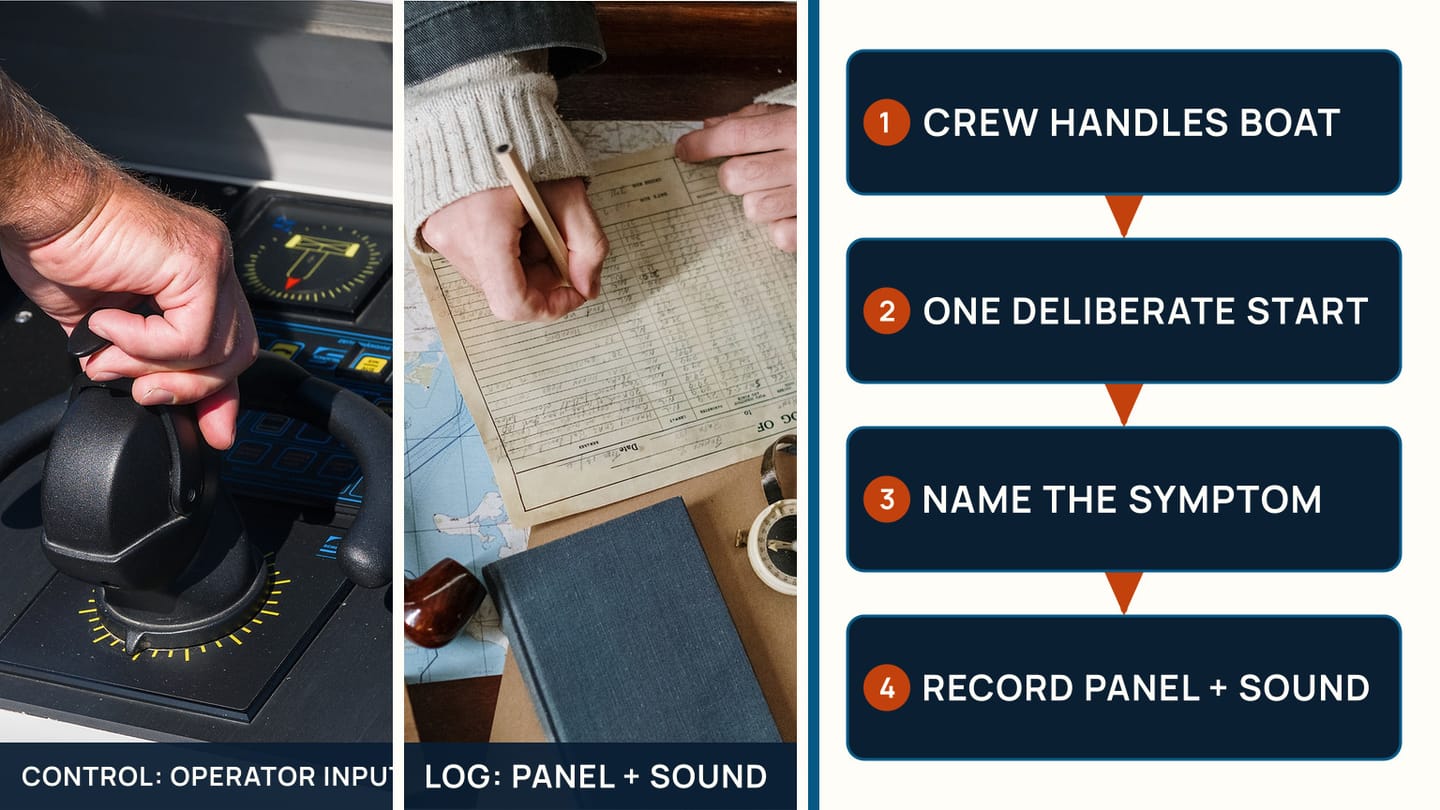
Try one deliberate start while watching and listening. Record what happens at the panel and engine:
- A dead panel points first toward the main supply, battery selector, stop or control circuit, and panel power.
- A click without rotation keeps the starter circuit, battery, cable connections, or a mechanical restriction in view.
- Slow cranking suggests weak supply or excessive voltage loss, although mechanical causes are possible.
- Normal cranking without firing moves attention toward fuel delivery, shutdown controls, start procedure, and engine faults.
- Starts then stops calls for the time to failure, warning indications, and whether the stop is abrupt or gradual.
Write down fuel level, battery selected, recent maintenance, how long the engine last ran, ambient temperature, warning lamps or codes, and any unusual smoke, smell, heat, or sound. If it stopped during a previous run, note whether it faded under load or stopped instantly. Do not erase electronic evidence or disconnect batteries merely to make a code disappear.
Open an engine enclosure only as the boat and manual permit. Keep clothing, hair, and tools clear of belts and pulleys. Treat hot metal and pressurised coolant as burn hazards. Smoke, arcing, a burnt smell, a fuel leak, or abnormal resistance at the crank ends the attempt. The sailboat engine-check routine is worth practising before trouble because it teaches where normal levels, controls, and sounds are on your installation.
Check a Dead Panel, Click, or Slow Crank
Return the shift control positively to neutral and confirm the engine stop control is fully in its run position. On some installations, a control can look correct without reaching its interlock. Never bypass a neutral-start switch to test it. Confirm the battery selector is set to the intended bank and that an emergency isolation switch has not been opened.
With power isolated where required, inspect accessible battery and starter-circuit connections for looseness, corrosion, damage, or a cable disturbed by recent work. Do not place a tool across terminals or bridge a starter solenoid. A marine starting circuit can deliver very high current, and a spark near fuel or a battery can have severe consequences.
A display or cabin light is not a load test. A battery can produce a normal-looking resting voltage yet fall sharply during cranking. A corroded or loose connection can cause the same symptom. Use only the battery and engine maker’s specified measurements, connection sequence, and protective equipment. If you do not understand the circuit or cannot reach it without contacting moving or hot parts, stop and arrange help.
Check only owner-serviceable fuses and breakers identified in the manuals. Replace a blown fuse once with the same specified type and rating after looking for an obvious cause. If it opens again, the fault needs diagnosis. Never increase the rating. Heat at a terminal, damaged insulation, melted plastic, smoke, or repeated clicking also calls for qualified electrical service.
Some engines specify glow-plug or intake-heater time before cranking. Others manage preheat automatically. Follow the exact panel sequence and observe its indicators. Repeated short guesses can flatten the battery and obscure the original symptom. Respect the starter’s crank and cooling intervals. If the engine turns unevenly, locks, or makes a new mechanical noise, do not force another attempt.
Check Normal Cranking With No Start
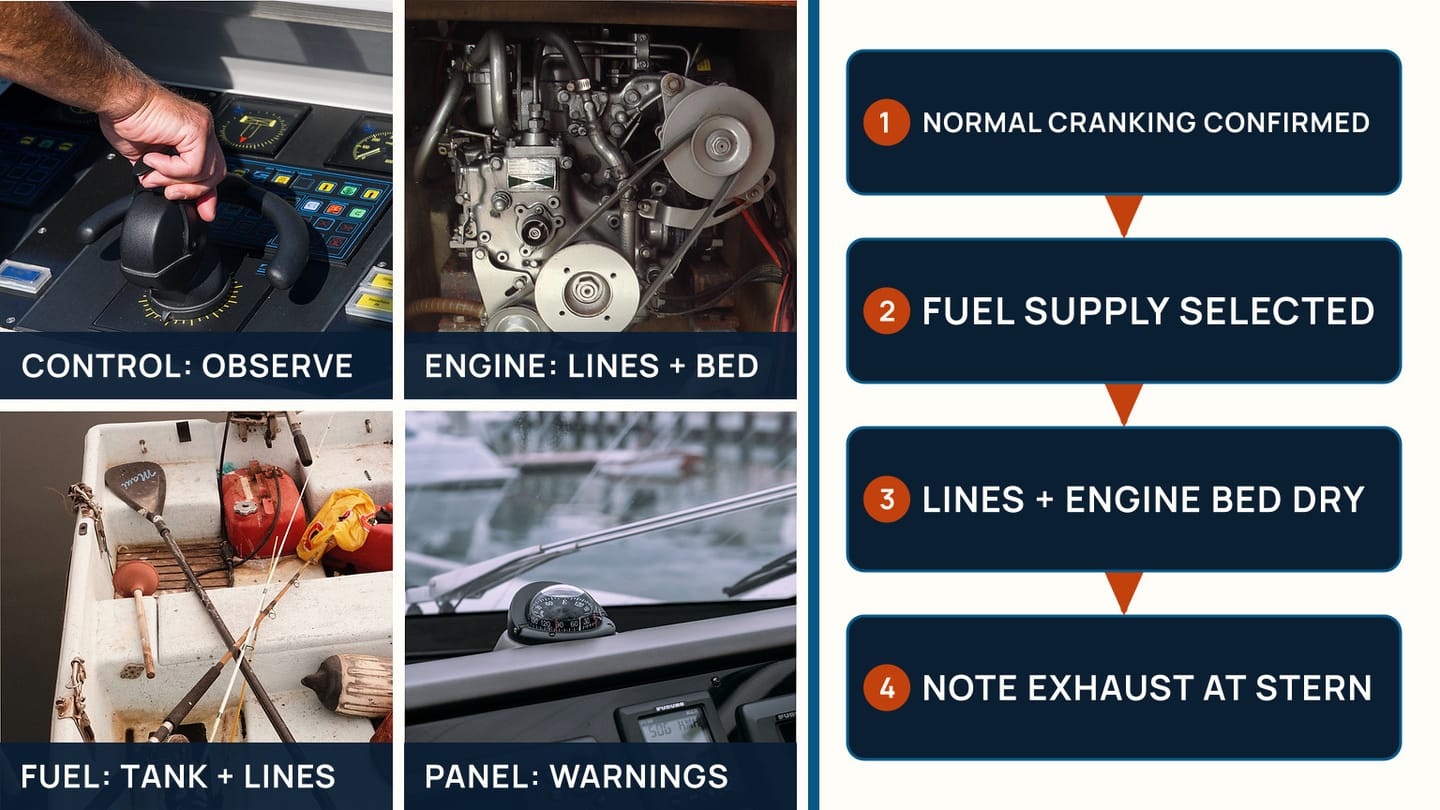
Confirm the fuel shutoff is open or the stop control is released, the selected tank has the correct fuel, and any changeover valves are in the intended position. Read the gauge but verify the tank selection and known fuel state; a gauge can mislead, and an unused tank may contain old or contaminated fuel. Inspect accessible supply lines and the bilge for leakage before operating a primer or lift pump.
If the system was recently serviced, look for a closed valve, loose filter connection, or other disturbed item without dismantling it under way. Air can enter a diesel fuel system after a filter change or empty tank, but bleeding procedures differ. Follow the installed manual at the stated low-pressure points. Do not loosen high-pressure injection pipes: fuel can penetrate skin, and modern systems may retain dangerous pressure after stopping.
Water in a separator, blocked filters, failed lift supply, electrical shutdown devices, or injection faults may all produce a no-start, but naming possibilities is not permission to replace parts at random. Drain or replace an owner-serviceable filter only when the manual permits it, you can contain fuel, and the boat is secure. Prevent fuel from reaching the bilge or water and follow current local disposal rules.
Watch the exhaust during a permitted attempt from a safe position. The presence or absence of smoke can be useful to a mechanic, but it is not a complete diagnosis. Record its colour and duration without leaning near the outlet. Likewise, a fuel smell is a reason to check for leakage and ventilation, not proof the cylinders are receiving the right amount of fuel.
If the engine has overheated, lost oil pressure, taken in water, run out of fuel in unsafe conditions, or been partly submerged, move to the maker’s specific recovery procedure and professional help. If temperature was involved, use the separate marine diesel overheating guide rather than treating the event as an ordinary no-start.
Restart Carefully and Escalate With Evidence
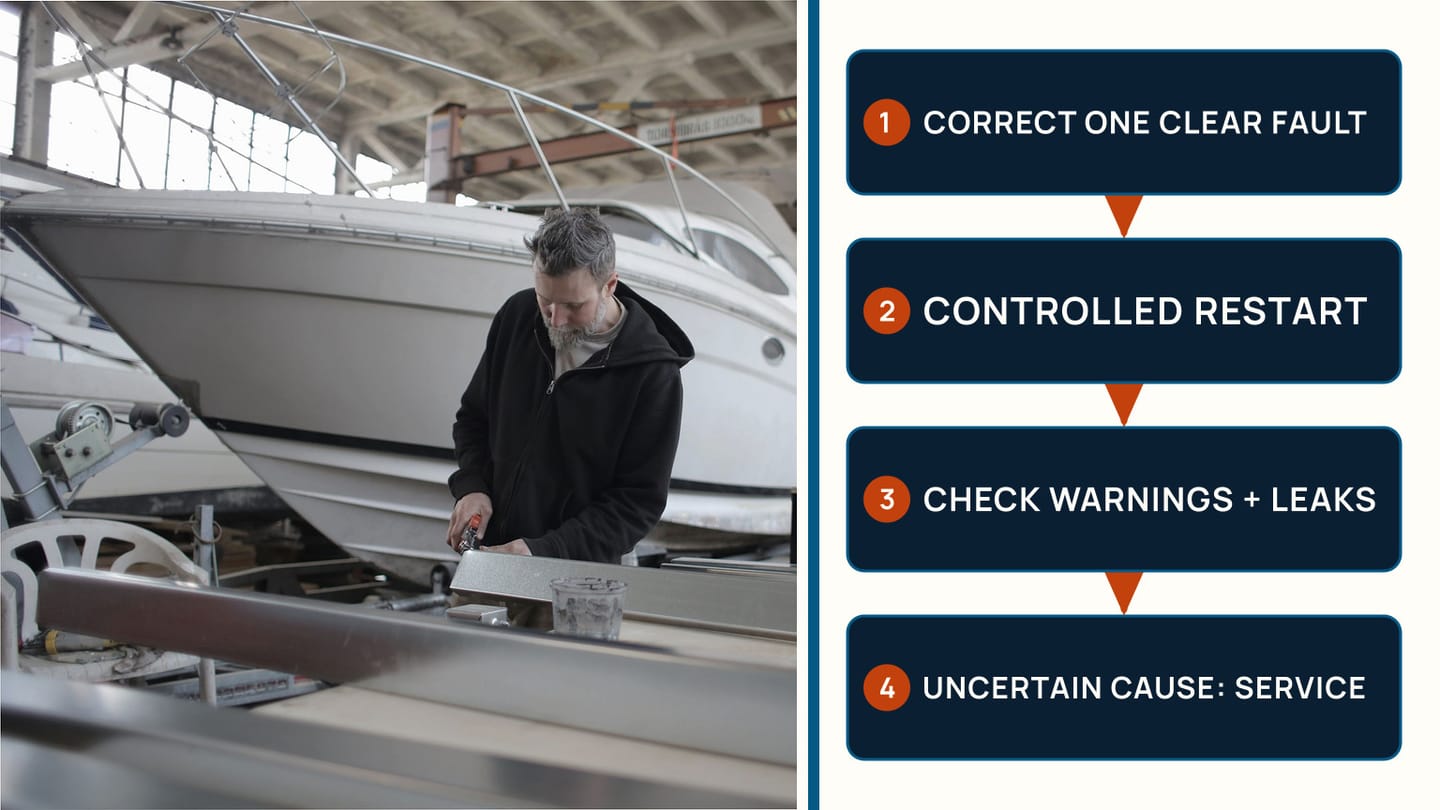
When one clear setup fault is corrected, carry out a controlled restart with the boat secured. Before cranking, confirm neutral, ventilation as fitted, fuel and cooling valves in their operating positions, tools removed, guards installed, and everyone clear of moving parts. Follow the manual’s preheat and crank limits.
After starting, confirm normal warning indications, oil-pressure response, cooling-water discharge where visible, stable idle, and no fuel, oil, coolant, raw-water, or exhaust leak. Do not leave the berth solely because the alarm stopped. Increase load only in the manner and place the maker permits, and keep watching the systems disturbed during the check.
A start is not proof of repair when the cause is uncertain. A cable that works after being moved needs a correct termination. An engine that runs only after repeated priming still has a supply problem. One that starts cold but not warm gives a technician a repeatable condition. Book service before relying on it for a narrow channel or lee shore.
Prepare a useful handoff: engine model and serial, hours, exact symptom, battery and fuel selection, control positions, panel messages, weather, last successful run, recent work, measurements made, and what changed the result. Photographs of displays and accessible leaks help. A service history built with the marine diesel maintenance checklist often reveals whether a filter, belt, battery, or inspection is overdue.
Restore fuel absorbents, fuses, and other spares after the event. Recharge and test the starting bank as its maker specifies. Correct any reason the boat became exposed while troubleshooting. If reliable propulsion cannot be restored, arrange an appropriate tow at sea rather than attempting a demanding approach on hope.
The best first checks do not prove expertise by dismantling the engine. They keep the yacht safe, split the symptom into a useful category, verify simple controls and supplies, and preserve evidence for the person who can diagnose the next layer.
Use SailStarter’s propulsion lesson to locate your neutral interlock, stop control, battery selector, fuel shutoff, primary filter, cooling-water inlet, and normal panel indications. Keep the correct manual aboard and rehearse a calm, spoken no-start sequence while the boat is securely berthed.
Try it from the lesson
Can you spot the next move?
The engine is idling, the boat is safely secured and the propeller area is clear. What should you confirm before departure?
Why you can trust this guide
. We build each guide from public seamanship and safety sources, then teach the universal principle before any local difference.