Chart your course
Why Won’t My Outboard Start?
Quick answer
The short version
When an outboard will not start, first keep the boat clear of traffic, rocks, and a lee shore. Then identify the symptom: nothing happens, the starter clicks, it cranks slowly, it cranks normally without firing, or it starts and stops. Confirm the control is in neutral, the emergency-stop clip is fitted, battery connections are secure, the correct fuel is available, the tank vent and fuel path are open, and the model-specific start controls are set as its manual directs. Stop repeated attempts at the manual’s limit.
That short sequence catches simple setup faults without turning the cockpit into a workshop. It also gives a mechanic useful evidence if the problem lies beyond owner checks.
Secure the Boat and Read the Symptom
Loss of propulsion is a boat-handling problem before it is an engine problem. Put on flotation, keep a lookout, and tell the crew what is happening. Use the anchor, sails, a line, or assistance only as conditions and competence allow. A drifting boat near a harbour entrance needs an early call for help, not another ten minutes with everyone looking at the engine.
Make the working area orderly before anyone starts checking controls. Secure loose lines away from the propeller, keep the key with the person doing the test, and ask one crew member to repeat each change aloud. On a small tender, move weight carefully so two people leaning over the transom do not reduce freeboard or stability. These controls matter more than a quick diagnosis when the boat is exposed.
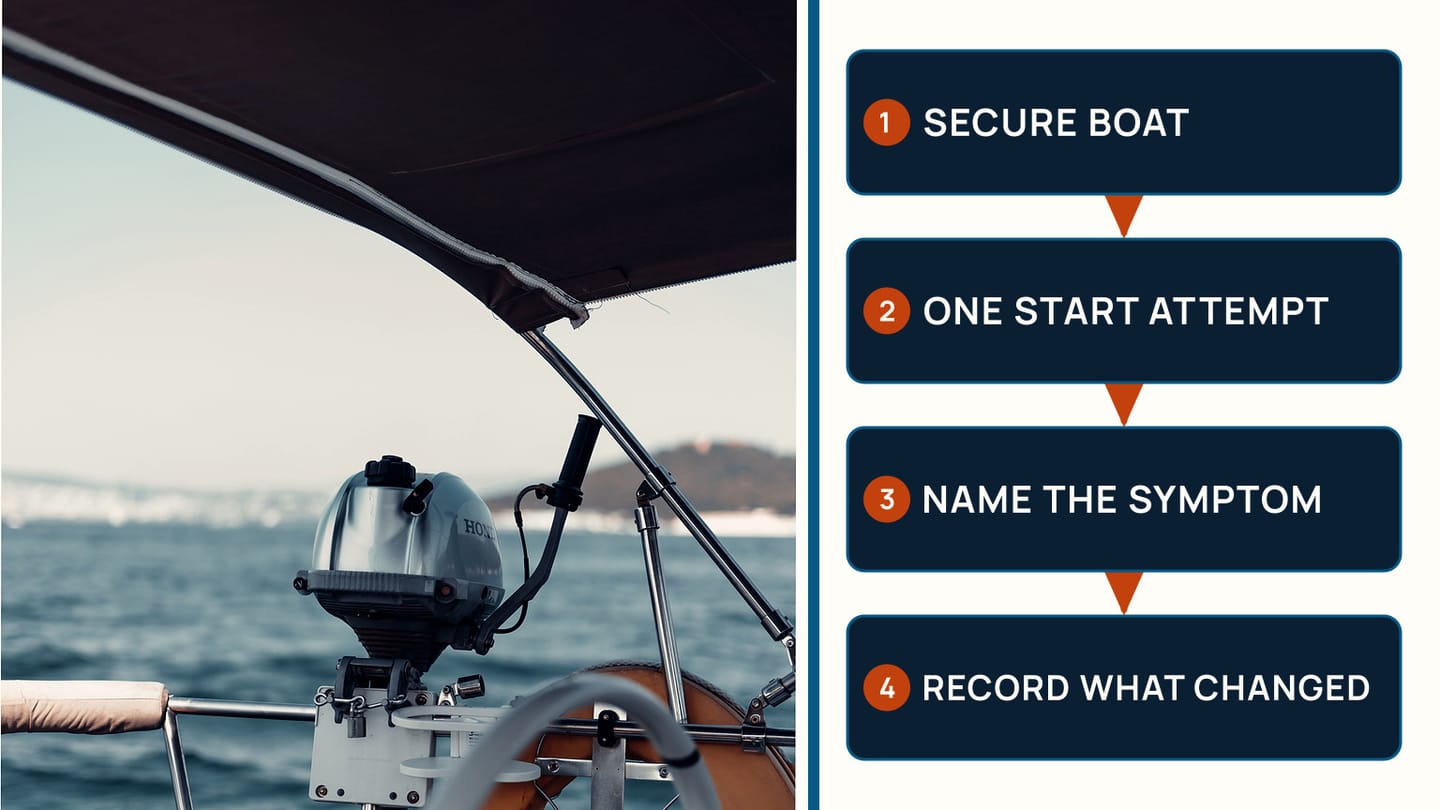
Stop and listen through one deliberate start attempt. Record what the engine and controls actually do:
- No sound or movement: start with neutral position, stop circuit, main switch, battery, fuse, and control power.
- A click but no rotation: think about battery state, loose or corroded connections, starter circuit, or a mechanical problem.
- Slow cranking: weak supply, voltage loss, cold conditions, or excessive mechanical load may be involved.
- Normal cranking with no firing: move toward fuel supply, correct starting procedure, and faults requiring service.
- Starts then stops: note how long it runs and whether fuel priming or control position changes the symptom.
Do not guess from the word “dead.” A silent panel and a normally cranking engine are different cases. Note warning lamps, display messages, fuel smell, smoke, unusual heat, and the last work done. If the engine stopped while running, record whether it faded, stopped abruptly, alarmed, struck something, or followed a fuel-tank change.
Keep people clear of the propeller whenever the engine might start. Never defeat the neutral interlock or emergency-stop system to test it. Remove the key or isolate power before touching accessible connections, and do not work over the transom in unsafe water. Review leaving a dock under power before the next trip so a failed start at the berth does not become an improvised departure.
Check Interlocks and Electrical Supply
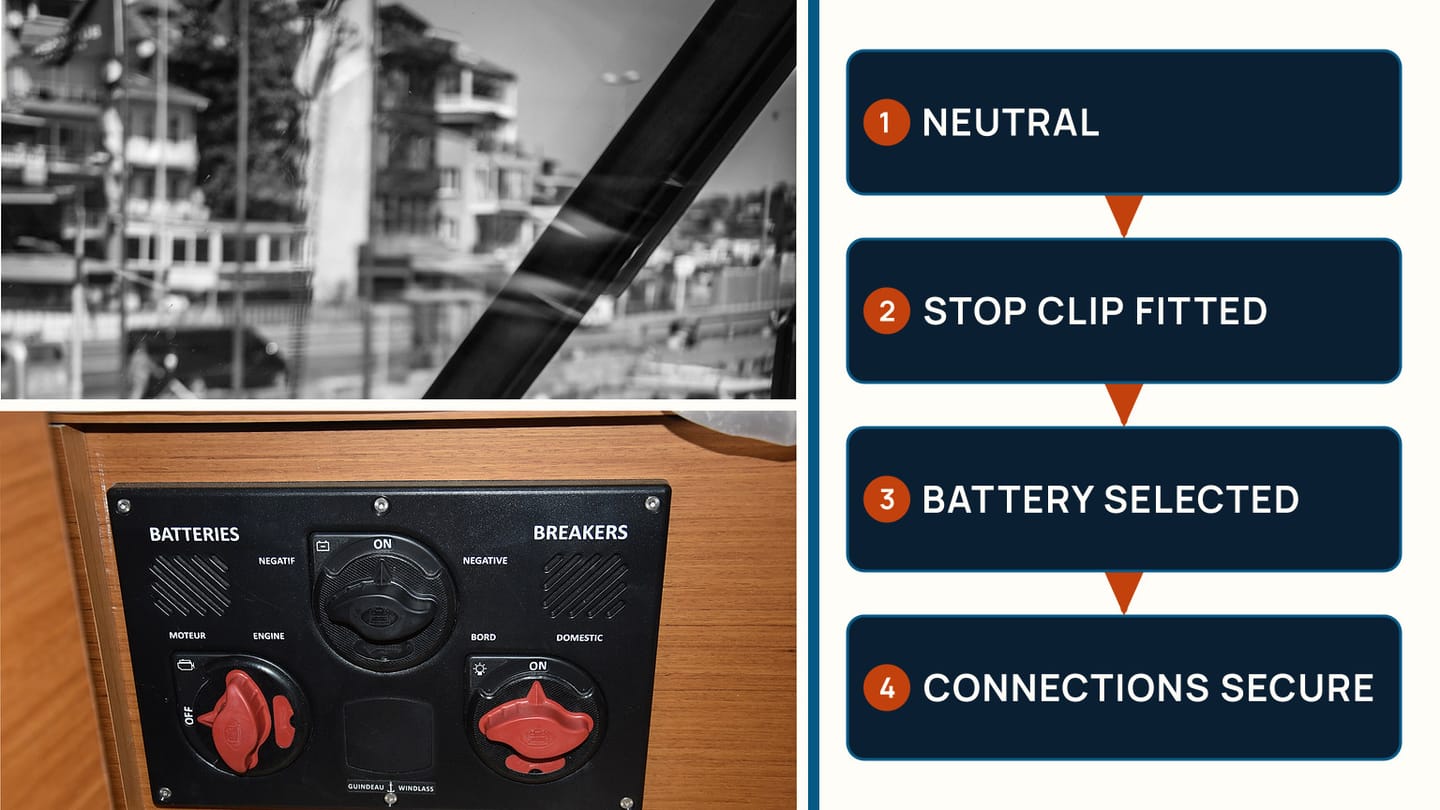
Return the control firmly to neutral even if it appears close. Many outboards will not crank when the shift position is not recognised. Fit the correct emergency-stop clip and check that its lanyard has not pulled partly free. Use the exact start sequence in the owner’s manual because key, button, throttle, choke, and priming arrangements vary by model and age.
For electric start, switch off unnecessary loads and inspect the battery only where access is safe. Confirm the selector or main switch is in the intended position. Look for a loose terminal, obvious corrosion, a damaged cable, or a connection disturbed during recent work. Do not bridge terminals or bypass a fuse. Sparks around fuel vapour and unprotected high-current circuits can cause fire or injury.
A voltmeter reading can help when you know the system and the maker’s procedure, but one resting reading does not prove the battery or starter circuit can carry cranking load. A battery may show voltage and still collapse under load; a poor cable connection can create the same slow-crank symptom. If cleaning or tightening a permitted connection is within your skills, isolate the system and follow the battery and engine manuals. Otherwise, record the symptom and arrange service.
Locate only the fuses the manual identifies for owner inspection. Replace a failed fuse once with the specified type and rating after checking for an obvious cause. A second failure is evidence of an electrical fault, not permission to fit a larger fuse. Heat, smoke, arcing, melted insulation, or a burnt smell ends the check immediately.
Manual-start engines still have interlocks and stop circuits. Do not pull repeatedly against abnormal resistance or remove covers around moving parts afloat. A cord that will not move normally, a recently submerged engine, or evidence of impact calls for the maker’s recovery or service procedure.
Trace Fuel Supply and Starting Controls
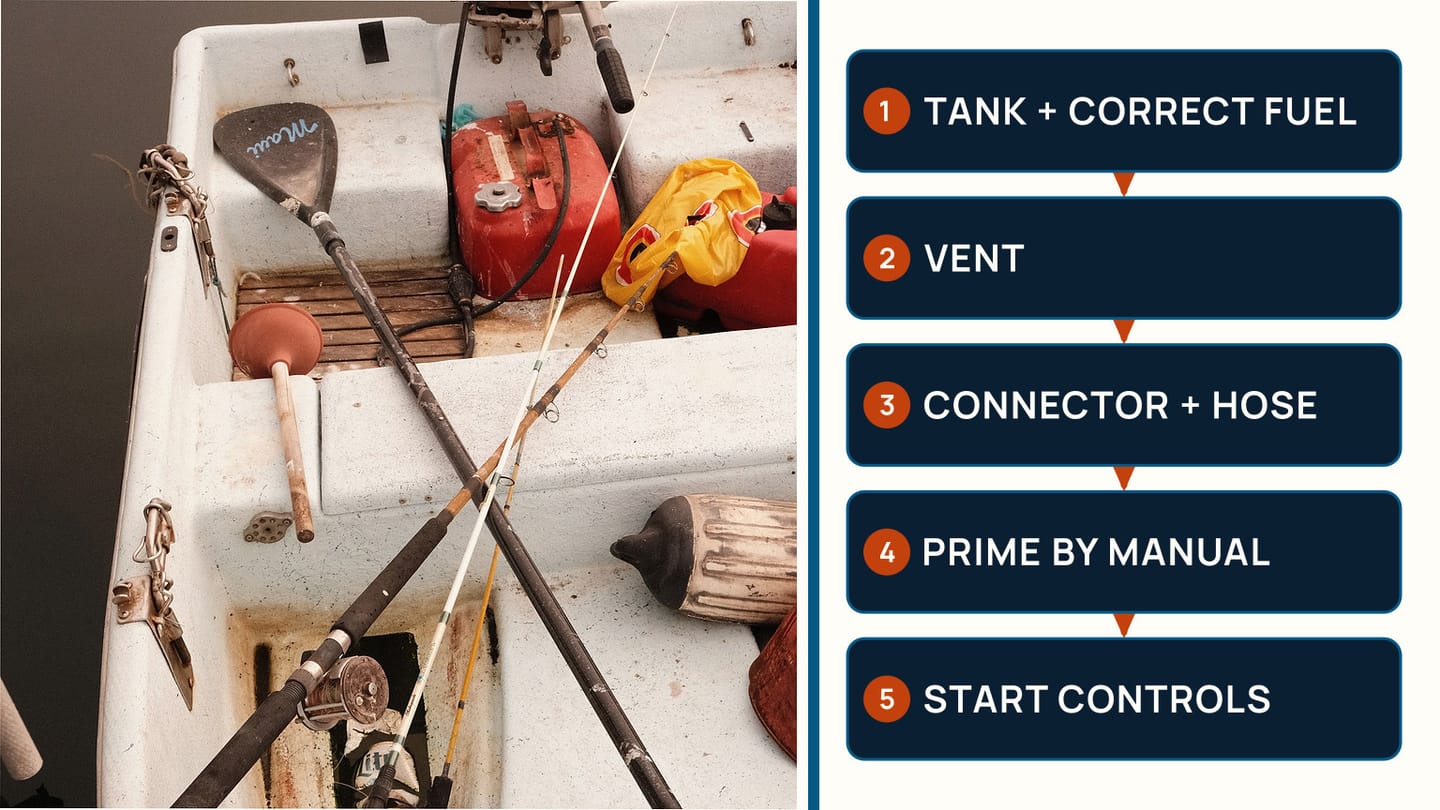
If the engine cranks normally, confirm the fuel before dismantling anything. Check that the tank contains the correct fresh fuel, the vent is open where the design requires it, the connector is fully seated, and the hose is not sharply kinked or visibly damaged. Confirm any fuel cock is in the operating position. Portable tanks and connectors are model-specific; forcing a fitting can create a leak.
Prime only as the manual directs. A primer bulb has a specified orientation and procedure on many systems, and excessive priming or unnecessary choke can flood some engines. Cold-start enrichment, throttle position, and warm-start steps differ between carburetted and fuel-injected models. Follow the installed manual rather than a remembered routine from another motor.
Stop if you see leaking fuel or smell strong fuel accumulation. Do not smoke, switch unprotected equipment, or create sparks. Ventilate as appropriate, control the spill, and follow the boat’s fuel-safety procedure. Boat engine ventilation and fueling safety gives the wider preparation that should already be in place.
Avoid the common escalation from observation to random parts removal. Spark testing, carburettor work, injection diagnosis, starter bypasses, and internal repairs can introduce ignition, shock, fire, or mechanical hazards. Modern engines may store fault information that a qualified technician can read. Preserve that evidence instead of disconnecting everything in search of a reset.
If there are two portable tanks, hoses, or engines aboard, label them rather than swapping components casually. A controlled substitution is useful only when the manual permits it, the fittings and fuel are correct, and the result is recorded. Moving an unknown hose or suspect tank to the other engine can turn one no-start into two.
Make a compact service note: engine model and serial, fuel age and source, tank used, exact symptom, battery behaviour, controls checked, warnings shown, weather, and recent maintenance. If switching tanks or making one manual-approved correction changes the symptom, record that too. This is much more useful than “it sometimes won’t start.” The routine outboard maintenance checklist can help prevent stale fuel, connection, and service-interval surprises.
Know When to Stop and How to Verify
Stop owner diagnosis when the manual’s cranking limit is reached, the battery or cables heat, a fuse fails again, fuel leaks, the starter behaves abnormally, the engine has been submerged, or there is impact damage. Stop sooner if the boat’s position is worsening. Calling for assistance before a situation becomes urgent is sound seamanship.
If a simple correction restores the start, do not immediately cast off. Secure the boat and run the manufacturer’s post-start checks. Confirm cooling-water indication or discharge where the model provides it, normal warning lights, stable idle, correct shifting while safely restrained, and no fuel, cooling-water, or exhaust leak. Keep hands, clothing, and lines away from moving parts and the propeller.
Repeat the start only enough to prove the correction under controlled conditions. A motor that starts after a battery terminal is moved still needs that connection inspected and corrected properly. One that runs only while the primer is operated has not been repaired. One that starts after cooling down may have an intermittent electrical or protection fault. Arrange service before depending on it in confined water.
Before the next trip, restore used spares, charge and test the battery as specified, correct the root cause, and write the event into the maintenance log. Add a waterproof copy of the model’s start sequence and emergency numbers. Include anchoring and communication equipment in the sailboat safety-equipment checklist, since engine reliability does not remove the need for a backup plan.
The useful habit is simple: secure, classify, check the manual-approved basics, and stop before a small fault becomes an unsafe repair. An outboard does not need to be dismantled to produce good diagnostic evidence.
Use SailStarter’s propulsion lesson to rehearse the start controls, stop clip, battery switch, fuel shutoff, and cooling indication on your own boat. Photograph each control and keep the correct manual aboard, then practise explaining the no-start sequence to another crew member while the boat is safely secured.
Try it from the lesson
Can you spot the next move?
The engine is idling, the boat is safely secured and the propeller area is clear. What should you confirm before departure?
Why you can trust this guide
. We build each guide from public seamanship and safety sources, then teach the universal principle before any local difference.